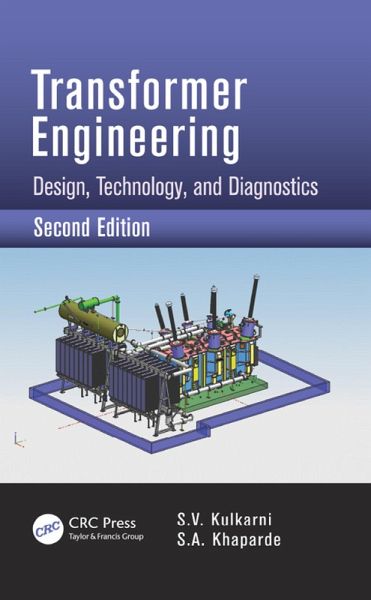
186,95 €
186,95 €
inkl. MwSt.
Sofort per Download lieferbar

93 °P sammeln
186,95 €
Als Download kaufen
186,95 €
inkl. MwSt.
Sofort per Download lieferbar
93 °P sammeln
Jetzt verschenken
Alle Infos zum eBook verschenken
186,95 €
inkl. MwSt.
Sofort per Download lieferbar
Alle Infos zum eBook verschenken
93 °P sammeln

Andere Kunden interessierten sich auch für
") Electric Power Transformer Engineering (eBook, PDF)157,95 €
Electric Power Transformer Engineering (eBook, PDF)157,95 €") Fundamentals of Electric Machines: A Primer with MATLAB (eBook, PDF)42,95 €
Fundamentals of Electric Machines: A Primer with MATLAB (eBook, PDF)42,95 €") Modeling and Stability Analysis of Inverter-Based Resources (eBook, PDF)167,95 €
Modeling and Stability Analysis of Inverter-Based Resources (eBook, PDF)167,95 €") Engineering Electrodynamics (eBook, PDF)157,95 €
Engineering Electrodynamics (eBook, PDF)157,95 €") RF and Microwave Passive and Active Technologies (eBook, PDF)157,95 €
RF and Microwave Passive and Active Technologies (eBook, PDF)157,95 €") Bridging Circuits and Fields (eBook, PDF)53,95 €
Bridging Circuits and Fields (eBook, PDF)53,95 €") Theory and Technology of Wireless Power Transfer (eBook, PDF)49,95 €
Theory and Technology of Wireless Power Transfer (eBook, PDF)49,95 €



Transformer Engineering: Design, Technology, and Diagnostics, Second Edition helps you design better transformers, apply advanced numerical field computations more effectively, and tackle operational and maintenance issues. Building on the bestselling Transformer Engineering: Design and Practice, this greatly expanded second edition also emphasizes diagnostic aspects and transformer-system interactions.
What's New in This Edition
A blend of theory and practice, this comprehensive book examines aspects of transformer engineering, from design to diagnostics. It thoroughly explains electromagnetic fields and the finite element method to help you solve practical problems related to transformers. Coverage includes important design challenges, such as eddy and stray loss evaluation and control, transient response, short-circuit withstand and strength, and insulation design. The authors also give pointers for further research. Students and engineers starting their careers will appreciate the sample design of a typical power transformer.
Presenting in-depth explanations, modern computational techniques, and emerging trends, this is a valuable reference for those working in the transformer industry, as well as for students and researchers. It offers guidance in optimizing and enhancing transformer design, manufacturing, and condition monitoring to meet the challenges of a highly competitive market.
What's New in This Edition
- Three new chapters on electromagnetic fields in transformers, transformer-system interactions and modeling, and monitoring and diagnostics
- An extensively revised chapter on recent trends in transformer technology
- An extensively updated chapter on short-circuit strength, including failure mechanisms and safety factors
- A step-by-step procedure for designing a transformer
- Updates throughout, reflecting advances in the field
A blend of theory and practice, this comprehensive book examines aspects of transformer engineering, from design to diagnostics. It thoroughly explains electromagnetic fields and the finite element method to help you solve practical problems related to transformers. Coverage includes important design challenges, such as eddy and stray loss evaluation and control, transient response, short-circuit withstand and strength, and insulation design. The authors also give pointers for further research. Students and engineers starting their careers will appreciate the sample design of a typical power transformer.
Presenting in-depth explanations, modern computational techniques, and emerging trends, this is a valuable reference for those working in the transformer industry, as well as for students and researchers. It offers guidance in optimizing and enhancing transformer design, manufacturing, and condition monitoring to meet the challenges of a highly competitive market.
Dieser Download kann aus rechtlichen Gründen nur mit Rechnungsadresse in A, B, BG, CY, CZ, D, DK, EW, E, FIN, F, GR, HR, H, IRL, I, LT, L, LR, M, NL, PL, P, R, S, SLO, SK ausgeliefert werden.
Praise for the Previous Edition
"... the timely publication of this book is quite a welcome delight. ... the authors provide in-depth coverage on both theory and practical application of modern computational techniques in transformer engineering. ... this book is an easy-to-use reference source and is recommended for academic and research libraries."
-E-Streams
"... contains practical information used in the industry."
-IEEE Electrical Insulation Magazine
"Authors' personal research and their experience in industry and in education is the source for the numerous worked examples-very useful for didactic purposes. ... More than 400 references are mentioned, spread in the 12 chapters. The book is written in an impressively deep analytical spirit."
-IEEE Power Electronics Society Newsletter
"... the timely publication of this book is quite a welcome delight. ... the authors provide in-depth coverage on both theory and practical application of modern computational techniques in transformer engineering. ... this book is an easy-to-use reference source and is recommended for academic and research libraries."
-E-Streams
"... contains practical information used in the industry."
-IEEE Electrical Insulation Magazine
"Authors' personal research and their experience in industry and in education is the source for the numerous worked examples-very useful for didactic purposes. ... More than 400 references are mentioned, spread in the 12 chapters. The book is written in an impressively deep analytical spirit."
-IEEE Power Electronics Society Newsletter