88,95 €
88,95 €
inkl. MwSt.
Sofort per Download lieferbar

44 °P sammeln
88,95 €
Als Download kaufen
88,95 €
inkl. MwSt.
Sofort per Download lieferbar
44 °P sammeln
Jetzt verschenken
Alle Infos zum eBook verschenken
88,95 €
inkl. MwSt.
Sofort per Download lieferbar
Alle Infos zum eBook verschenken
44 °P sammeln

Andere Kunden interessierten sich auch für
") The Palgrave Handbook of Internationalization of Language Education (eBook, PDF)183,95 €
The Palgrave Handbook of Internationalization of Language Education (eBook, PDF)183,95 €") Researching Second Language Incidental Vocabulary Acquisition through Reading (eBook, PDF)44,95 €
Researching Second Language Incidental Vocabulary Acquisition through Reading (eBook, PDF)44,95 €") Pursuing Language and Metalinguistics in K-12 Classrooms (eBook, PDF)38,95 €
Pursuing Language and Metalinguistics in K-12 Classrooms (eBook, PDF)38,95 €") Content and Language Integrated Learning in Spanish and Japanese Contexts (eBook, PDF)112,95 €
Content and Language Integrated Learning in Spanish and Japanese Contexts (eBook, PDF)112,95 €") Empowering Educators: Integrating AI Tools for Personalized Language Instruction (eBook, PDF)136,95 €
Empowering Educators: Integrating AI Tools for Personalized Language Instruction (eBook, PDF)136,95 €") Translanguaging for Empowerment and Equity (eBook, PDF)112,95 €
Translanguaging for Empowerment and Equity (eBook, PDF)112,95 €") Science Teacher Preparation in Content-Based Second Language Acquisition (eBook, PDF)88,95 €
Science Teacher Preparation in Content-Based Second Language Acquisition (eBook, PDF)88,95 €
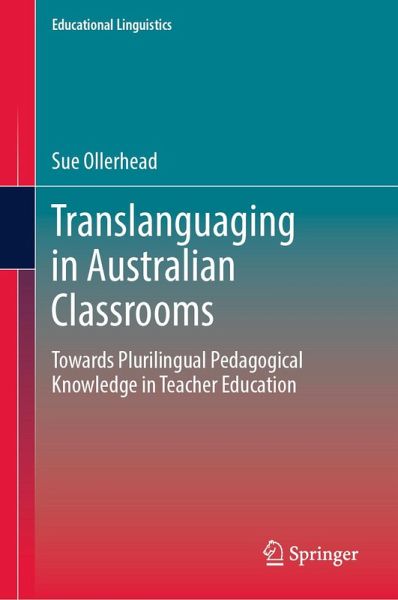
Australian classrooms are among the most linguistically diverse in the world, with more than 350 languages spoken across the nation. Yet, despite this rich reality, schools continue to be shaped by the enduring dominance of English monolingualism. Translanguaging in Australian Classrooms calls for a fundamental rethinking of teacher education, curriculum, and pedagogy to better reflect and harness the plurilingual repertoires of today's learners.
At the heart of this book is the concept of Plurilingual Pedagogical Knowledge (PPK), a transformative framework that equips teachers to move beyond traditional literacy models and to value, mobilise, and affirm students' full communicative resources. Drawing on practitioner inquiry and richly detailed case studies, the book demonstrates how translanguaging can be enacted across subject areas, from mathematics and science to social studies and the arts.
Challenging entrenched language ideologies, this volume positions teachers as agents of linguistic equity, capable of designing inclusive classrooms that support both academic success and cultural identity. It offers a compelling vision for teacher education in Australia, one that places linguistic justice at the centre of professional practice and reimagines the future of schooling through the dynamic possibilities of plurilingualism.
At the heart of this book is the concept of Plurilingual Pedagogical Knowledge (PPK), a transformative framework that equips teachers to move beyond traditional literacy models and to value, mobilise, and affirm students' full communicative resources. Drawing on practitioner inquiry and richly detailed case studies, the book demonstrates how translanguaging can be enacted across subject areas, from mathematics and science to social studies and the arts.
Challenging entrenched language ideologies, this volume positions teachers as agents of linguistic equity, capable of designing inclusive classrooms that support both academic success and cultural identity. It offers a compelling vision for teacher education in Australia, one that places linguistic justice at the centre of professional practice and reimagines the future of schooling through the dynamic possibilities of plurilingualism.
Dieser Download kann aus rechtlichen Gründen nur mit Rechnungsadresse in A, B, BG, CY, CZ, D, DK, EW, E, FIN, F, GR, HR, H, IRL, I, LT, L, LR, M, NL, PL, P, R, S, SLO, SK ausgeliefert werden.
Es gelten unsere Allgemeinen Geschäftsbedingungen: www.buecher.de/agb
Impressum
www.buecher.de ist ein Internetauftritt der buecher.de internetstores GmbH
Geschäftsführung: Monica Sawhney | Roland Kölbl | Günter Hilger
Sitz der Gesellschaft: Batheyer Straße 115 - 117, 58099 Hagen
Postanschrift: Bürgermeister-Wegele-Str. 12, 86167 Augsburg
Amtsgericht Hagen HRB 13257
Steuernummer: 321/5800/1497
USt-IdNr: DE450055826
Bitte wählen Sie Ihr Anliegen aus.
Rechnungen
Retourenschein anfordern
Bestellstatus
Storno