39,95 €
inkl. MwSt.
Sofort per Download lieferbar
20 °P sammeln

Andere Kunden interessierten sich auch für
") Transnational Architecture and Urbanism (eBook, ePUB)39,95 €
Transnational Architecture and Urbanism (eBook, ePUB)39,95 €") Planning Abu Dhabi (eBook, PDF)46,95 €
Planning Abu Dhabi (eBook, PDF)46,95 €") Urban Modernity in the Contemporary Gulf (eBook, PDF)0,00 €
Urban Modernity in the Contemporary Gulf (eBook, PDF)0,00 €") Post-Growth Planning (eBook, PDF)39,95 €
Post-Growth Planning (eBook, PDF)39,95 €") European Planning History in the 20th Century (eBook, PDF)0,00 €
European Planning History in the 20th Century (eBook, PDF)0,00 €") Smart Cities in Poland (eBook, PDF)39,95 €
Smart Cities in Poland (eBook, PDF)39,95 €") Growing Green Infrastructure in Contemporary Asian Cities (eBook, PDF)30,95 €
Growing Green Infrastructure in Contemporary Asian Cities (eBook, PDF)30,95 €



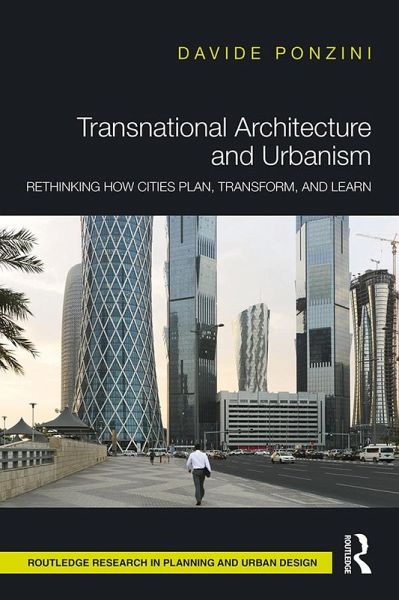
Transnational Architecture and Urbanism combines urban planning, design, policy, and geography studies to offer place-based and project-oriented insight into relevant case studies of urban transformation in Europe, North America, Asia, and the Middle East.
Since the 1990s, increasingly multinational modes of design have arisen, especially concerning prominent buildings and places. Traditional planning and design disciplines have proven to have limited comprehension of, and little grip on, such transformations. Public and scholarly discussions argue that these projects and transformations derive from socioeconomic, political, cultural trends or conditions of globalization. The author suggests that general urban theories are relevant as background, but of limited efficacy when dealing with such context-bound projects and policies.
This book critically investigates emerging problematic issues such as the spectacularization of the urban environment, the decontextualization of design practice, and the global circulation of plans and projects. The book portends new conceptualizations, evidence-based explanations, and practical understanding for architects, planners, and policy makers to critically learn from practice, to cope with these transnational issues, and to put better planning in place.
Since the 1990s, increasingly multinational modes of design have arisen, especially concerning prominent buildings and places. Traditional planning and design disciplines have proven to have limited comprehension of, and little grip on, such transformations. Public and scholarly discussions argue that these projects and transformations derive from socioeconomic, political, cultural trends or conditions of globalization. The author suggests that general urban theories are relevant as background, but of limited efficacy when dealing with such context-bound projects and policies.
This book critically investigates emerging problematic issues such as the spectacularization of the urban environment, the decontextualization of design practice, and the global circulation of plans and projects. The book portends new conceptualizations, evidence-based explanations, and practical understanding for architects, planners, and policy makers to critically learn from practice, to cope with these transnational issues, and to put better planning in place.
Dieser Download kann aus rechtlichen Gründen nur mit Rechnungsadresse in A, B, BG, CY, CZ, D, DK, EW, E, FIN, F, GR, HR, H, IRL, I, LT, L, LR, M, NL, PL, P, R, S, SLO, SK ausgeliefert werden.
"Critical urban scholarship at its best, Transnational Architecture and Urbanism is a thoughtful and balanced approach - deeply embedded in the literature and replete with examples - to the transnational flows of ideas about cities and buildings. This is urban theory as it is meant to be written."
Robert Beauregard, Professor Emeritus, Columbia University
"The subtitle of this book is Rethinking How Contemporary Cities Plan, Transform and Learn, and this is exactly what it delivers. A tight conceptual framework effectively organises a critical analysis of the ubiquitous and homogenizing forces of urban globalization through a series of case studies. Ponzini's conclusion that 'contextual learning' by architects and urban planners, focusing less on the global (though not ignoring it) and more on the local, presents a timely and formidable challenge to the whole community of urbanists and architects who build in cities. With its rich complement of images, this book achieves that unusual but much sought after goal - a text that students, academic researchers, professionals, and indeed anyone interested in cities will find informative, intellectually provocative, visually exciting, and readable."
Leslie Sklair, London School of Economics
Robert Beauregard, Professor Emeritus, Columbia University
"The subtitle of this book is Rethinking How Contemporary Cities Plan, Transform and Learn, and this is exactly what it delivers. A tight conceptual framework effectively organises a critical analysis of the ubiquitous and homogenizing forces of urban globalization through a series of case studies. Ponzini's conclusion that 'contextual learning' by architects and urban planners, focusing less on the global (though not ignoring it) and more on the local, presents a timely and formidable challenge to the whole community of urbanists and architects who build in cities. With its rich complement of images, this book achieves that unusual but much sought after goal - a text that students, academic researchers, professionals, and indeed anyone interested in cities will find informative, intellectually provocative, visually exciting, and readable."
Leslie Sklair, London School of Economics