52,95 €
inkl. MwSt.
Sofort per Download lieferbar
26 °P sammeln

Andere Kunden interessierten sich auch für
") The European Union's Democratization Agenda in the Mediterranean (eBook, ePUB)33,95 €
The European Union's Democratization Agenda in the Mediterranean (eBook, ePUB)33,95 €") Arab Spring Challenges for Democracy and Security in the Mediterranean (eBook, ePUB)39,95 €
Arab Spring Challenges for Democracy and Security in the Mediterranean (eBook, ePUB)39,95 €") The EU's Democracy Promotion and the Mediterranean Neighbours (eBook, ePUB)43,95 €
The EU's Democracy Promotion and the Mediterranean Neighbours (eBook, ePUB)43,95 €") The New Mediterranean Democracies (eBook, ePUB)33,95 €
The New Mediterranean Democracies (eBook, ePUB)33,95 €") Europe and the Management of Globalization (eBook, ePUB)12,95 €
Europe and the Management of Globalization (eBook, ePUB)12,95 €") EU Democracy Promotion and Governmentality (eBook, ePUB)44,95 €
EU Democracy Promotion and Governmentality (eBook, ePUB)44,95 €") Negotiation Theory and the EU (eBook, ePUB)45,95 €
Negotiation Theory and the EU (eBook, ePUB)45,95 €







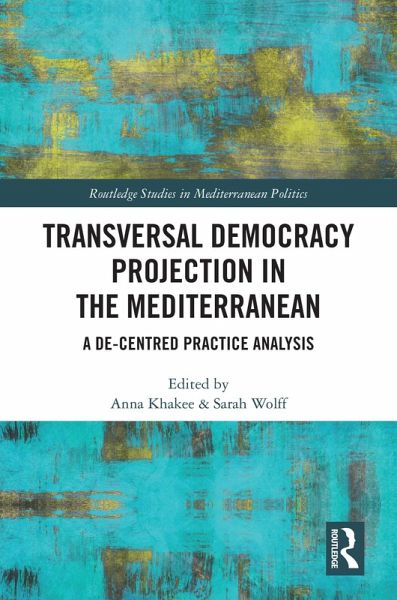
This book expands on the existing literature on the international dimension of democratization by introducing the concept of democracy projection. Democracy projection is defined as the projection of (democratic) norms through the every-day practice of interactions - beyond any donor-recipient relationship - between states and foreign civil society actors on issue areas where both sides have interests to defend.
The edited volume examines a variety of such issue areas, including trade, anti-corruption, applied research, gender and LGBTI, focusing on EU practices in its everyday dealings with civil society in the Southern Mediterranean. Based on comparative case studies relying on extensive interviews, direct observations and content analysis, the chapters in this book conclude that the extent to which democracy is projected varies according to four main factors: the EU's perceived interest, its ideational commitment to norms of dialogue and inclusion, the degree of institutional inertia, and dominant discourses/structures of meanings which preclude EU engagement on substance.
Transversal Democracy Projection in the Mediterranean will be of interest to students and scholars of Political Science, International Relations, and Democratisation studies. The chapters in this book were originally published as a special issue of Mediterranean Politics.
The edited volume examines a variety of such issue areas, including trade, anti-corruption, applied research, gender and LGBTI, focusing on EU practices in its everyday dealings with civil society in the Southern Mediterranean. Based on comparative case studies relying on extensive interviews, direct observations and content analysis, the chapters in this book conclude that the extent to which democracy is projected varies according to four main factors: the EU's perceived interest, its ideational commitment to norms of dialogue and inclusion, the degree of institutional inertia, and dominant discourses/structures of meanings which preclude EU engagement on substance.
Transversal Democracy Projection in the Mediterranean will be of interest to students and scholars of Political Science, International Relations, and Democratisation studies. The chapters in this book were originally published as a special issue of Mediterranean Politics.
Dieser Download kann aus rechtlichen Gründen nur mit Rechnungsadresse in A, B, BG, CY, CZ, D, DK, EW, E, FIN, F, GR, HR, H, IRL, I, LT, L, LR, M, NL, PL, P, R, S, SLO, SK ausgeliefert werden.