Sie sind bereits eingeloggt. Klicken Sie auf 2. tolino select Abo, um fortzufahren.
Bitte loggen Sie sich zunächst in Ihr Kundenkonto ein oder registrieren Sie sich bei bücher.de, um das eBook-Abo tolino select nutzen zu können.
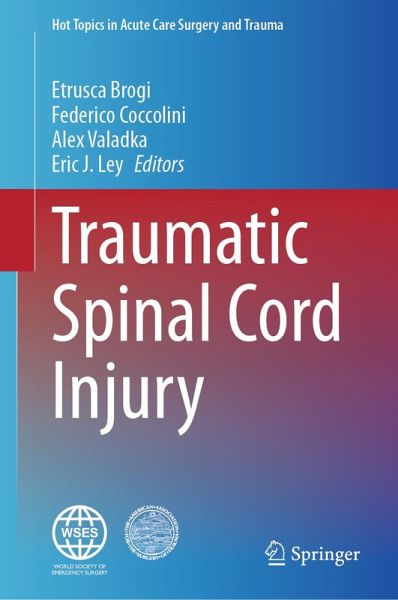
Despite significant improvements in prehospital, critical care and surgical management, traumatic spinal cord injury is still a major cause of disability with devastating physical, social and psychological consequences, leading to significant direct and indirect health care costs. Taking a practical approach, this book addresses all aspects of traumatic spinal cord injury, from the pre-hospital setting to discharge. Furthermore, the book highlights the central role of trauma networks and neurocritical care specialisation.Encouraging a protocol-driven, multidisciplinary approach, the authors…mehr
Despite significant improvements in prehospital, critical care and surgical management, traumatic spinal cord injury is still a major cause of disability with devastating physical, social and psychological consequences, leading to significant direct and indirect health care costs. Taking a practical approach, this book addresses all aspects of traumatic spinal cord injury, from the pre-hospital setting to discharge. Furthermore, the book highlights the central role of trauma networks and neurocritical care specialisation.Encouraging a protocol-driven, multidisciplinary approach, the authors provide a methodological description of the diagnostic and therapeutic management of patients with traumatic spinal cord injury throughout the patient's entire course.
Neurological injuries and their sequelae assume predominant significance in this type of patient. Patients with traumatic spinal cord injury may suffer from both acute injuries and long-term dysfunctions affecting different types of organs and apparatuses. Bradyarrhythmia, haemodynamic instability, hypothermia, hyperthermia, pain, spasticity and autonomic dysreflexia are just a few examples of the possible debilitating conditions that our patients may suffer from and that, consequently, the clinician must address. Consequently, a multidisciplinary approach is required to provide appropriate clinical management.
Paying particular attention to prognosis and the implementation of an early neurorehabilitation programme, the authors examine the challenges of living with spinal cord injury for both patients and families.
Dieser Download kann aus rechtlichen Gründen nur mit Rechnungsadresse in A, B, BG, CY, CZ, D, DK, EW, E, FIN, F, GR, HR, H, IRL, I, LT, L, LR, M, NL, PL, P, R, S, SLO, SK ausgeliefert werden.
Die Herstellerinformationen sind derzeit nicht verfügbar.
Autorenporträt
Etrusca Brogi, MD, is a Neuroanaesthesia and Neurointensive Care specialist consultant working at ASST Grande Ospedale Metropolitano Niguarda, Milan (Italy). Her principal fields of interest are the management of the polytrauma patient, evaluation and control of the patient with hemorrhagic shock, neurogenic shock, abdominal, thoracic, spinal trauma and head trauma, intra / inter hospital transfers of critically ill patients, neurosurgical patients’ management, ECMO management, management of potential organ donors and local DCD management protocol. She served as reviewer for various journals and she authored several articles published in long-time indexed journal on ultrasound in intensive care, and trauma brain injury. She is also the author of several chapter for various Springer book series. She is an active member of ESCIM, SIAARTI and SARNePI. Federico Coccolini, MD, is Professor of Surgery at the Pisa Universuty and consultant in general, emergency and trauma surgery at thePisa University Hospital, one of the biggest Level I trauma centres in Italy. He has a deep and documented experience in managing post-traumatic and non-post-traumatic patients. His principal interests are emergency surgery, trauma surgery, advanced oncology, oncologic gastrointestinal surgery, laparoscopic and minimally invasive surgery, tissue engineering and experimental surgery, evidence-based medicine, and surgery. He is the principal investigator of multicentre studies and registers, and authored hundreds of papers and tens of book chapters. He edited a Textbook of Emergency General Surgery, several books and a book series. He served as reviewer for several journals. He is the Vice President of the World Society of Emergency Surgery (WSES) and of the World Journal of Emergency Surgery (WJES), head of the scientific committee of the EVTM Society, member of the Executive Committee of the Italian Society of Emergency Surgery and Trauma, Italian Society of Geriatric Surgery and of the Italian Society of Surgical Physiopathology. Prof. Coccolini is a recognized world opinion leader in emergency general surgery and trauma. Alex Valadka, MD, serves as Professor of Neurological Surgery at the University of Texas Southwestern Medical Center in Dallas, where he is Chief of Neurological Surgery at Parkland Memorial Hospital. He has had a career-long clinical and research interest in neurotrauma and critical care, including numerous papers, presentations, research grants, courses, seminars, and visiting professorships. He has served in numerous leadership roles in neurosurgery and neurotrauma, including President of the American Association of Neurological Surgeons, Director of the American Board of Neurological Surgery, Chair of the Neurosurgical Specialty Group of the American College of Surgeons Committee on Trauma, and membership on numerous study sections, data and safety monitoring boards, and similar activities for the NIH and other organizations. Eric J. Ley, MD, FACS, is a surgeon specializing in trauma, acute care surgery, and critical care at the R Adams Cowley Shock Trauma Center. As Professor of Surgery and Chief of Critical Care within the University of Maryland School of Medicine Dr. Ley’s clinical research includes human factors in surgery, serving as coeditor for a textbook on this subject. Dr. Ley has an interest in reducing venous thromboembolism after trauma and recently led the efforts to revise the national guidelines for venous thromboembolism prophylaxis for the Western Trauma Association. His benchtop research focus is on the mechanisms for secondary injury after trauma including the role of the beta adrenergic response in deteriorating patients. Previously, Dr. Ley was a Clinical Professor of Surgery at the University of California, Los Angeles and Professor of Surgery at the Cedars-Sinai Medical Center where he was the Medical Director of the Surgical Intensive Care Unit and Program Director of the Trauma and Surgical Critical Care Fellowship.
Inhaltsangabe
1. Epidemiology and socioeconomic impact of traumatic spinal cord injury.- 2. Mechanisms and pathophysiology of spinal cord injury.- 3. Prehospital evaluation and management, Part I: clinical presentation, spine stabilization, airway management..- 4. Prehospital evaluation and management, Part II: fluid and blood pressure management, assessment of hemostasis and correction of coagulopathy..- 5. The role of trauma networks and neurocritical care specialization in the treatment of spinal cord injury.- 6. Spinal cord injury syndromes and classification .- 7. Neuroradiological imaging: techniques and prognostication .- 8. Principles and timing of surgical management .- 9. Anesthesia considerations and intraoperative monitoring .- 10. Pharmacotherapy .- 11. Special populations: elderly, pregnant, pediatric, and polytrauma patients.- 12. Hemodynamic management and cardiovascular complications .- 13. Respiratory Complications and the Role of the Respiratory Therapist: Noninvasive and Invasive Ventilation.- 14. Mechanical ventilation management, indications and Timing of Tracheotomy and the Role of Diaphragmatic Pacing Stimulation in Spinal Cord Injury.- 15. Hematological and endocrine complications after traumatic spinal cord injury.- 16. Gastrointestinal and genitourinary dysfunction: acute and long-term management.- 17. Infectious complications.- 18. Metabolism, nutrition, and muscle wasting in critically ill spinal cord injury patients .- 19. Autonomic dysreflexia, postural hypotension, pain and spasticity, and altered temperature homeostasis.- 20. Neural repair and regeneration after spinal cord injury .- 21. Prognostication, long-term functional trajectories, and psychological support for patients and families.- 22. Current and future role of neurorehabilitation and challenges of living with spinal cord injury.
1. Epidemiology and socioeconomic impact of traumatic spinal cord injury.- 2. Mechanisms and pathophysiology of spinal cord injury.- 3. Prehospital evaluation and management, Part I: clinical presentation, spine stabilization, airway management..- 4. Prehospital evaluation and management, Part II: fluid and blood pressure management, assessment of hemostasis and correction of coagulopathy..- 5. The role of trauma networks and neurocritical care specialization in the treatment of spinal cord injury.- 6. Spinal cord injury syndromes and classification .- 7. Neuroradiological imaging: techniques and prognostication .- 8. Principles and timing of surgical management .- 9. Anesthesia considerations and intraoperative monitoring .- 10. Pharmacotherapy .- 11. Special populations: elderly, pregnant, pediatric, and polytrauma patients.- 12. Hemodynamic management and cardiovascular complications .- 13. Respiratory Complications and the Role of the Respiratory Therapist: Noninvasive and Invasive Ventilation.- 14. Mechanical ventilation management, indications and Timing of Tracheotomy and the Role of Diaphragmatic Pacing Stimulation in Spinal Cord Injury.- 15. Hematological and endocrine complications after traumatic spinal cord injury.- 16. Gastrointestinal and genitourinary dysfunction: acute and long-term management.- 17. Infectious complications.- 18. Metabolism, nutrition, and muscle wasting in critically ill spinal cord injury patients .- 19. Autonomic dysreflexia, postural hypotension, pain and spasticity, and altered temperature homeostasis.- 20. Neural repair and regeneration after spinal cord injury .- 21. Prognostication, long-term functional trajectories, and psychological support for patients and families.- 22. Current and future role of neurorehabilitation and challenges of living with spinal cord injury.
Es gelten unsere Allgemeinen Geschäftsbedingungen: www.buecher.de/agb
Impressum
www.buecher.de ist ein Internetauftritt der buecher.de internetstores GmbH
Geschäftsführung: Monica Sawhney | Roland Kölbl | Günter Hilger
Sitz der Gesellschaft: Batheyer Straße 115 - 117, 58099 Hagen
Postanschrift: Bürgermeister-Wegele-Str. 12, 86167 Augsburg
Amtsgericht Hagen HRB 13257
Steuernummer: 321/5800/1497
USt-IdNr: DE450055826