80,95 €
inkl. MwSt.
Sofort per Download lieferbar
40 °P sammeln

Andere Kunden interessierten sich auch für
") Comparative Law and Legal Traditions (eBook, PDF)96,95 €
Comparative Law and Legal Traditions (eBook, PDF)96,95 €") Comparative Law and Multicultural Legal Classes: Challenge or Opportunity? (eBook, PDF)112,95 €
Comparative Law and Multicultural Legal Classes: Challenge or Opportunity? (eBook, PDF)112,95 €") Legal Traditions in Asia (eBook, PDF)120,95 €
Legal Traditions in Asia (eBook, PDF)120,95 €") Social Security Law in Small Jurisdictions (eBook, PDF)72,95 €
Social Security Law in Small Jurisdictions (eBook, PDF)72,95 €") Rule of Law and Fundamental Rights (eBook, PDF)72,95 €
Rule of Law and Fundamental Rights (eBook, PDF)72,95 €") Regionalism and Regional Self-Government in South-East Europe (eBook, PDF)136,95 €
Regionalism and Regional Self-Government in South-East Europe (eBook, PDF)136,95 €") Presidential Impeachment in Latin America (eBook, PDF)128,95 €
Presidential Impeachment in Latin America (eBook, PDF)128,95 €







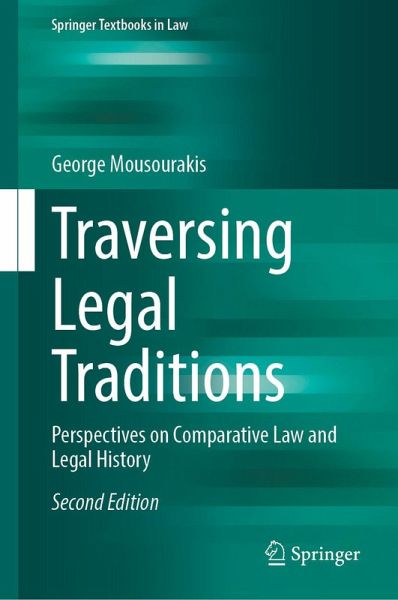
This textbook provides clear, reliable, and comprehensive insights into key topics in comparative law and legal history. As fundamental pillars of modern legal education, comparative law and legal history play a crucial role in shaping a new generation of legal scholars and practicing lawyers who appreciate the significance of legal diversity while recognizing the shared foundations of legal systems worldwide. By integrating these two disciplines, scholars and professionals can better understand the dominant features and developmental trajectories of various legal systems, fostering a broader, more culturally informed perspective on the law. This approach enables readers to develop the analytical skills and critical standards necessary to address the complexities of an increasingly interconnected and rapidly evolving legal landscape.
The book is divided into two main parts. Part I explores the foundational principles of comparative law, tracing its historical evolution and examining its relationship with other areas of legal study. It provides an extensive overview of legal comparatism from classical antiquity to the modern period, with particular attention paid to the contributions of eighteenth- and nineteenth-century thinkers who helped shape the field. Additionally, it assesses the role of comparative law in contemporary legal scholarship, lawmaking, and judicial decision-making, highlighting its methodological approaches and practical applications in both domestic and international contexts.
In turn, Part II examines the historical development and defining characteristics of major legal traditions. It begins with the Roman and civil law tradition, followed by an exploration of the English common law tradition, the Islamic legal tradition, and various indigenous legal traditions. Special attention is given to legal transplantation, including a case study on the Japanese legal tradition and its interactions with Chinese and Western legal influences.
By integrating comparative law and legal history, this book provides readers with the knowledge and analytical tools needed to navigate diverse legal traditions and systems, promoting a deeper understanding of historical legacies and contemporary legal challenges.
The book is divided into two main parts. Part I explores the foundational principles of comparative law, tracing its historical evolution and examining its relationship with other areas of legal study. It provides an extensive overview of legal comparatism from classical antiquity to the modern period, with particular attention paid to the contributions of eighteenth- and nineteenth-century thinkers who helped shape the field. Additionally, it assesses the role of comparative law in contemporary legal scholarship, lawmaking, and judicial decision-making, highlighting its methodological approaches and practical applications in both domestic and international contexts.
In turn, Part II examines the historical development and defining characteristics of major legal traditions. It begins with the Roman and civil law tradition, followed by an exploration of the English common law tradition, the Islamic legal tradition, and various indigenous legal traditions. Special attention is given to legal transplantation, including a case study on the Japanese legal tradition and its interactions with Chinese and Western legal influences.
By integrating comparative law and legal history, this book provides readers with the knowledge and analytical tools needed to navigate diverse legal traditions and systems, promoting a deeper understanding of historical legacies and contemporary legal challenges.
Dieser Download kann aus rechtlichen Gründen nur mit Rechnungsadresse in A, B, BG, CY, CZ, D, DK, EW, E, FIN, F, GR, HR, H, IRL, I, LT, L, LR, M, NL, PL, P, R, S, SLO, SK ausgeliefert werden.