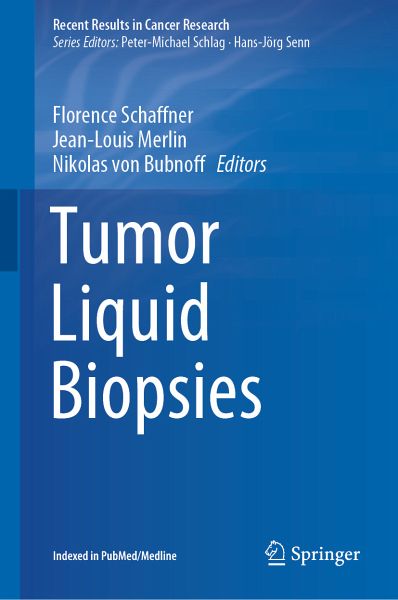
Tumor Liquid Biopsies (eBook, PDF)
Redaktion: Schaffner, Florence; Bubnoff, Nikolas von; Merlin, Jean-Louis
46,95 €
46,95 €
inkl. MwSt.
Sofort per Download lieferbar

23 °P sammeln

46,95 €
Als Download kaufen
46,95 €
inkl. MwSt.
Sofort per Download lieferbar
23 °P sammeln
Jetzt verschenken
Alle Infos zum eBook verschenken
46,95 €
inkl. MwSt.
Sofort per Download lieferbar
Alle Infos zum eBook verschenken
23 °P sammeln
Tumor Liquid Biopsies (eBook, PDF)
Redaktion: Schaffner, Florence; Bubnoff, Nikolas von; Merlin, Jean-Louis
- Format: PDF
- Merkliste
- Auf die Merkliste
- Bewerten Bewerten
- Teilen
- Produkt teilen
- Produkterinnerung
- Produkterinnerung

Bitte loggen Sie sich zunächst in Ihr Kundenkonto ein oder registrieren Sie sich bei
bücher.de, um das eBook-Abo tolino select nutzen zu können.
Hier können Sie sich einloggen
Sie sind bereits eingeloggt. Klicken Sie auf 2. tolino select Abo, um fortzufahren.

Bitte loggen Sie sich zunächst in Ihr Kundenkonto ein oder registrieren Sie sich bei bücher.de, um das eBook-Abo tolino select nutzen zu können.
Describes the cutting-edge liquid biopsy technologies that promise to revolutionize oncology practice
Covers all basic approaches in the fields, with explanation of uses, benefits, and limitations
Focuses on translational aspects
- Geräte: PC
- ohne Kopierschutz
- eBook Hilfe
- Größe: 7.04MB
Andere Kunden interessierten sich auch für
Biomarkers in Cancer Therapy (eBook, PDF)72,95 €
Atlas of Liquid Biopsy (eBook, PDF)120,95 €
Thrombosis and Hemostasis in Cancer (eBook, PDF)64,95 €
Development of Oral Cancer (eBook, PDF)80,95 €
Patient-Derived Mouse Models of Cancer (eBook, PDF)68,95 €
Oncoimmunology (eBook, PDF)136,95 €
Molecular Determinants of Head and Neck Cancer (eBook, PDF)112,95 €-
-
-
Describes the cutting-edge liquid biopsy technologies that promise to revolutionize oncology practice
Covers all basic approaches in the fields, with explanation of uses, benefits, and limitations
Focuses on translational aspects
Covers all basic approaches in the fields, with explanation of uses, benefits, and limitations
Focuses on translational aspects
Dieser Download kann aus rechtlichen Gründen nur mit Rechnungsadresse in A, B, BG, CY, CZ, D, DK, EW, E, FIN, F, GR, HR, H, IRL, I, LT, L, LR, M, NL, PL, P, R, S, SLO, SK ausgeliefert werden.
Produktdetails
- Produktdetails
- Verlag: Springer International Publishing
- Seitenzahl: 368
- Erscheinungstermin: 11. Oktober 2019
- Englisch
- ISBN-13: 9783030264390
- Artikelnr.: 57910795
- Verlag: Springer International Publishing
- Seitenzahl: 368
- Erscheinungstermin: 11. Oktober 2019
- Englisch
- ISBN-13: 9783030264390
- Artikelnr.: 57910795
- Herstellerkennzeichnung Die Herstellerinformationen sind derzeit nicht verfügbar.
Florence Schaffner obtained her PhD in Cell Biology and Biochemistry in Freiburg-im-Breisgau (Germany), in Prof. Hellmut Augustin's angiogenesis and tumor biology lab. There, she studied in depth the role of the interaction between the receptor EphB4 and its ligand ephrinB2 during tumor angiogenesis and metastatic processes and in particular tumor cell seeding at the site of metastasis. She then took up a postdoctoral research position at Scripps Research Institute in California, under Prof. Wolfram Ruf, where she investigated the role of coagulation proteins such as tissue factor and the protease-activated receptor in tumor angiogenesis, metastasis, and cancer stem cell biology. She continued her work on cancer stem cells in France, in Dr. Dontenwill's lab in Strasbourg. She now works at the Cancéropôle Grand-East, where she is developing new and innovative research axes in relation to translational medicine. Jean-Louis Merlin obtained his PharmD in Lille (France) and his PhDand Research Direction degree in Nancy (France), while working in Prof. Vigneron's lab (Faculty of Pharmacy) on innovative anticancer drug targeting in liposomes and molecular mechanisms of drug resistance in preclinical models. While head of the research lab at the Alexis Vautrin Cancer Center (now the Institut de Cancérologie de Lorraine) in Nancy, he became Professor of Cellular Oncology at the Faculty of Pharmacy. There he set up the tumor biology unit to implement the analysis of molecular tumor genetic markers in the clinical management of cancer patients. Professor Merlin coordinates the Advanced Diagnostic and Translational Research project of the CNRS research unit (UMR 7039) and the Translational Research axis at Cancéropôle Grand-East. He is also coordinating several clinical trials aiming at the validation of circulating tumor DNA as an alternative to tumor DNA for molecular diagnosis and follow-up of patients with colorectal and breast cancer, and melanoma. Nikolasvon Bubnoff obtained his MD at the Ludwig Maximilian University in Munich and gained his postdoctoral qualification at the Technical University, Munich for work describing and characterizing secondary resistance mutations of the Bcr-Abl gene in CML. While a resident at Klinikum rechts der Isar (Munich) he continued working on molecular mechanisms of treatment resistance, establishing a cell line-based screening strategy for resistance to targeted cancer treatment. Professor von Bubnoff continued his work on circulating tumor (ct)DNA in gastrointestinal stromal tumors in Freiburg, where he established routine ctDNA testing in solid tumors. There, together with Robert Zeiser, he translated this preclinical work into clinical applications. Professor von Bubnoff is currently Deputy Medical Director of the Comprehensive Cancer Center Freiburg, where he has established a molecular tumor board to make use of genome analysis to guide treatment. He is currently coordinating clinical trials on ctDNA biomarkers, treatment optimization in CML, and ruxolitinib treatment of steroid-refractory GvHD.
Circulating Tumor Cells: Pathophysiology of Tumor Cell Release into the Circulation and characterization of CTC.- CTC enrichment technologies.- Genotyping of CTC :example Lung cancer.- CTC in Breast Cancer: a clinical approach.- Circulating Tumor DNA: Pathophysiology of ctDNA Release into the Circulation and its characterization.- Enrichment and Analysis of ctDNA.- ctDNA in Lung Cancer.- ctDNA in Breast Cancer.- ctDNA in Colorectal Cancer.- Dynamic Treatment Stratification using ctDNA.- Circulating Tumor RNA: Noncoding Tumor RNAs: Pathophysiology of Release and Techniques of Detection.- Circulating miRNAs as Biomarker in Cancer.- Plasma Subcompartments as Source for Tumor derived Biomarkers: Exosomes and Vesicles as Biomarker in Cancer.- Quantitative proteomic Analysis of Plasma in Cancer.