64,95 €
64,95 €
inkl. MwSt.
Sofort per Download lieferbar

32 °P sammeln
64,95 €
Als Download kaufen
64,95 €
inkl. MwSt.
Sofort per Download lieferbar
32 °P sammeln
Jetzt verschenken
Alle Infos zum eBook verschenken
64,95 €
inkl. MwSt.
Sofort per Download lieferbar
Alle Infos zum eBook verschenken
32 °P sammeln

Andere Kunden interessierten sich auch für
") Measuring Uncertainty within the Theory of Evidence (eBook, PDF)68,95 €
Measuring Uncertainty within the Theory of Evidence (eBook, PDF)68,95 €") Inference on the Low Level (eBook, PDF)112,95 €
Inference on the Low Level (eBook, PDF)112,95 €") Geometric Modeling in Probability and Statistics (eBook, PDF)46,95 €
Geometric Modeling in Probability and Statistics (eBook, PDF)46,95 €") Probabilistic Networks and Expert Systems (eBook, PDF)88,95 €
Probabilistic Networks and Expert Systems (eBook, PDF)88,95 €") Janus-Faced Probability (eBook, PDF)40,95 €
Janus-Faced Probability (eBook, PDF)40,95 €") Introduction to Uncertainty Quantification (eBook, PDF)48,95 €
Introduction to Uncertainty Quantification (eBook, PDF)48,95 €") Copulas and Dependence Models with Applications (eBook, PDF)96,95 €
Copulas and Dependence Models with Applications (eBook, PDF)96,95 €

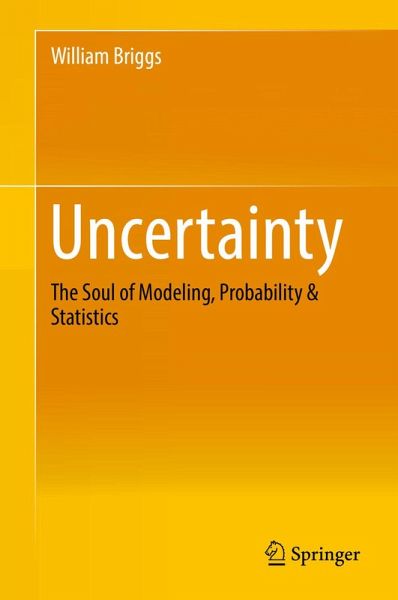
This book presents a philosophical approach to probability and probabilistic thinking, considering the underpinnings of probabilistic reasoning and modeling, which effectively underlie everything in data science. The ultimate goal is to call into question many standard tenets and lay the philosophical and probabilistic groundwork and infrastructure for statistical modeling. It is the first book devoted to the philosophy of data aimed at working scientists and calls for a new consideration in the practice of probability and statistics to eliminate what has been referred to as the "Cult of Statistical Significance."
Its jargon-free approach asserts that standard methods, such as out-of-the-box regression, cannot help in discovering cause. This new way of looking at uncertainty ties together disparate fields - probability, physics, biology, the "soft" sciences, computer science - because each aims at discovering cause (of effects). It broadens the understanding beyond frequentist and Bayesian methods to propose a Third Way of modeling.
Dieser Download kann aus rechtlichen Gründen nur mit Rechnungsadresse in A, B, BG, CY, CZ, D, DK, EW, E, FIN, F, GR, HR, H, IRL, I, LT, L, LR, M, NL, PL, P, R, S, SLO, SK ausgeliefert werden.
"Briggs, an adjunct professor of statistics at Cornell University, cautions his readers to carefully examine the uncertain reliability of such conclusions when these tools are used. His challenging premises are thoroughly supported by philosophical explanations as to why these traditional approaches need to be questioned. ... Briggs provides fully fleshed out reasoning, impressive support, precisely worded insight, and graphical illustrations, as appropriate, to justify his stand. ... Summing Up: Recommended. Upper-division undergraduates and above; faculty and professionals." (N. W. Schillow, Choice, Vol. 54 (6), February, 2017)
"This is a book about probability and probabilistic reasoning. It is more philosophy than mathematics, but it does have mathematical content and it relies in some measure on mathematical reasoning. ... This book is worth a look by anyone who teaches probability and statistics." (William J. Satzer, MAA Reviews, August, 2016)
"[This book] is not for sissies, true, but its clear-headed (i.e., Aristotelian) approach to the subject of truth (which, in the end, is what exercises in probability and statistical analysis are all about, notwithstanding what they tell you in school) is refreshing: a long, cool drink of plain speaking about intellectual topics that, in these hot and humid days, is as enlivening as it is enlightening." (Roger Kimball, The New Criterion's Critic's Notebook, newcriterion.com, August, 2016)
"This book has the potential to turn the world of evidence-based medicine upside down. It boldly asserts that with regard to everything having to do with evidence, we're doing it all wrong: probability, statistics, causality, modeling, deciding, communicating-everything. ... the book is full of humor and a delight to read and re-read." (Jane M. Orient, Journal of American Physicians and Surgeons, Vol. 21 (3), 2016)
"This is a book about probability and probabilistic reasoning. It is more philosophy than mathematics, but it does have mathematical content and it relies in some measure on mathematical reasoning. ... This book is worth a look by anyone who teaches probability and statistics." (William J. Satzer, MAA Reviews, August, 2016)
"[This book] is not for sissies, true, but its clear-headed (i.e., Aristotelian) approach to the subject of truth (which, in the end, is what exercises in probability and statistical analysis are all about, notwithstanding what they tell you in school) is refreshing: a long, cool drink of plain speaking about intellectual topics that, in these hot and humid days, is as enlivening as it is enlightening." (Roger Kimball, The New Criterion's Critic's Notebook, newcriterion.com, August, 2016)
"This book has the potential to turn the world of evidence-based medicine upside down. It boldly asserts that with regard to everything having to do with evidence, we're doing it all wrong: probability, statistics, causality, modeling, deciding, communicating-everything. ... the book is full of humor and a delight to read and re-read." (Jane M. Orient, Journal of American Physicians and Surgeons, Vol. 21 (3), 2016)
Es gelten unsere Allgemeinen Geschäftsbedingungen: www.buecher.de/agb
Impressum
www.buecher.de ist ein Internetauftritt der buecher.de internetstores GmbH
Geschäftsführung: Monica Sawhney | Roland Kölbl | Günter Hilger
Sitz der Gesellschaft: Batheyer Straße 115 - 117, 58099 Hagen
Postanschrift: Bürgermeister-Wegele-Str. 12, 86167 Augsburg
Amtsgericht Hagen HRB 13257
Steuernummer: 321/5800/1497
USt-IdNr: DE450055826
Bitte wählen Sie Ihr Anliegen aus.
Rechnungen
Retourenschein anfordern
Bestellstatus
Storno