8,99 €
8,99 €
inkl. MwSt.
Sofort per Download lieferbar

0 °P sammeln
8,99 €
Als Download kaufen
8,99 €
inkl. MwSt.
Sofort per Download lieferbar
0 °P sammeln
Jetzt verschenken
Alle Infos zum eBook verschenken
8,99 €
inkl. MwSt.
Sofort per Download lieferbar
Alle Infos zum eBook verschenken
0 °P sammeln

Andere Kunden interessierten sich auch für
") The Ideological Philosophy of Social Transcendentalism (eBook, ePUB)6,99 €
The Ideological Philosophy of Social Transcendentalism (eBook, ePUB)6,99 €") A Lot of People Are Saying (eBook, ePUB)9,95 €
A Lot of People Are Saying (eBook, ePUB)9,95 €") Why Nationalism (eBook, ePUB)11,95 €
Why Nationalism (eBook, ePUB)11,95 €") Utopia of Usurers and Other Essays (eBook, ePUB)5,99 €
Utopia of Usurers and Other Essays (eBook, ePUB)5,99 €") Left Wing, Right Wing, People, and Power: The Core Dynamics of Political Action (eBook, ePUB)4,99 €
Left Wing, Right Wing, People, and Power: The Core Dynamics of Political Action (eBook, ePUB)4,99 €") How To Be an Antiracist (eBook, ePUB)9,49 €
How To Be an Antiracist (eBook, ePUB)9,49 €") The Antinomies of Antonio Gramsci (eBook, ePUB)11,95 €
The Antinomies of Antonio Gramsci (eBook, ePUB)11,95 €





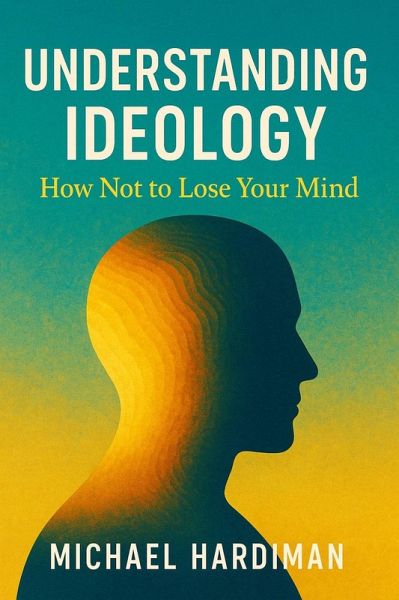
Understanding Ideology: How Not to Lose Your Mind is a penetrating analysis of how ordinary, decent people can be led into intellectual rigidity, moral blindness, and-at times-quiet forms of personal or political destructiveness. Drawing on over four decades of work as a counselling psychologist, educator, and philosopher, Michael Hardiman shows how personal beliefs are shaped, how they harden into ideological frameworks, and how those frameworks can either deepen human understanding or erode our capacity for truth, empathy, and moral responsibility.
The book demonstrates that ideology is not merely a political or sociological phenomenon-it is psychological. It operates in the intimate recesses of the mind, shaping what we see, how we interpret the world, what we fear, and what we believe we are justified in doing. Hardiman argues that ideology, when unexamined, is one of the most potent forces that can distort moral judgement. Yet he also insists that human beings possess the agency to resist this drift, provided they cultivate the courage to think, reflect, and confront the moral demands of freedom.
Blending classical philosophy (Plato, Kant, Nietzsche, Arendt, Jaspers) with modern psychology (Kohlberg, Frankl, Jung), Hardiman offers a rare synthesis: a guide not only to understanding ideology's grip on society, but also to understanding its grip on oneself. The book shows readers how ideological belief systems are formed, how they can be manipulated, and how they can be re-evaluated through conscience, moral development, and genuine self-knowledge.
At its heart, this book is a call to intellectual honesty and moral courage. In a world increasingly shaped by online tribalism, performative outrage, and weaponized narratives, Hardiman gives readers the tools to step back, think clearly, and resist the allure of simple stories that flatter the tribe but corrupt the individual.
Understanding Ideology: How Not to Lose Your Mind ultimately guides the reader through a challenging but liberating journey: from unconscious ideological conditioning, to conscious moral agency; from inherited ready-made belief systems, to authentic self-authored understanding; from being carried by the herd, to becoming a person capable of seeing, judging, and acting with integrity.
This is not a book about what to think. It is a book about how to think-freely, critically, and morally-within a world that constantly pulls us toward unthinking conformity.
The book demonstrates that ideology is not merely a political or sociological phenomenon-it is psychological. It operates in the intimate recesses of the mind, shaping what we see, how we interpret the world, what we fear, and what we believe we are justified in doing. Hardiman argues that ideology, when unexamined, is one of the most potent forces that can distort moral judgement. Yet he also insists that human beings possess the agency to resist this drift, provided they cultivate the courage to think, reflect, and confront the moral demands of freedom.
Blending classical philosophy (Plato, Kant, Nietzsche, Arendt, Jaspers) with modern psychology (Kohlberg, Frankl, Jung), Hardiman offers a rare synthesis: a guide not only to understanding ideology's grip on society, but also to understanding its grip on oneself. The book shows readers how ideological belief systems are formed, how they can be manipulated, and how they can be re-evaluated through conscience, moral development, and genuine self-knowledge.
At its heart, this book is a call to intellectual honesty and moral courage. In a world increasingly shaped by online tribalism, performative outrage, and weaponized narratives, Hardiman gives readers the tools to step back, think clearly, and resist the allure of simple stories that flatter the tribe but corrupt the individual.
Understanding Ideology: How Not to Lose Your Mind ultimately guides the reader through a challenging but liberating journey: from unconscious ideological conditioning, to conscious moral agency; from inherited ready-made belief systems, to authentic self-authored understanding; from being carried by the herd, to becoming a person capable of seeing, judging, and acting with integrity.
This is not a book about what to think. It is a book about how to think-freely, critically, and morally-within a world that constantly pulls us toward unthinking conformity.
Dieser Download kann aus rechtlichen Gründen nur mit Rechnungsadresse in A, B, CY, CZ, D, DK, EW, E, FIN, F, GR, H, IRL, I, LT, L, LR, M, NL, PL, P, R, S, SLO, SK ausgeliefert werden.