40,95 €
40,95 €
inkl. MwSt.
Sofort per Download lieferbar

20 °P sammeln
40,95 €
Als Download kaufen
40,95 €
inkl. MwSt.
Sofort per Download lieferbar
20 °P sammeln
Jetzt verschenken
Alle Infos zum eBook verschenken
40,95 €
inkl. MwSt.
Sofort per Download lieferbar
Alle Infos zum eBook verschenken
20 °P sammeln

- Format: PDF
- Merkliste
- Auf die Merkliste
- Bewerten Bewerten
- Teilen
- Produkt teilen
- Produkterinnerung
- Produkterinnerung

Bitte loggen Sie sich zunächst in Ihr Kundenkonto ein oder registrieren Sie sich bei
bücher.de, um das eBook-Abo tolino select nutzen zu können.
Hier können Sie sich einloggen
Sie sind bereits eingeloggt. Klicken Sie auf 2. tolino select Abo, um fortzufahren.

Bitte loggen Sie sich zunächst in Ihr Kundenkonto ein oder registrieren Sie sich bei bücher.de, um das eBook-Abo tolino select nutzen zu können.
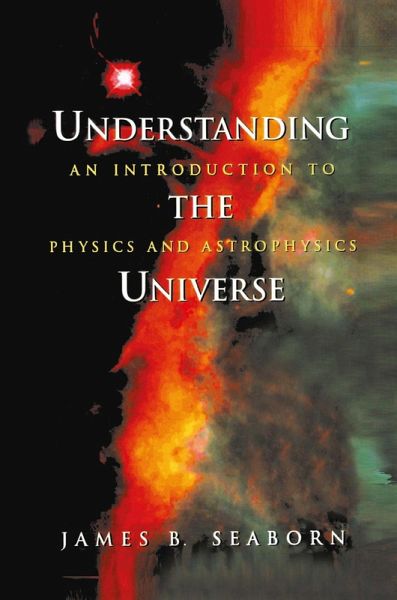
Intended for undergraduate nonscience majors satisfying a general, education requirement or seeking an elective in natural science, the text examines physics, but with a different perspective from most undergraduate astronomy courses: developing the principles of physics to illuminate the things we see in the heavens. The fundamental problems of the behavior of matter and energy are thus used to study the solar system, the structure and evolution of stars, and the early universe.
- Geräte: PC
- ohne Kopierschutz
- eBook Hilfe
- Größe: 26.38MB
Andere Kunden interessierten sich auch für
Wolfgang PriesterÜber den Ursprung des Universums: Das Problem der Singularität (eBook, PDF)39,99 €
Claus GrupenAstroparticle Physics (eBook, PDF)56,95 €
Claus GrupenAstroparticle Physics (eBook, PDF)52,95 €
Norman K. GlendenningSpecial and General Relativity (eBook, PDF)40,95 €
Peter HoyngRelativistic Astrophysics and Cosmology (eBook, PDF)40,95 €
Rudolf KippenhahnStellar Structure and Evolution (eBook, PDF)72,95 €
George ContopoulosOrder and Chaos in Dynamical Astronomy (eBook, PDF)72,95 €-
-
-
Intended for undergraduate nonscience majors satisfying a general, education requirement or seeking an elective in natural science, the text examines physics, but with a different perspective from most undergraduate astronomy courses: developing the principles of physics to illuminate the things we see in the heavens. The fundamental problems of the behavior of matter and energy are thus used to study the solar system, the structure and evolution of stars, and the early universe.
Dieser Download kann aus rechtlichen Gründen nur mit Rechnungsadresse in A, B, BG, CY, CZ, D, DK, EW, E, FIN, F, GR, HR, H, IRL, I, LT, L, LR, M, NL, PL, P, R, S, SLO, SK ausgeliefert werden.
Produktdetails
- Produktdetails
- Verlag: Springer US
- Seitenzahl: 304
- Erscheinungstermin: 6. Dezember 2012
- Englisch
- ISBN-13: 9781461206897
- Artikelnr.: 44046268
- Verlag: Springer US
- Seitenzahl: 304
- Erscheinungstermin: 6. Dezember 2012
- Englisch
- ISBN-13: 9781461206897
- Artikelnr.: 44046268
- Herstellerkennzeichnung Die Herstellerinformationen sind derzeit nicht verfügbar.
Intended for undergraduate nonscience majors satisfying a general, education requirement or seeking an elective in natural science, the text examines physics, but with a different perspective from most undergraduate astronomy courses: developing the principles of physics to illuminate the things we see in the heavens. The fundamental problems of the behavior of matter and energy are thus used to study the solar system, the structure and evolution of stars, and the early universe.
1. Watchers of the Heavens.- 1.1. Celestial Motions.- 1.2. Early Astronomy.- 1.3. The Copernican Revolution.- Exercises.- 2. The Stuff Moves Around.- 2.1. Fundamental Properties.- 2.2. Derived Quantities.- 2.3. Scalars and Vectors 21 Exercises.- 3. Eyes on the Skies.- 3.1. Wave Phenomena.- 3.2. Reflection and Refraction of Light.- 3.3. The Doppler Effect.- Exercises.- 4. Newton Puts It All Together.- 4.1. Newton's Laws of Motion.- 4.2. Linear Momentum.- 4.3. Weight.- Exercises.- 5. Running the Machine.- 5.1. Mechanical Work.- 5.2. Energy.- 5.3. Collisions.- 5.4. Power.- Exercises.- 6. Off the Straight and Narrow.- 6.1. Uniform Circular Motion.- 6.2. Centripetal Force.- Exercises.- 7. The Gravity of It All.- 7.1. Early Speculations.- 7.2. Newton's Law of Universal Gravitation.- 7.3. Measurement of the Force Constant.- 7.4. Escape Velocity.- 7.5. Planetary Atmospheres.- Exercises.- 8. Round and Round She Goes.- 8.1. Orbital Motion.- 8.2. Artificial Satellites in Earth Orbit.- Exercises.-9. As the World Turns.- 9.1. Mechanical Equilibrium.- 9.2. The Origin of the Solar System.- Exercises.- 10. Let There Be Light!.- 10.1. Electricity.- 10.2. Magnetism.- 10.3. Induced Electric Currents.- 10.4. Electromagnetic Radiation and Light.- 10.5. The Earth's Magnetic Field.- 10.6. Electric Potential Energy.- Exercises.- 11. What's the Matter?.- 11.1. Thomson's Model of the Atom.- 11.2. The Discovery of Radioactivity.- 11.3. The Geiger-Marsden Experiment.- 11.4. Rutherford's Model of the Atom.- Exercises.- 12. Hot Stuff.- 12.1. Radiation from Hot Matter.- 12.2. The Failure of Classical Physics.- 12.3. Planck's Quantum Hypothesis.- Exercises.- 13. Einstein's Bundles.- 13.1. The Photoelectric Effect.- 13.2. Momentum of Light.- 13.3. Equivalence of Mass and Energy.- Exercises.- 14. The Great Dane.- 14.1. The Structure of the Atom.- 14.2. The Man from Copenhagen.- 14.3. Comets.- Exercises.- 15. Sugar and Spice and Everything Nice.- 15.1. The Many-Electron Atom.- 15.2. Atomic Spectra.-15.3. The Periodic Table of the Elements.- Exercises.- 16. The Starry Messenger.- 16.1. Intrinsic Brightness.- 16.2. Stellar Spectra.- 16.3. The Hertzsprung-Russell Diagram.- 16.4. Binary Stars.- Exercises.- 17. The Sun Is a Gas.- 17.1. Boyle's Law.- 17.2. A Molecular Model of the Gas.- 17.3. The Ideal Gas Law.- 17.4. Absolute Temperature.- Exercises.- 18. The Sun Is a Nuclear Furnace.- 18.1. The Structure of the Atomic Nucleus.- 18.2. Nuclear Reactions.- Exercises.- 19. No More to Wonder What You Are.- 19.1. The Evolution of a Star Like the Sun.- 19.2. The Evolution of a Heavier Star.- 19.3. The Stuff Between the Stars.- 19.4. Solar Neutrinos.- Exercises.- 20. The Flight of the Galaxies.- 20.1. The Nebulae.- 20.2. Variable Stars and Cosmic Distances.- 20.3. Hubble's Discovery.- 20.4. The Structure of a Spiral Galaxy.- Exercises.- 21. The Big Picture.- 21.1. The Cosmological Principle.- 21.2. The Quasars.- 21.3. The Cosmic Background Radiation.- 21.4. A Final Word.- Exercises.- Appendix A. Linear Graphs.- Exercises.- Appendix B. Physical and Astronomical Data.- Appendix C. Useful Formulas.- Appendix D. The Chemical Elements.- Appendix E. The Brightest Stars in the Sky.
From the reviews "This excellent text on physics is intended for undergraduate non-science majors. It is a unique introductory physics book in the sense that its emphasis is on applications in astronomy ... This kind of well-written and compelling text is the best publicity for the physical sciences! Even science majors and physicists (especially teachers) should read it and enjoy (at least the reviewer enjoyed it a lot)." Mathematical Reviews