Sie sind bereits eingeloggt. Klicken Sie auf 2. tolino select Abo, um fortzufahren.
Bitte loggen Sie sich zunächst in Ihr Kundenkonto ein oder registrieren Sie sich bei bücher.de, um das eBook-Abo tolino select nutzen zu können.
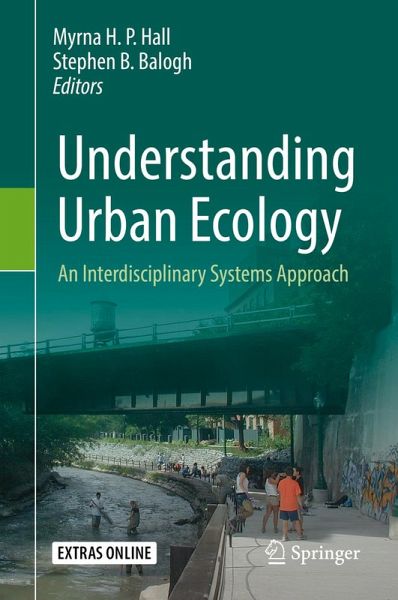
Includes 10 detailed field exercises to promote hands on experience, observation, and quantification of urban ecosystem structure and function. Provides an overview for graduate students and a rich literature base on the topic.
Includes 10 detailed field exercises to promote hands on experience, observation, and quantification of urban ecosystem structure and function.
Provides an overview for graduate students and a rich literature base on the topic.
Dieser Download kann aus rechtlichen Gründen nur mit Rechnungsadresse in A, B, BG, CY, CZ, D, DK, EW, E, FIN, F, GR, HR, H, IRL, I, LT, L, LR, M, NL, PL, P, R, S, SLO, SK ausgeliefert werden.
Die Herstellerinformationen sind derzeit nicht verfügbar.
Autorenporträt
Myrna H. P. Hall (Ed.) is Professor Emerita of Environmental Studies at the State University of New York, College of Environmental Science in Syracuse, NY, where she helped establish the College's Urban Initiative in 2001, was Director of the SUNY ESF Center for the Urban Environment, coordinated the College's Urban Environmental Science Minor, and worked with an interdisciplinary team of faculty members to design an urban ecology course which she taught for 12 years before retiring. As a spatial ecologist, her research and publications have focused on environmental alteration from human activities, including urban/suburban sprawl effects on water quality in the New York City Catskill-Delaware watersheds, ecosystem impacts of glacier loss in Glacier National Park, and the impact of alternative urban green infrastructure implementation on urban energy budgets. She has done extensive land use change modeling inBrazil, Mexico, Bolivia, and Belize to estimate carbon benefits of avoided deforestation. Her interests span urban ecology and architecture, geographic information systems, and land change modeling. Stephen Balogh earned his doctorate from SUNY College of Environmental Science and Forestry (ESF). He currently works as a postdoctoral researcher at the US EPA Office of Research and Development in the Atlantic Ecology Division. He is an environmental scientist who studies communities and their connections to the environment across global, regional and local scales - including nutrient issues, ecosystem services, energy and material flows, and restoration. He has collaborated with other scientists, academics, and stakeholders on a broad range of interdisciplinary research. These projects range in scale from regional optimization of nitrogen removal interventions in Cape Cod to neighborhood scale analyses of ecosystem services and material andenergy flows resulting from restoration efforts and population dynamics in San Juan, Puerto Rico. Prior to his current position, he worked as a visiting assistant professor at SUNY-ESF and adjunct at the Whitman School of Management at Syracuse University, where he taught courses about urban ecology, renewable energy, and sustainable business strategies. His PhD dissertation is entitled "Feeding and Fueling the Cities of the 21st Century." He has published eleven papers and several book chapters on the nexus of the environment, energy, and the economy.
Inhaltsangabe
Preface. 1. What Is Urban Ecology and Why Should We Study It?.- 2. Urban Ecology from a Biophysical and Systems Perspective.- 3. Social Processes, Urban Ecosystems and Sustainability.- 4. Scale and Metabolism in Ancient Cities.- 5. Economy and Development in Modern Cities.- 6. The Urban Hydrological System.- 7. The Climate System.- 8. The Atmospheric System: Air Quality and Greenhouse Gases.- 9. Nutrient Biogeochemistry of Urban Systems.- 10. Material Cycles.- 11. The Biological System: Plants in the Urban Environment.- 12. The Biological System: Urban Wildlife, Adaptation and Evolution; Urbanization as a Driver of Contemporary Evolution in Gray Squirrels (Sciurus carolinensis).- 13. Environmental Justice in the Urban Environment.- 14. Urban Food Systems.- 15. 15.Urban Design Toward More Holistic Systems: Improving Discipline Integration and Sustainability Evaluation.- 16. The Epilogue.
Preface. 1. What Is Urban Ecology and Why Should We Study It?.- 2. Urban Ecology from a Biophysical and Systems Perspective.- 3. Social Processes, Urban Ecosystems and Sustainability.- 4. Scale and Metabolism in Ancient Cities.- 5. Economy and Development in Modern Cities.- 6. The Urban Hydrological System.- 7. The Climate System.- 8. The Atmospheric System: Air Quality and Greenhouse Gases.- 9. Nutrient Biogeochemistry of Urban Systems.- 10. Material Cycles.- 11. The Biological System: Plants in the Urban Environment.- 12. The Biological System: Urban Wildlife, Adaptation and Evolution; Urbanization as a Driver of Contemporary Evolution in Gray Squirrels (Sciurus carolinensis).- 13. Environmental Justice in the Urban Environment.- 14. Urban Food Systems.- 15. 15.Urban Design Toward More Holistic Systems: Improving Discipline Integration and Sustainability Evaluation.- 16. The Epilogue.
Es gelten unsere Allgemeinen Geschäftsbedingungen: www.buecher.de/agb
Impressum
www.buecher.de ist ein Internetauftritt der buecher.de internetstores GmbH
Geschäftsführung: Monica Sawhney | Roland Kölbl | Günter Hilger
Sitz der Gesellschaft: Batheyer Straße 115 - 117, 58099 Hagen
Postanschrift: Bürgermeister-Wegele-Str. 12, 86167 Augsburg
Amtsgericht Hagen HRB 13257
Steuernummer: 321/5800/1497
USt-IdNr: DE450055826