153,95 €
inkl. MwSt.
Erscheint vor. 22.01.26
77 °P sammeln

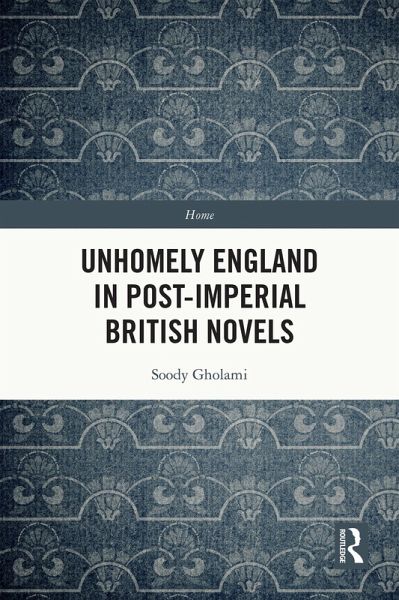
This book investigates the nature of 'home' and nation in post-imperial British novels, which deal with the loss of Empire and its uncanny presence 'at home'. It delves into histories of British colonialism, the 'end' of the Empire, decolonisation, post-Second World War nation-building, and devolution; all of which resurface in four selected novels of the late twentieth and early twenty-first centuries: Marina Warner's Indigo (1992), Caryl Phillips's The Nature of Blood (1997), Julian Barnes's Arthur & George (2005), and Zadie Smith's NW (2012).
Soody Gholami draws on postcolonial theory and Freud's unheimlich, translated as unhomely and uncanny, to investigate the novels' engagement with postwar government policies, specifically in the areas of social housing, the British Welfare State and the National Curriculum. The analytical perspective highlights the novels' evocation of unhomely England that challenges underlying illiberal and jingoistic national narratives. Exploring the writers' different depictions of home interiors, architectural features and British local landscapes, this book argues that post-imperial British novels continue to highlight racial, gendered and class inequalities that undergird domestic perceptions of belonging and national identity in post-imperial Britain. Gholami also refers to Brexit as the symptom and result of the unresolved history and legacy of colonialism, which the novels studied have anticipated all along.
Combining postcolonial, literary critical, and psychoanalytical methodology, this book will be of interest to scholars of literature, postcolonial studies, social policy and other disciplines that engage with the concept of home.
Soody Gholami draws on postcolonial theory and Freud's unheimlich, translated as unhomely and uncanny, to investigate the novels' engagement with postwar government policies, specifically in the areas of social housing, the British Welfare State and the National Curriculum. The analytical perspective highlights the novels' evocation of unhomely England that challenges underlying illiberal and jingoistic national narratives. Exploring the writers' different depictions of home interiors, architectural features and British local landscapes, this book argues that post-imperial British novels continue to highlight racial, gendered and class inequalities that undergird domestic perceptions of belonging and national identity in post-imperial Britain. Gholami also refers to Brexit as the symptom and result of the unresolved history and legacy of colonialism, which the novels studied have anticipated all along.
Combining postcolonial, literary critical, and psychoanalytical methodology, this book will be of interest to scholars of literature, postcolonial studies, social policy and other disciplines that engage with the concept of home.
Dieser Download kann aus rechtlichen Gründen nur mit Rechnungsadresse in A, B, BG, CY, CZ, D, DK, EW, E, FIN, F, GR, HR, H, IRL, I, LT, L, LR, M, NL, PL, P, R, S, SLO, SK ausgeliefert werden.