25,95 €
25,95 €
inkl. MwSt.
Sofort per Download lieferbar

13 °P sammeln
25,95 €
Als Download kaufen
25,95 €
inkl. MwSt.
Sofort per Download lieferbar
13 °P sammeln
Jetzt verschenken
Alle Infos zum eBook verschenken
25,95 €
inkl. MwSt.
Sofort per Download lieferbar
Alle Infos zum eBook verschenken
13 °P sammeln

Andere Kunden interessierten sich auch für
") Ideology (eBook, ePUB)16,95 €
Ideology (eBook, ePUB)16,95 €") Three Early Modern Utopias (eBook, ePUB)3,99 €
Three Early Modern Utopias (eBook, ePUB)3,99 €") Socialist Realism in Central and Eastern European Literatures under Stalin (eBook, ePUB)55,95 €
Socialist Realism in Central and Eastern European Literatures under Stalin (eBook, ePUB)55,95 €") The Postcolonial Gramsci (eBook, ePUB)55,95 €
The Postcolonial Gramsci (eBook, ePUB)55,95 €") German Culture and the Uncomfortable Past (eBook, ePUB)21,95 €
German Culture and the Uncomfortable Past (eBook, ePUB)21,95 €") Marxism, Postcolonial Theory, and the Future of Critique (eBook, ePUB)42,95 €
Marxism, Postcolonial Theory, and the Future of Critique (eBook, ePUB)42,95 €") Marxist Literary Criticism Today (eBook, ePUB)19,95 €
Marxist Literary Criticism Today (eBook, ePUB)19,95 €



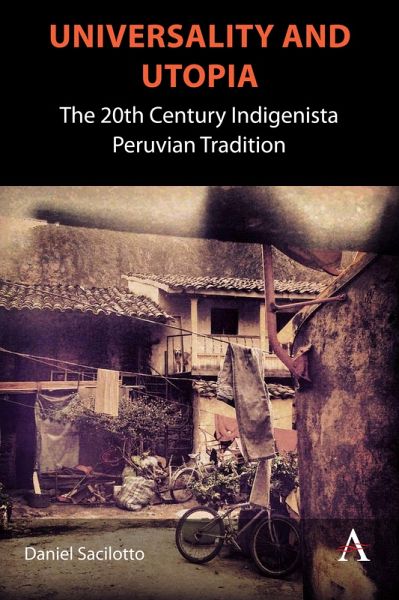
Universality and Utopia explores the intersection between philosophical universalism and revolutionary politics in twentieth-century Peruvian indigenista literature. It traces a tradition of thought whose basic tenets originate in the philosophical works of José Carlos Mariátegui and are subsequently elaborated in the literary works of César Vallejo and José MaríaArguedas. My central thesis is that, more than a "regionalist" or "provincialist" literature that describes the social reality and historic oppression of the rural Indian since colonial times, the socialist indigenismo is continuous with the invention of a utopian imaginary for a project of alternative modernity, through which urban intellectuals, artists and activists conceived of a national future beyond that of capitalist modernization. Above all, such a future would traverse the prescient division between the urban mestizo and the Indian, and finally the lingering disparity between the nation's Western and native heritage. In doing so, indigenista writers did not only adapt the tenets of socialist philosophy and avant-garde aesthetics to describe their unique social realities and thinking of the possibility of an emancipatory political practice; they also interrogated the foundations of European Marxism, expressing various figurations of the emancipatory process to come, and different models for the new revolutionary subjectivity that would aid this transition.
Rejecting assimilation into Western modernization within the urban milieu ("acculturation") under liberal capitalism imagined by liberal writers-such as Manuel González Prada and ClorindaMatto de Turner, in the late nineteenth century-I argue that the twentieth-century socialist indigenista tradition anticipated a bilateral process of appropriation and mediation between the rural Indian and mestizo, integrating indigenous as well as Western cultural and economic forms. In the first chapter, I assess Mariátegui's heterodox "Peruvian socialism," tracing the articulation of a nascentindigenista aesthetics to an emancipatory politics as part of an "active philosophy" driven by what the author names "creative antagonism." In the second chapter, I explore how César Vallejo's "materialist poetics" progressively extend the nationalist destiny and social realist aesthetic avowed by Mariátegui onto an internationalist and geopolitical horizon, as part of an "aesthetics of transmutation" that coincides with a plea for humanity as a whole. In the third chapter, I trace how José MaríaArguedas' novels attempt to reconcile what he named "the magical and rational conceptions of the world," extending the ideal of a transcultural mediation between the rural Indian and urban mestizo to conceive of a new collectivist and cooperativist ethics of "labor for-itself," informed by his anthropological and ethnographic research. In the fourth chapter, I propose a general retrospective of the aims and limitations of the ideals guiding this tradition, considering the development of Peruvian indigenista literature after Arguedas, interrogating the legacy and prospects of emancipatory politics in response to the limits of neoliberal capitalism and the crisis of democracy in Latin America today.
Rejecting assimilation into Western modernization within the urban milieu ("acculturation") under liberal capitalism imagined by liberal writers-such as Manuel González Prada and ClorindaMatto de Turner, in the late nineteenth century-I argue that the twentieth-century socialist indigenista tradition anticipated a bilateral process of appropriation and mediation between the rural Indian and mestizo, integrating indigenous as well as Western cultural and economic forms. In the first chapter, I assess Mariátegui's heterodox "Peruvian socialism," tracing the articulation of a nascentindigenista aesthetics to an emancipatory politics as part of an "active philosophy" driven by what the author names "creative antagonism." In the second chapter, I explore how César Vallejo's "materialist poetics" progressively extend the nationalist destiny and social realist aesthetic avowed by Mariátegui onto an internationalist and geopolitical horizon, as part of an "aesthetics of transmutation" that coincides with a plea for humanity as a whole. In the third chapter, I trace how José MaríaArguedas' novels attempt to reconcile what he named "the magical and rational conceptions of the world," extending the ideal of a transcultural mediation between the rural Indian and urban mestizo to conceive of a new collectivist and cooperativist ethics of "labor for-itself," informed by his anthropological and ethnographic research. In the fourth chapter, I propose a general retrospective of the aims and limitations of the ideals guiding this tradition, considering the development of Peruvian indigenista literature after Arguedas, interrogating the legacy and prospects of emancipatory politics in response to the limits of neoliberal capitalism and the crisis of democracy in Latin America today.
Dieser Download kann aus rechtlichen Gründen nur mit Rechnungsadresse in A, D ausgeliefert werden.