0,00 €
0,00 €
inkl. MwSt.
Sofort per Download lieferbar

0 °P sammeln
0,00 €
Als Download kaufen
0,00 €
inkl. MwSt.
Sofort per Download lieferbar
0 °P sammeln
Jetzt verschenken
Alle Infos zum eBook verschenken
0,00 €
inkl. MwSt.
Sofort per Download lieferbar
Alle Infos zum eBook verschenken
0 °P sammeln

Andere Kunden interessierten sich auch für
") India Higher Education Report 2020 (eBook, PDF)41,95 €
India Higher Education Report 2020 (eBook, PDF)41,95 €") Liberal Education and Its Discontents (eBook, PDF)41,95 €
Liberal Education and Its Discontents (eBook, PDF)41,95 €") International Trends in University Governance (eBook, PDF)54,95 €
International Trends in University Governance (eBook, PDF)54,95 €") New Education Policy, Sustainable Development and Nation Building (eBook, PDF)52,95 €
New Education Policy, Sustainable Development and Nation Building (eBook, PDF)52,95 €") India Higher Education Report 2022 (eBook, PDF)39,95 €
India Higher Education Report 2022 (eBook, PDF)39,95 €") The Humanities, the Social Sciences and the University (eBook, PDF)39,95 €
The Humanities, the Social Sciences and the University (eBook, PDF)39,95 €") The Organisational Dynamics of University Reform in Japan (eBook, PDF)45,95 €
The Organisational Dynamics of University Reform in Japan (eBook, PDF)45,95 €




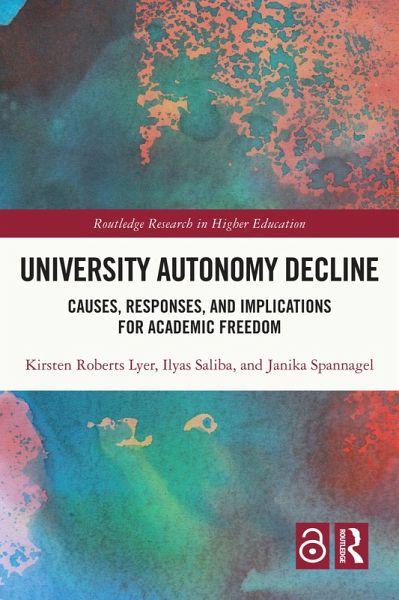
This book provides empirically grounded insights into the causes, trajectories, and effects of a severe decline in university autonomy and the relationship to other dimensions of academic freedom by comparing in-depth country studies and evidence from a new global timeseries dataset.
Drawing attention to ongoing discussions on standards for monitoring and assessment of academic freedom at regional and international organizations, this book identifies a need for clearer standards on academic freedom and a human rights-based definition of university autonomy. Further, the book calls for accompanying international oversight and the inclusion of criteria related to academic freedom in international university rankings. Five expert-authored case studies on academic freedom from diverse nations (Bangladesh, Mozambique, India, Poland, and Turkey) are included in the volume.
Drawing on both qualitative and quantitative evidence, the book offers a unique and timely contribution to the field and will be of great interest to scholars, researchers, and students in the fields of higher education, human rights, political science and public policy.
This Open Access book is available at www.taylorfrancis.com, and has been made available under a Creative Commons Attribution-Non Commercial-No Derivatives 4.0 license.
Drawing attention to ongoing discussions on standards for monitoring and assessment of academic freedom at regional and international organizations, this book identifies a need for clearer standards on academic freedom and a human rights-based definition of university autonomy. Further, the book calls for accompanying international oversight and the inclusion of criteria related to academic freedom in international university rankings. Five expert-authored case studies on academic freedom from diverse nations (Bangladesh, Mozambique, India, Poland, and Turkey) are included in the volume.
Drawing on both qualitative and quantitative evidence, the book offers a unique and timely contribution to the field and will be of great interest to scholars, researchers, and students in the fields of higher education, human rights, political science and public policy.
This Open Access book is available at www.taylorfrancis.com, and has been made available under a Creative Commons Attribution-Non Commercial-No Derivatives 4.0 license.
Dieser Download kann aus rechtlichen Gründen nur mit Rechnungsadresse in A, B, BG, CY, CZ, D, DK, EW, E, FIN, F, GR, HR, H, IRL, I, LT, L, LR, M, NL, PL, P, R, S, SLO, SK ausgeliefert werden.
"Academic freedom is more important and more under threat than ever. Autonomy is the first line of defense, but little understood and poorly guarded. The authors meet this gap with data and case examples that inform and support further research and calls for action."
Robert Quinn, Executive Director, Scholars at Risk Network
"Academic Freedom is a good proxy for democracy, and institutional autonomy a good indicator of academic freedom. By focusing on the decline in institutional autonomy across states, this valuable book fills a critical gap in the literature. Keeping universities free matters not just for students and teachers, but for the wider public and future generations."
Nandini Sundar, Delhi University, India
Robert Quinn, Executive Director, Scholars at Risk Network
"Academic Freedom is a good proxy for democracy, and institutional autonomy a good indicator of academic freedom. By focusing on the decline in institutional autonomy across states, this valuable book fills a critical gap in the literature. Keeping universities free matters not just for students and teachers, but for the wider public and future generations."
Nandini Sundar, Delhi University, India