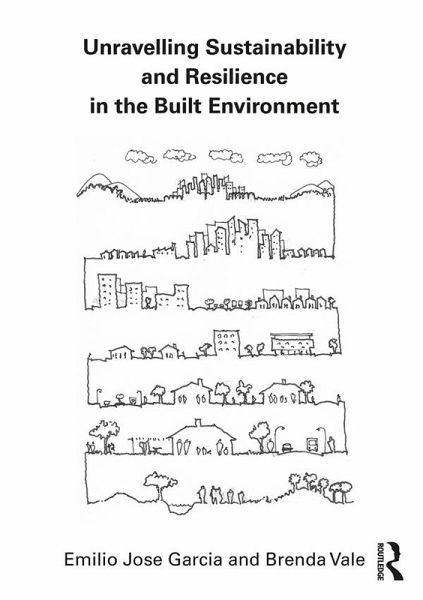
Unravelling Sustainability and Resilience in the Built Environment (eBook, ePUB)
Alle Infos zum eBook verschenken
Unravelling Sustainability and Resilience in the Built Environment (eBook, ePUB)
- Format: ePub
- Merkliste
- Auf die Merkliste
- Bewerten Bewerten
- Teilen
- Produkt teilen
- Produkterinnerung
- Produkterinnerung

Hier können Sie sich einloggen

Bitte loggen Sie sich zunächst in Ihr Kundenkonto ein oder registrieren Sie sich bei bücher.de, um das eBook-Abo tolino select nutzen zu können.
In this timely book, Emilio Jose Garcia and Brenda Vale explore what sustainability and resilience might mean when applied to the built environment. Conceived as a primer for students and professionals, it defines what the terms sustainability and resilience mean and how they are related to each other and to the design of the built environment. After discussion of the origins of the terms, these definitions are then compared and applied to case studies, including Whitehill and Bordon, UK, Tianjin Eco-city, China, and San Miguel de Tucuman, Argentina, which highlight the principles of both…mehr
- Geräte: eReader
- mit Kopierschutz
- eBook Hilfe
- Größe: 5778.32MB
Emilio Jose GarciaUnravelling Sustainability and Resilience in the Built Environment (eBook, PDF)39,95 €
Thomas FisherDesigning To Avoid Disaster (eBook, ePUB)39,95 €
Infrastructure Sustainability and Design (eBook, ePUB)142,95 €
Circular Economy for the Built Environment (eBook, ePUB)52,95 €
Michael A. RichardsRegreening the Built Environment (eBook, ePUB)39,95 €
Alisdair McGregorTwo Degrees: The Built Environment and Our Changing Climate (eBook, ePUB)56,95 €
The Routledge Handbook of Embodied Carbon in the Built Environment (eBook, ePUB)47,95 €-
-
-
Dieser Download kann aus rechtlichen Gründen nur mit Rechnungsadresse in A, B, BG, CY, CZ, D, DK, EW, E, FIN, F, GR, HR, H, IRL, I, LT, L, LR, M, NL, PL, P, R, S, SLO, SK ausgeliefert werden.
- Produktdetails
- Verlag: Taylor & Francis eBooks
- Seitenzahl: 222
- Erscheinungstermin: 27. März 2017
- Englisch
- ISBN-13: 9781317242963
- Artikelnr.: 48114653
- Verlag: Taylor & Francis eBooks
- Seitenzahl: 222
- Erscheinungstermin: 27. März 2017
- Englisch
- ISBN-13: 9781317242963
- Artikelnr.: 48114653
- Herstellerkennzeichnung Die Herstellerinformationen sind derzeit nicht verfügbar.
Brenda Vale is a Professorial Research Fellow at the University of Wellington in Victoria, New Zealand. Since her first publication (with Robert Vale) in 1975, The Autonomous House, she has been an influential figure in the area of sustainability as it relates to the built environment.
Environmentalism and the built environment. 1.3. A resilient built
environment 1.4. Institutionalisation of definitions: sustainability. 1.5.
Institutionalisation of definitions: resilience. 1.6. Unravelling
sustainability and resilience. 2. Defining Sustainability 2.1. Living
within ones means. 2.2. The emergence of modern sustainability. 2.3.
Sustainability thinking: continuity within limits. 2.4. What is to be
sustained? 2.5. Development, evolution and sustainability. 2.6.
Technological development and sustainability. 2.7. Sustainability and
economics. 2.8. Sustainable design. 2.9. Happiness: the ultimate goal of
sustainability? 2.10. A sustainable society. 3. Defining Resilience. 3.1.
Why bother with resilience? 3.2. Why is resilience an issue for architects
and urban and landscape designers? 3.3. Why bother with the definition of
resilience? 3.4. Early definitions. 3.5. The consolidation of ecological
resilience. 3.6. The expansion of ecological resilience: from ecology to
social science. 3.7.What resilience is not: misunderstandings. 3.8. Critics
of the concept of resilience. 3.9. Conclusions. 4. Mapping Sustainability
and Resilience. 4.1. Introduction. 4.2. Similarities. 4.3. Differences.
4.4. Emergent themes Part 2: Case Studies 5. Eco-cities 5.1. Why
eco-cities? 5.2. Whitehill and Bordon, Hampshire: a UK eco-town. 5.3.
Tianjin Eco-city, China. 5.4. Conclusions. 6. Heritage. 6.1. Persistence.
6.2. Identity. 6.3. Why link heritage and sustainability? 6.4. Why link
heritage and resilience. 6.5. The built heritage is more than old
buildings. 6.6. Braudel and Waisman. 6.7. Case study: the inheritance of
San Miguel de Tucuman in Argentina. 6.8. Humble heritage: the tube houses
of Hanoi. 6.9. Conclusions. 7. Compact cities. 7.1. Introduction. 7.2.
Density. 7.3. Intensity. 7.4. Compactness. 7.5. The example of Auckland.
7.6. Sustainability and a compact built environment. 7.7. Compaction and
resilience. 7.8. Conclusions. Part 3: Measuring Sustainability and
Resilience in the Build Environment 8. Measuring Sustainability. 8.1. The
issues. 8.2 Measuring sustainability with carbon footprint. 8.3 Measuring
sustainability with the ecological footprint. 8.4 Measuring sustainability
with indicators. 8.5 Measuring the sustainability of the built environment.
8.6 Measuring the sustainability of buildings. 8.7 Measuring the
sustainability of people. 9. Measuring Resilience. 9.1 State of the art in
the measurement of resilience. 9.2 How to build and urban Panarchy. 9.3
Assessing the texture of urban landscapes. 9.4 Conclusions. 10. Assessing
resilience and sustainability. 10.1 Assessing an urban Panarchy in the
Auckland CBD. 10.2 Assessing relative resilience in urban landscapes using
discontinuities and aggregations. 10.3 Measuring relative resilience. 10.4
Measuring sustainability and resilience together. 10.5 Conclusions. 11.
Conclusion. 11.1 Confusion in sustainability and resilience. 11.2
Sustainability and resilience. 11.3 Applying ecological resilience to the
built environment. 11.4 Why it might be worth applying resilience to built
environments. Index
Environmentalism and the built environment. 1.3. A resilient built
environment 1.4. Institutionalisation of definitions: sustainability. 1.5.
Institutionalisation of definitions: resilience. 1.6. Unravelling
sustainability and resilience. 2. Defining Sustainability 2.1. Living
within ones means. 2.2. The emergence of modern sustainability. 2.3.
Sustainability thinking: continuity within limits. 2.4. What is to be
sustained? 2.5. Development, evolution and sustainability. 2.6.
Technological development and sustainability. 2.7. Sustainability and
economics. 2.8. Sustainable design. 2.9. Happiness: the ultimate goal of
sustainability? 2.10. A sustainable society. 3. Defining Resilience. 3.1.
Why bother with resilience? 3.2. Why is resilience an issue for architects
and urban and landscape designers? 3.3. Why bother with the definition of
resilience? 3.4. Early definitions. 3.5. The consolidation of ecological
resilience. 3.6. The expansion of ecological resilience: from ecology to
social science. 3.7.What resilience is not: misunderstandings. 3.8. Critics
of the concept of resilience. 3.9. Conclusions. 4. Mapping Sustainability
and Resilience. 4.1. Introduction. 4.2. Similarities. 4.3. Differences.
4.4. Emergent themes Part 2: Case Studies 5. Eco-cities 5.1. Why
eco-cities? 5.2. Whitehill and Bordon, Hampshire: a UK eco-town. 5.3.
Tianjin Eco-city, China. 5.4. Conclusions. 6. Heritage. 6.1. Persistence.
6.2. Identity. 6.3. Why link heritage and sustainability? 6.4. Why link
heritage and resilience. 6.5. The built heritage is more than old
buildings. 6.6. Braudel and Waisman. 6.7. Case study: the inheritance of
San Miguel de Tucuman in Argentina. 6.8. Humble heritage: the tube houses
of Hanoi. 6.9. Conclusions. 7. Compact cities. 7.1. Introduction. 7.2.
Density. 7.3. Intensity. 7.4. Compactness. 7.5. The example of Auckland.
7.6. Sustainability and a compact built environment. 7.7. Compaction and
resilience. 7.8. Conclusions. Part 3: Measuring Sustainability and
Resilience in the Build Environment 8. Measuring Sustainability. 8.1. The
issues. 8.2 Measuring sustainability with carbon footprint. 8.3 Measuring
sustainability with the ecological footprint. 8.4 Measuring sustainability
with indicators. 8.5 Measuring the sustainability of the built environment.
8.6 Measuring the sustainability of buildings. 8.7 Measuring the
sustainability of people. 9. Measuring Resilience. 9.1 State of the art in
the measurement of resilience. 9.2 How to build and urban Panarchy. 9.3
Assessing the texture of urban landscapes. 9.4 Conclusions. 10. Assessing
resilience and sustainability. 10.1 Assessing an urban Panarchy in the
Auckland CBD. 10.2 Assessing relative resilience in urban landscapes using
discontinuities and aggregations. 10.3 Measuring relative resilience. 10.4
Measuring sustainability and resilience together. 10.5 Conclusions. 11.
Conclusion. 11.1 Confusion in sustainability and resilience. 11.2
Sustainability and resilience. 11.3 Applying ecological resilience to the
built environment. 11.4 Why it might be worth applying resilience to built
environments. Index