19,95 €
19,95 €
inkl. MwSt.
Sofort per Download lieferbar

10 °P sammeln
19,95 €
Als Download kaufen
19,95 €
inkl. MwSt.
Sofort per Download lieferbar
10 °P sammeln
Jetzt verschenken
Alle Infos zum eBook verschenken
19,95 €
inkl. MwSt.
Sofort per Download lieferbar
Alle Infos zum eBook verschenken
10 °P sammeln

Andere Kunden interessierten sich auch für
") The Sensorium of the Drone and Communities (eBook, ePUB)25,95 €
The Sensorium of the Drone and Communities (eBook, ePUB)25,95 €") The Smartness Mandate (eBook, ePUB)19,95 €
The Smartness Mandate (eBook, ePUB)19,95 €") The Charisma Machine (eBook, ePUB)19,95 €
The Charisma Machine (eBook, ePUB)19,95 €") Analog (eBook, ePUB)9,95 €
Analog (eBook, ePUB)9,95 €") We Now Disrupt This Broadcast (eBook, ePUB)16,95 €
We Now Disrupt This Broadcast (eBook, ePUB)16,95 €") Mother Media (eBook, ePUB)19,95 €
Mother Media (eBook, ePUB)19,95 €") Left to Our Own Devices (eBook, ePUB)14,95 €
Left to Our Own Devices (eBook, ePUB)14,95 €







What it means when media moves from the new to the habitualwhen our bodies become archives of supposedly obsolescent media, streaming, updating, sharing, saving.
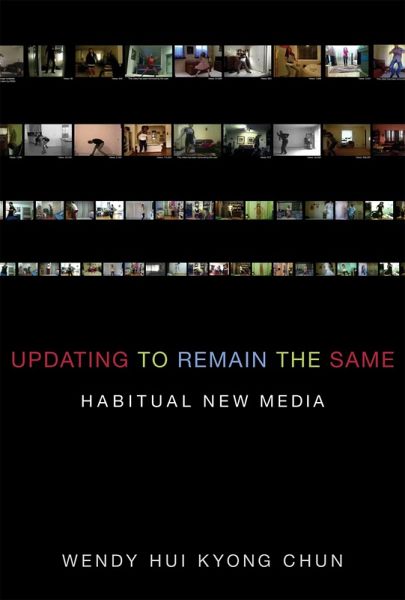
New mediawe are toldexist at the bleeding edge of obsolescence. We thus forever try to catch up, updating to remain the same. Meanwhile, analytic, creative, and commercial efforts focus exclusively on the next big thing: figuring out what will spread and who will spread it the fastest. But what do we miss in this constant push to the future? In Updating to Remain the Same, Wendy Hui Kyong Chun suggests another approach, arguing that our media matter most when they seem not to matter at allwhen they have moved from new to habitual. Smart phones, for example, no longer amaze, but they increasingly structure and monitor our lives. Through habits, Chun says, new media become embedded in our livesindeed, we become our machines: we stream, update, capture, upload, link, save, trash, and troll.
Chun links habits to the rise of networks as the defining concept of our era. Networks have been central to the emergence of neoliberalism, replacing society with groupings of individuals and connectable YOUS. (For isn't new media actually NYOU media?) Habit is central to the inversion of privacy and publicity that drives neoliberalism and networks. Why do we view our networked devices as personal when they are so chatty and promiscuous? What would happen, Chun asks, if, rather than pushing for privacy that is no privacy, we demanded public rightsthe right to be exposed, to take risks and to be in public and not be attacked?
New mediawe are toldexist at the bleeding edge of obsolescence. We thus forever try to catch up, updating to remain the same. Meanwhile, analytic, creative, and commercial efforts focus exclusively on the next big thing: figuring out what will spread and who will spread it the fastest. But what do we miss in this constant push to the future? In Updating to Remain the Same, Wendy Hui Kyong Chun suggests another approach, arguing that our media matter most when they seem not to matter at allwhen they have moved from new to habitual. Smart phones, for example, no longer amaze, but they increasingly structure and monitor our lives. Through habits, Chun says, new media become embedded in our livesindeed, we become our machines: we stream, update, capture, upload, link, save, trash, and troll.
Chun links habits to the rise of networks as the defining concept of our era. Networks have been central to the emergence of neoliberalism, replacing society with groupings of individuals and connectable YOUS. (For isn't new media actually NYOU media?) Habit is central to the inversion of privacy and publicity that drives neoliberalism and networks. Why do we view our networked devices as personal when they are so chatty and promiscuous? What would happen, Chun asks, if, rather than pushing for privacy that is no privacy, we demanded public rightsthe right to be exposed, to take risks and to be in public and not be attacked?
Dieser Download kann aus rechtlichen Gründen nur mit Rechnungsadresse in A, B, BG, CY, CZ, D, DK, EW, E, FIN, F, GR, HR, H, IRL, I, LT, L, LR, M, NL, PL, P, R, S, SLO, SK ausgeliefert werden.