33,95 €
33,95 €
inkl. MwSt.
Sofort per Download lieferbar

17 °P sammeln
33,95 €
Als Download kaufen
33,95 €
inkl. MwSt.
Sofort per Download lieferbar
17 °P sammeln
Jetzt verschenken
Alle Infos zum eBook verschenken
33,95 €
inkl. MwSt.
Sofort per Download lieferbar
Alle Infos zum eBook verschenken
17 °P sammeln

Andere Kunden interessierten sich auch für
") Being Urban (eBook, ePUB)39,95 €
Being Urban (eBook, ePUB)39,95 €") Food Policy and Practice in Early Childhood Education and Care (eBook, ePUB)42,95 €
Food Policy and Practice in Early Childhood Education and Care (eBook, ePUB)42,95 €") Feeding Cities (eBook, ePUB)45,95 €
Feeding Cities (eBook, ePUB)45,95 €") The Routledge Handbook of Urban Cultural Planning (eBook, ePUB)47,95 €
The Routledge Handbook of Urban Cultural Planning (eBook, ePUB)47,95 €") Food Consumption in the City (eBook, ePUB)44,95 €
Food Consumption in the City (eBook, ePUB)44,95 €") Finding Meaning in Wine (eBook, ePUB)39,95 €
Finding Meaning in Wine (eBook, ePUB)39,95 €") Food Policy and Practice in Early Childhood Education and Care (eBook, PDF)42,95 €
Food Policy and Practice in Early Childhood Education and Care (eBook, PDF)42,95 €
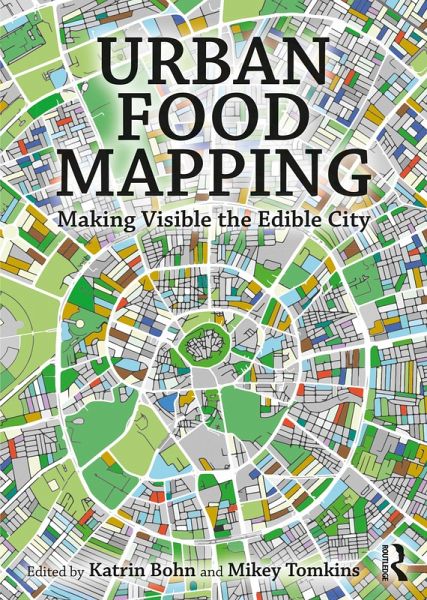
With cities becoming so vast, so entangled and perhaps so critically unsustainable, there is an urgent need for clarity around the subject of how we feed ourselves as an urban species. Urban food mapping becomes the tool to investigate the spatial relationships, gaps, scales and systems that underlie and generate what, where and how we eat, highlighting current and potential ways to (re)connect with our diet, ourselves and our environments.
Richly explored, using over 200 mapping images in 25 selected chapters, this book identifies urban food mapping as a distinct activity and area of research that enables a more nuanced way of understanding the multiple issues facing contemporary urbanism and the manyfold roles food spaces play within it. The authors of this multidisciplinary volume extend their approaches to place making, storytelling, in-depth observation and imagining liveable futures and engagement around food systems, thereby providing a comprehensive picture of our daily food flows and intrastructures. Their images and essays combine theoretical, methodological and practical analysis and applications to examine food through innovative map-making that empowers communities and inspires food planning authorities. This first book to systematise urban food mapping showcases and bridges disciplinary boundaries to make theoretical concepts as well as practical experiences and issues accessible and attractive to a wide audience, from the activist to the academic, the professional and the amateur. It will be of interest to those involved in the all-important work around food cultures, food security, urban agriculture, land rights, environmental planning and design who wish to create a more beautiful, equitable and sustainable urban environment.
Richly explored, using over 200 mapping images in 25 selected chapters, this book identifies urban food mapping as a distinct activity and area of research that enables a more nuanced way of understanding the multiple issues facing contemporary urbanism and the manyfold roles food spaces play within it. The authors of this multidisciplinary volume extend their approaches to place making, storytelling, in-depth observation and imagining liveable futures and engagement around food systems, thereby providing a comprehensive picture of our daily food flows and intrastructures. Their images and essays combine theoretical, methodological and practical analysis and applications to examine food through innovative map-making that empowers communities and inspires food planning authorities. This first book to systematise urban food mapping showcases and bridges disciplinary boundaries to make theoretical concepts as well as practical experiences and issues accessible and attractive to a wide audience, from the activist to the academic, the professional and the amateur. It will be of interest to those involved in the all-important work around food cultures, food security, urban agriculture, land rights, environmental planning and design who wish to create a more beautiful, equitable and sustainable urban environment.
Dieser Download kann aus rechtlichen Gründen nur mit Rechnungsadresse in A, B, BG, CY, CZ, D, DK, EW, E, FIN, F, GR, HR, H, IRL, I, LT, L, LR, M, NL, PL, P, R, S, SLO, SK ausgeliefert werden.