45,95 €
45,95 €
inkl. MwSt.
Sofort per Download lieferbar

23 °P sammeln
45,95 €
Als Download kaufen
45,95 €
inkl. MwSt.
Sofort per Download lieferbar
23 °P sammeln
Jetzt verschenken
Alle Infos zum eBook verschenken
45,95 €
inkl. MwSt.
Sofort per Download lieferbar
Alle Infos zum eBook verschenken
23 °P sammeln

Andere Kunden interessierten sich auch für
") Resourcing an Agroecological Urbanism (eBook, PDF)37,95 €
Resourcing an Agroecological Urbanism (eBook, PDF)37,95 €") Cities and Agriculture (eBook, PDF)45,95 €
Cities and Agriculture (eBook, PDF)45,95 €") Food Justice in American Cities (eBook, PDF)39,95 €
Food Justice in American Cities (eBook, PDF)39,95 €") Routledge Handbook of Urban Food Governance (eBook, PDF)43,95 €
Routledge Handbook of Urban Food Governance (eBook, PDF)43,95 €") Resistance to the Neoliberal Agri-Food Regime (eBook, PDF)43,95 €
Resistance to the Neoliberal Agri-Food Regime (eBook, PDF)43,95 €") Food, Senses and the City (eBook, PDF)41,95 €
Food, Senses and the City (eBook, PDF)41,95 €") Food Policy in the United Kingdom (eBook, PDF)36,95 €
Food Policy in the United Kingdom (eBook, PDF)36,95 €

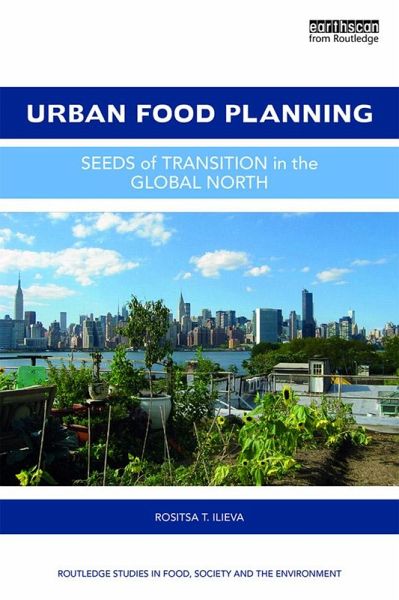
This highly original work examines the rise of the urban food planning movement in the Global North and provides insights into the new relationship between cities and food which has started developing over the past decade. It sheds light on cities as new spaces for food system innovation and on food as a tool for sustainable urban development. Drawing insights from the literature on socio-technical transitions, the book presents examples of pioneering urban food planning endeavours from North America and Western Europe (especially the Netherlands and the UK). These are integrated into a single mosaic helping to uncover the conceptual, analytical, design, and organizational innovations emerging at the interface of food and urban policy and planning.
The author shows how promising "seeds of transition" to a shared urban food planning agenda are in the making, though the urban food planning niche as a whole still lacks the necessary maturity to lastingly influence mainstream planning practices and the dominant agri-food system regime. Some of the strategic levers to cope with the current instability and limitations of urban food planning and effectively transition it from a marginal novelty to a normalized domain of policy, research, and practice are systematically examined to this end. The conclusions and recommendations put forward have major implications for scholars, activists, and public officials seeking to radically transform the co-evolution of food, cities, and the environment.
The author shows how promising "seeds of transition" to a shared urban food planning agenda are in the making, though the urban food planning niche as a whole still lacks the necessary maturity to lastingly influence mainstream planning practices and the dominant agri-food system regime. Some of the strategic levers to cope with the current instability and limitations of urban food planning and effectively transition it from a marginal novelty to a normalized domain of policy, research, and practice are systematically examined to this end. The conclusions and recommendations put forward have major implications for scholars, activists, and public officials seeking to radically transform the co-evolution of food, cities, and the environment.
Dieser Download kann aus rechtlichen Gründen nur mit Rechnungsadresse in A, B, BG, CY, CZ, D, DK, EW, E, FIN, F, GR, HR, H, IRL, I, LT, L, LR, M, NL, PL, P, R, S, SLO, SK ausgeliefert werden.