45,95 €
45,95 €
inkl. MwSt.
Sofort per Download lieferbar

23 °P sammeln
45,95 €
Als Download kaufen
45,95 €
inkl. MwSt.
Sofort per Download lieferbar
23 °P sammeln
Jetzt verschenken
Alle Infos zum eBook verschenken
45,95 €
inkl. MwSt.
Sofort per Download lieferbar
Alle Infos zum eBook verschenken
23 °P sammeln

Andere Kunden interessierten sich auch für
") Responding to Climate Change in Asian Cities (eBook, PDF)45,95 €
Responding to Climate Change in Asian Cities (eBook, PDF)45,95 €") Climate Change and Cultural Heritage (eBook, PDF)45,95 €
Climate Change and Cultural Heritage (eBook, PDF)45,95 €") Sustainability Citizenship in Cities (eBook, PDF)45,95 €
Sustainability Citizenship in Cities (eBook, PDF)45,95 €") Transport, Climate Change and the City (eBook, PDF)49,95 €
Transport, Climate Change and the City (eBook, PDF)49,95 €") Urban Poverty and Climate Change (eBook, PDF)49,95 €
Urban Poverty and Climate Change (eBook, PDF)49,95 €") Housing Sustainability in Low Carbon Cities (eBook, PDF)41,95 €
Housing Sustainability in Low Carbon Cities (eBook, PDF)41,95 €") Energy, Cities and Sustainability (eBook, PDF)49,95 €
Energy, Cities and Sustainability (eBook, PDF)49,95 €

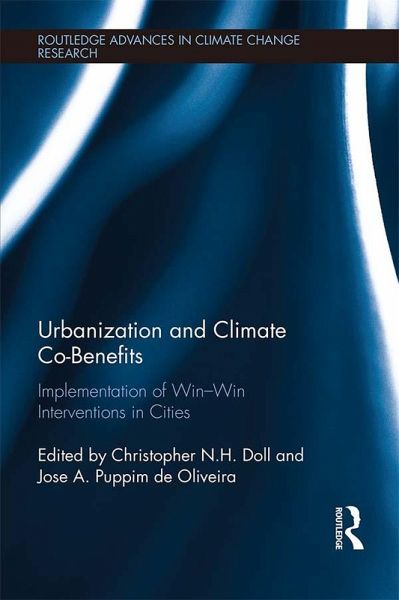
Urban areas are increasingly contributing to climate change while also suffering many of its impacts. Moreover, many cities, particularly in developing countries, continue to struggle to provide services, infrastructure and socio-economic opportunities. How do we achieve the global goals on climate change and also make room for allowing global urban development? Increasing levels of awareness and engagement on climate change at the local level, coupled with recent global agreements on climate and development goals, as well as the New Urban Agenda emerging from Habitat III, present an unprecedented opportunity to radically rethink how we develop and manage our cities.
Urbanization and Climate Co-Benefits examines the main opportunities and challenges to the implementation of a co-benefits approach in urban areas. Drawing on the results of empirical research carried out in Brazil, China, Indonesia, South Africa, India and Japan, the book is divided into two parts. The first part uses a common framework to analyse co-benefits across the urban sectors. The second part examines the tools and legal and governance perspectives at the local and international level that can help in planning for co-benefits.
This book will be of great interest to students, practitioners and scholars of urban studies, climate/development policy and environmental studies.
Urbanization and Climate Co-Benefits examines the main opportunities and challenges to the implementation of a co-benefits approach in urban areas. Drawing on the results of empirical research carried out in Brazil, China, Indonesia, South Africa, India and Japan, the book is divided into two parts. The first part uses a common framework to analyse co-benefits across the urban sectors. The second part examines the tools and legal and governance perspectives at the local and international level that can help in planning for co-benefits.
This book will be of great interest to students, practitioners and scholars of urban studies, climate/development policy and environmental studies.
Dieser Download kann aus rechtlichen Gründen nur mit Rechnungsadresse in A, B, BG, CY, CZ, D, DK, EW, E, FIN, F, GR, HR, H, IRL, I, LT, L, LR, M, NL, PL, P, R, S, SLO, SK ausgeliefert werden.