40,95 €
40,95 €
inkl. MwSt.
Sofort per Download lieferbar

20 °P sammeln
40,95 €
Als Download kaufen
40,95 €
inkl. MwSt.
Sofort per Download lieferbar
20 °P sammeln
Jetzt verschenken
Alle Infos zum eBook verschenken
40,95 €
inkl. MwSt.
Sofort per Download lieferbar
Alle Infos zum eBook verschenken
20 °P sammeln

Andere Kunden interessierten sich auch für
") Vector Analysis for Computer Graphics (eBook, PDF)40,95 €
Vector Analysis for Computer Graphics (eBook, PDF)40,95 €") Computer Animation and Simulation '95 (eBook, PDF)40,95 €
Computer Animation and Simulation '95 (eBook, PDF)40,95 €") Digital Illustration Fundamentals (eBook, PDF)15,95 €
Digital Illustration Fundamentals (eBook, PDF)15,95 €") Computer Animation and Simulation '99 (eBook, PDF)72,95 €
Computer Animation and Simulation '99 (eBook, PDF)72,95 €") Computer Animation and Simulation '96 (eBook, PDF)40,95 €
Computer Animation and Simulation '96 (eBook, PDF)40,95 €") Computer Animation and Simulation '98 (eBook, PDF)40,95 €
Computer Animation and Simulation '98 (eBook, PDF)40,95 €") Processing (eBook, PDF)40,95 €
Processing (eBook, PDF)40,95 €




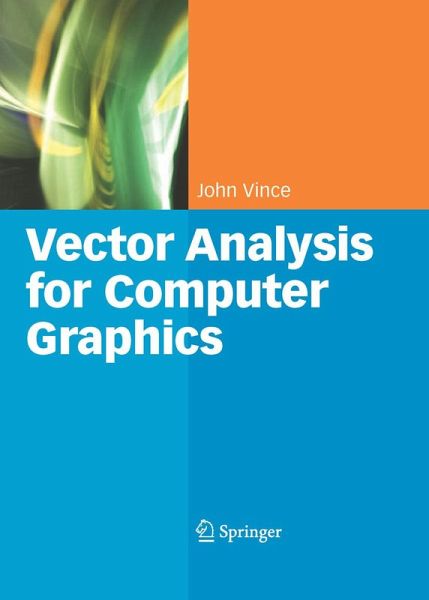
An ideal course book for mathematics undergraduates and graduates alike, this book is a complete introduction to vector analysis, especially within the context of computer graphics. The author shows why vectors are useful and how it is possible to develop analytical skills in manipulating vector algebra. Even though vector analysis is a relatively recent development in the history of mathematics, it has become a powerful and central tool in describing and solving a wide range of geometric problems, many, of which, arise in computer graphics. Each topic covered here is placed in the context of a practical application within computer graphics. The book is divided into eleven chapters covering the mathematical foundations of vector algebra and its application to, among others, lines, planes, intersections, rotating vectors, and vector differentiation.
Dieser Download kann aus rechtlichen Gründen nur mit Rechnungsadresse in A, B, BG, CY, CZ, D, DK, EW, E, FIN, F, GR, HR, H, IRL, I, LT, L, LR, M, NL, PL, P, R, S, SLO, SK ausgeliefert werden.
From the reviews:
"Vince's book applies to more than computer graphics: it is a resource for many areas in applied mathematics. ... Students in computer graphics courses would find it very useful if their class discussions moved into the mathematical fundamentals underlying the tools. ... Undergraduate students especially lack the mathematics background that this book provides. ... It is comprehensive and coherent, and a good addition to the library of any computational scientist." (Anthony J. Duben, ACM Computing Reviews, Vol. 49 (8), August, 2008)
"Vince's book applies to more than computer graphics: it is a resource for many areas in applied mathematics. ... Students in computer graphics courses would find it very useful if their class discussions moved into the mathematical fundamentals underlying the tools. ... Undergraduate students especially lack the mathematics background that this book provides. ... It is comprehensive and coherent, and a good addition to the library of any computational scientist." (Anthony J. Duben, ACM Computing Reviews, Vol. 49 (8), August, 2008)
"Each chapter presents some topic from vector analysis and contains a well-developed derivation and mathematical demonstration that makes following the topic easier. ... The book is written in a very accessible fashion. The author gives many examples presenting the notations and problems considered, making study easier. The book is suitable for undergraduate students of computer science, mathematics, and engineering, and is an ideal reference for researchers and professionals in computer graphics." (Krzysztof Gdawiec, zbMATH 1478.68008, 2022)