42,95 €
42,95 €
inkl. MwSt.
Sofort per Download lieferbar

21 °P sammeln
42,95 €
Als Download kaufen
42,95 €
inkl. MwSt.
Sofort per Download lieferbar
21 °P sammeln
Jetzt verschenken
Alle Infos zum eBook verschenken
42,95 €
inkl. MwSt.
Sofort per Download lieferbar
Alle Infos zum eBook verschenken
21 °P sammeln

Andere Kunden interessierten sich auch für
") Velocity-Based Training (eBook, ePUB)42,95 €
Velocity-Based Training (eBook, ePUB)42,95 €") Strength and Conditioning (eBook, PDF)46,95 €
Strength and Conditioning (eBook, PDF)46,95 €") Testing and Evaluation of Strength and Power (eBook, PDF)39,95 €
Testing and Evaluation of Strength and Power (eBook, PDF)39,95 €") Multidirectional Speed in Sport (eBook, PDF)38,95 €
Multidirectional Speed in Sport (eBook, PDF)38,95 €") Motor Learning and Control for Practitioners (eBook, PDF)67,95 €
Motor Learning and Control for Practitioners (eBook, PDF)67,95 €") Motor Control, Learning and Development (eBook, PDF)39,95 €
Motor Control, Learning and Development (eBook, PDF)39,95 €") Sport and Exercise Science (eBook, PDF)73,95 €
Sport and Exercise Science (eBook, PDF)73,95 €







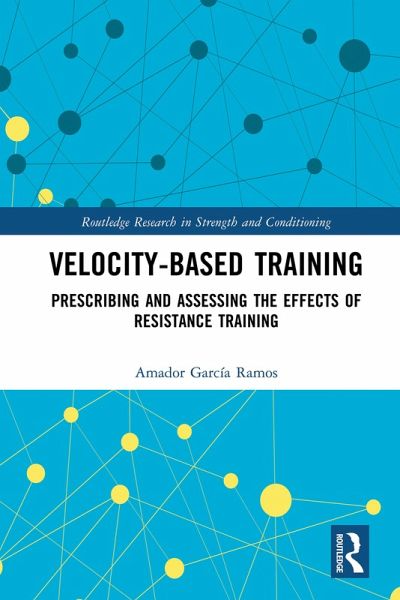
Velocity-based training (VBT) is a contemporary method of resistance training (RT) that has become popular among sport scientists and practitioners due to the proliferation of devices that allow accurate real-time monitoring of movement velocity during RT exercises. The main input of VBT is the lifting velocity of repetitions performed with maximal intent (i.e., executed as fast as possible). Barbell's velocity monitoring is known to have important applications for (I) enhancing training quality, (II) prescribing RT intensities and volumes, and (III) assessing day-to-day physical readiness and training-induced neuromuscular adaptations.
Velocity Based Training looks to describe how movement velocity can be used as a supplement to or replacement for more traditional methods commonly used to prescribe RT and assess its effects on neuromuscular function
This new volume thoroughly examines the scientific literature related to VBT. Consisting of 15 chapters that have been distributed in 5 sections covering the main topics of VBT. In each section the reader is presented with (I) the importance of the topic, (II) the investigations that have contributed to the development of the topic, (III) guidelines for applying the scientific knowledge in practice, and (IV) scientific gaps that need to be addressed for a more accurate implementation of VBT.
The key audience for this book are academic researchers and postgraduate students interested in the field of strength training and conditioning. Practitioners or emerging practitioners in the field of sport and kinesiology could also benefit from this book as it provides research-based guidelines that facilitate the implementation of individualized VBT programs in real-world training settings.
Velocity Based Training looks to describe how movement velocity can be used as a supplement to or replacement for more traditional methods commonly used to prescribe RT and assess its effects on neuromuscular function
This new volume thoroughly examines the scientific literature related to VBT. Consisting of 15 chapters that have been distributed in 5 sections covering the main topics of VBT. In each section the reader is presented with (I) the importance of the topic, (II) the investigations that have contributed to the development of the topic, (III) guidelines for applying the scientific knowledge in practice, and (IV) scientific gaps that need to be addressed for a more accurate implementation of VBT.
The key audience for this book are academic researchers and postgraduate students interested in the field of strength training and conditioning. Practitioners or emerging practitioners in the field of sport and kinesiology could also benefit from this book as it provides research-based guidelines that facilitate the implementation of individualized VBT programs in real-world training settings.
Dieser Download kann aus rechtlichen Gründen nur mit Rechnungsadresse in A, B, BG, CY, CZ, D, DK, EW, E, FIN, F, GR, HR, H, IRL, I, LT, L, LR, M, NL, PL, P, R, S, SLO, SK ausgeliefert werden.