0,49 €
0,49 €
inkl. MwSt.
Sofort per Download lieferbar

0 °P sammeln
0,49 €
Als Download kaufen
0,49 €
inkl. MwSt.
Sofort per Download lieferbar
0 °P sammeln
Jetzt verschenken
Alle Infos zum eBook verschenken
0,49 €
inkl. MwSt.
Sofort per Download lieferbar
Alle Infos zum eBook verschenken
0 °P sammeln

Andere Kunden interessierten sich auch für
") Vera; Or, The Nihilists (eBook, ePUB)0,49 €
Vera; Or, The Nihilists (eBook, ePUB)0,49 €") Vera; Or, The Nihilists (eBook, ePUB)0,99 €
Vera; Or, The Nihilists (eBook, ePUB)0,99 €") The Devil is an Ass (eBook, ePUB)0,49 €
The Devil is an Ass (eBook, ePUB)0,49 €") The Surrender of Calais (eBook, ePUB)1,99 €
The Surrender of Calais (eBook, ePUB)1,99 €") The Second Part of King Henry the Sixth (eBook, ePUB)1,99 €
The Second Part of King Henry the Sixth (eBook, ePUB)1,99 €") The Second Part of King Henry the Sixth (eBook, ePUB)0,99 €
The Second Part of King Henry the Sixth (eBook, ePUB)0,99 €") The First Part of King Henry the Fourth (eBook, ePUB)0,99 €
The First Part of King Henry the Fourth (eBook, ePUB)0,99 €



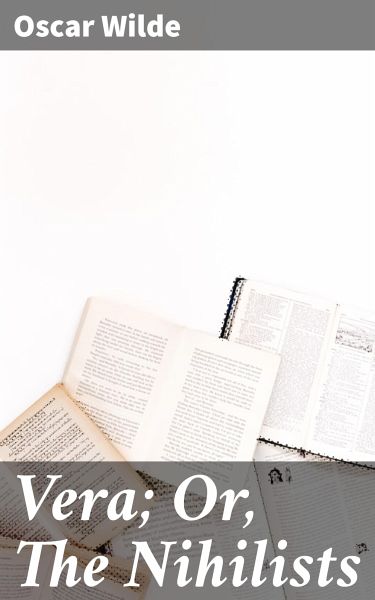
Oscar Wilde's "Vera; Or, The Nihilists" presents a captivating exploration of the philosophical and political undercurrents of nihilism amid a backdrop of 19th-century Russian revolutionism. Written in a dramatic style that combines intricate character development with sharp, witty dialogue, the play delves into the turmoil of human emotions and moral dilemmas. Wilde deftly employs the tension between idealistic aspiration and brutal reality, capturing the zeitgeist that questioned traditional values and societal norms. Through its vivid portrayal of passion, betrayal, and the quest for meaning, the work serves as a compelling reflection on the impact of radical thought on personal agency and existential despair. Oscar Wilde, renowned for his flamboyant wit and aesthetic principles, was profoundly influenced by the socio-political landscape of his time. The rise of nihilism in Russia struck a chord with Wilde, who faced his own public and private battles regarding social conventions and personal identity. His encounters with revolutionary ideas and figures informed the creation of "Vera," offering a captivating synthesis of political philosophy and intricate human relationships that reveal Wilde's deep engagement with the themes of sacrifice and disillusionment. Readers seeking a thought-provoking dive into the charged atmosphere of political idealism and individual struggle will find "Vera; Or, The Nihilists" both enlightening and engrossing. With its rich literary style and philosophical depth, Wilde's work resonates with contemporary concerns about activism, ethics, and the quest for authenticity, making it a timeless classic that invites reflection and discussion.
Dieser Download kann aus rechtlichen Gründen nur mit Rechnungsadresse in A, B, BG, CY, CZ, D, DK, EW, E, FIN, F, GR, H, IRL, I, LT, L, LR, M, NL, PL, P, R, S, SLO, SK ausgeliefert werden.
A Critic in Pall MallBy Oscar WildeAs one enters Rome from the Via Ostiensis by the Porta San Paolo, the first object that meets the eye is a marble pyramid which stands close at hand on the left. There are many Egyptian obelisks in Rome-tall, snakelike spires of red sandstone, mottled with strange writings, which remind us of the pillars of flame which led the children of Israel through the desert away from the land of the Pharaohs but more wonderful than these to look upon is this gaunt, wedge-shaped pyramid standing here in this Italian city, unshattered amid the ruins and wrecks of time, looking older than the Eternal City itself, like terrible impassiveness turned to stone. And so in the Middle Ages men supposed this to be the sepulchre of Remus, who was slain by his own brother at the founding of the city, so ancient and mysterious it appears but we have now, perhaps unfortunately, more accurate information about it, and know that it is the tomb of one Caius Cestius, a Roman gentleman of small note, who died about 30 b.c. Yet though we cannot care much for the dead man who lies in lonely state beneath it, and who is only known to the world through his sepulchre, still this pyramid will be ever dear to the eyes of all English-speaking people, because at evening its shadows fall on the tomb of one who walks with Spenser, and Shakespeare, and Byron, and Shelley, and Elizabeth Barrett Browning in the great procession of the sweet singers of England. And the name of the young English poet is John Keats. Lord Houghton calls this cemetery 'one of the most beautiful spots on which the eye and heart of man can rest,' and Shelley speaks of it as making one 'in love with death, to think that one should be buried in so sweet a place' and indeed when I saw the violets and the daisies and the poppies that overgrow the tomb, I remembered how the dead poet had once told his friend that he thought the 'intensest pleasure he had received in life was in watching the growth of flowers,' and how another time, after lying a while quite still, he murmured in some strange prescience of early death, 'I feel the flowers growing over me.'