38,95 €
inkl. MwSt.
Sofort per Download lieferbar
19 °P sammeln

Andere Kunden interessierten sich auch für
") Violence and Gender in Ancient Egypt (eBook, ePUB)38,95 €
Violence and Gender in Ancient Egypt (eBook, ePUB)38,95 €") Ancient Egyptian Society (eBook, PDF)41,95 €
Ancient Egyptian Society (eBook, PDF)41,95 €") Women in Antiquity (eBook, PDF)47,95 €
Women in Antiquity (eBook, PDF)47,95 €") Graffiti in Antiquity (eBook, PDF)47,95 €
Graffiti in Antiquity (eBook, PDF)47,95 €") Women, Gender and Identity in Third Intermediate Period Egypt (eBook, PDF)45,95 €
Women, Gender and Identity in Third Intermediate Period Egypt (eBook, PDF)45,95 €") Boundary Stelae Of Akhentaten (eBook, PDF)50,95 €
Boundary Stelae Of Akhentaten (eBook, PDF)50,95 €") Akhenaten (eBook, PDF)40,95 €
Akhenaten (eBook, PDF)40,95 €
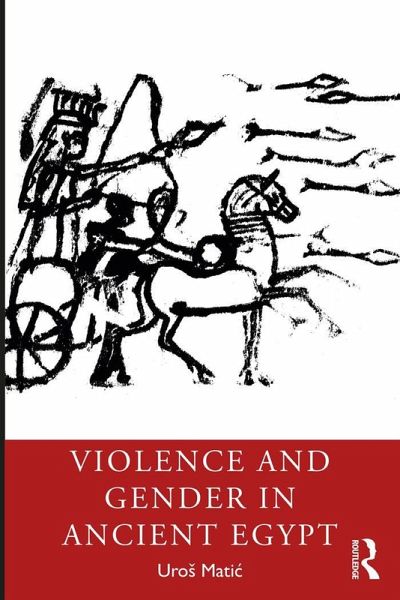
Violence and Gender in Ancient Egypt shifts the focus of gender studies in Egyptology to social phenomena rarely addressed through the lens of gender - war and violence, exploring the complex intersections of violence and gender in ancient Egypt.
Building on current discussions in philosophy, anthropology, and sociology, and on analysis of relevant historic texts, iconography, and archaeological remains by looking at possible gender patterns behind evidence of trauma, the book bridges the gap between modern understandings of gendered violence and its functioning in ancient Egypt. Areas explored include the following: differences in gendered aggression and violent acts between people and deities; sexual violence; the taking of men, women, and children as prisoners of war; and feminization of enemies. By examining ancient Egyptian texts and images with evidence for violence from different periods and contexts - private tombs, divine temples, royal stelae, papyri, and ostraca, ranging over 3,000 years of cultural history - Violence and Gender in Ancient Egypt highlights the complex intersection between gender and violence in ancient Egyptian culture.
The book will appeal to scholars and students working in Egyptology, archaeology, history, anthropology, sociology, and gender studies.
Building on current discussions in philosophy, anthropology, and sociology, and on analysis of relevant historic texts, iconography, and archaeological remains by looking at possible gender patterns behind evidence of trauma, the book bridges the gap between modern understandings of gendered violence and its functioning in ancient Egypt. Areas explored include the following: differences in gendered aggression and violent acts between people and deities; sexual violence; the taking of men, women, and children as prisoners of war; and feminization of enemies. By examining ancient Egyptian texts and images with evidence for violence from different periods and contexts - private tombs, divine temples, royal stelae, papyri, and ostraca, ranging over 3,000 years of cultural history - Violence and Gender in Ancient Egypt highlights the complex intersection between gender and violence in ancient Egyptian culture.
The book will appeal to scholars and students working in Egyptology, archaeology, history, anthropology, sociology, and gender studies.
Dieser Download kann aus rechtlichen Gründen nur mit Rechnungsadresse in A, B, BG, CY, CZ, D, DK, EW, E, FIN, F, GR, HR, H, IRL, I, LT, L, LR, M, NL, PL, P, R, S, SLO, SK ausgeliefert werden.
"This is the first monographic study connecting violence and gender in Egyptology and an excellent characterisation of the entanglement of these two concepts. It will be the starting point of a new way to deal with violence and gender in ancient Egypt, and especially the theory Frame of War is a lens to develop a different view on textual and pictorial sources. In addition to acts of violence committed and experienced by humans, the possible reflection in the transcendental sphere is also discussed, and historical contingency of gender and violence is stressed in contrast to rigid socio-biological understandings. Therefore, the book can make a groundbreaking contribution to Egyptological research."
~Angelika Lohwasser, University of Muenster, Germany
"Uros Matic's new study pushes ahead, in a contemporary fashion, his significant research concerned with violence in ancient Egypt with the connection of gender. He is superably able to cut through modern jargon and popular conceptions of these themes when dealing with pharaonic Egypt, and more importantly has contributed a whole rafter of scintillating perspectives on two interrelated issues. In this volume he does not just throw needed attention on ancient warfare or military events. Both symbolic as well as "real" violence are covered in this new study, one that I feel adds much to our present understanding of these somewhat hidden, but always present, aspects of ancient Egypt. Power relations are superbly covered, and Matic extends his argument further by dealing with archetypical scenes such as the "smithing king" to reveal new perspectives of this ancient society. Above, all, Matic's study is a refutation of the supposed placid, decorous civilization of pharaonic Egypt."
~ Anthony Spalinger, The University of Auckland, New Zealand
~Angelika Lohwasser, University of Muenster, Germany
"Uros Matic's new study pushes ahead, in a contemporary fashion, his significant research concerned with violence in ancient Egypt with the connection of gender. He is superably able to cut through modern jargon and popular conceptions of these themes when dealing with pharaonic Egypt, and more importantly has contributed a whole rafter of scintillating perspectives on two interrelated issues. In this volume he does not just throw needed attention on ancient warfare or military events. Both symbolic as well as "real" violence are covered in this new study, one that I feel adds much to our present understanding of these somewhat hidden, but always present, aspects of ancient Egypt. Power relations are superbly covered, and Matic extends his argument further by dealing with archetypical scenes such as the "smithing king" to reveal new perspectives of this ancient society. Above, all, Matic's study is a refutation of the supposed placid, decorous civilization of pharaonic Egypt."
~ Anthony Spalinger, The University of Auckland, New Zealand