Sie sind bereits eingeloggt. Klicken Sie auf 2. tolino select Abo, um fortzufahren.
Bitte loggen Sie sich zunächst in Ihr Kundenkonto ein oder registrieren Sie sich bei bücher.de, um das eBook-Abo tolino select nutzen zu können.
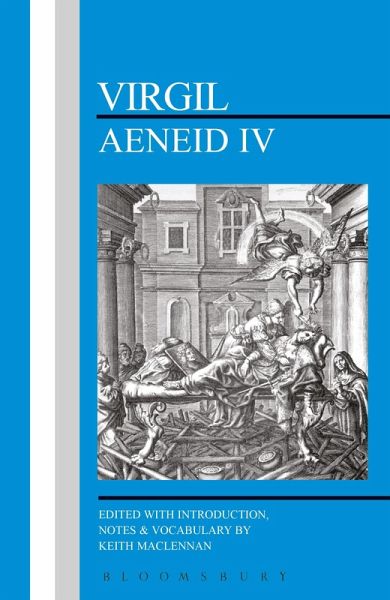
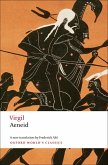
In Book IV of Virgil's "Aeneid", one of the most studied books of that epic poem, Dido, queen of Carthage, is inflamed by love for Aeneas. The goddesses Juno and Venus plot to unite them, and their 'marriage' is consummated in a cave during a hunt. However, Jupiter sends Mercury to remind Aeneas of his duty, and the hero departs despite Dido's passionate pleas. At the end of the book, Dido commits suicide. This classic edition of the Latin text of Book IV replaces the long-serving edition by Gould and Whiteley, making this book more accessible to today's students and taking account of the most…mehr
In Book IV of Virgil's "Aeneid", one of the most studied books of that epic poem, Dido, queen of Carthage, is inflamed by love for Aeneas. The goddesses Juno and Venus plot to unite them, and their 'marriage' is consummated in a cave during a hunt. However, Jupiter sends Mercury to remind Aeneas of his duty, and the hero departs despite Dido's passionate pleas. At the end of the book, Dido commits suicide. This classic edition of the Latin text of Book IV replaces the long-serving edition by Gould and Whiteley, making this book more accessible to today's students and taking account of the most recent scholarship and critical approaches to Virgil. It includes a substantial introduction, annotation to explain language and content, and a comprehensive vocabulary.
Die Herstellerinformationen sind derzeit nicht verfügbar.
Autorenporträt
Virgil (Publius Vergilius Maro, 70-19 BC) was born in the north of Italy and completed his education in Rome. Generally considered Rome's greatest poet, he wrote Eclogues, 37 BC, and Georgics, 29 BC. He then devoted the rest of his life to the composition of his greatest work, the epic poem the Aeneid.
Virgil (Publius Vergilius Maro, 70-19 BC) was born in the north of Italy and completed his education in Rome. Generally considered Rome's greatest poet, he wrote Eclogues, 37 BC, and Georgics, 29 BC. He then devoted the rest of his life to the composition of his greatest work, the epic poem the Aeneid.
Inhaltsangabe
Introduction 1. Historical background 2. Virgil's life and writing 3. The Aeneid 4. Books 1-4: the Carthaginian episode 5. Virgil's predecessors 6. Rome and Carthage 7. Dido and Aeneas 8. The gods 9. Similes in Book 4 10. Humour 11. Summary of books 5-12 12. Dido and Aeneas after Virgil 13. Metre general 14. Virgil's use of metre and language Some reading Notes Aeneid IV: The Latin text Notes on the text Index I: Literary, grammatical and metrical terms Index II: Names in the text Index III: Other names Vocabulary Abbreviations
Introduction 1. Historical background 2. Virgil's life and writing 3. The Aeneid 4. Books 1-4: the Carthaginian episode 5. Virgil's predecessors 6. Rome and Carthage 7. Dido and Aeneas 8. The gods 9. Similes in Book 4 10. Humour 11. Summary of books 5-12 12. Dido and Aeneas after Virgil 13. Metre general 14. Virgil's use of metre and language Some reading Notes Aeneid IV: The Latin text Notes on the text Index I: Literary, grammatical and metrical terms Index II: Names in the text Index III: Other names Vocabulary Abbreviations
Es gelten unsere Allgemeinen Geschäftsbedingungen: www.buecher.de/agb
Impressum
www.buecher.de ist ein Internetauftritt der buecher.de internetstores GmbH
Geschäftsführung: Monica Sawhney | Roland Kölbl | Günter Hilger
Sitz der Gesellschaft: Batheyer Straße 115 - 117, 58099 Hagen
Postanschrift: Bürgermeister-Wegele-Str. 12, 86167 Augsburg
Amtsgericht Hagen HRB 13257
Steuernummer: 321/5800/1497
USt-IdNr: DE450055826