21,95 €
21,95 €
inkl. MwSt.
Sofort per Download lieferbar

11 °P sammeln
21,95 €
Als Download kaufen
21,95 €
inkl. MwSt.
Sofort per Download lieferbar
11 °P sammeln
Jetzt verschenken
Alle Infos zum eBook verschenken
21,95 €
inkl. MwSt.
Sofort per Download lieferbar
Alle Infos zum eBook verschenken
11 °P sammeln

Andere Kunden interessierten sich auch für
") The Post-Racial Mystique (eBook, ePUB)22,95 €
The Post-Racial Mystique (eBook, ePUB)22,95 €") Sounds of Belonging (eBook, ePUB)21,95 €
Sounds of Belonging (eBook, ePUB)21,95 €") Contemporary Latina/o Media (eBook, ePUB)22,95 €
Contemporary Latina/o Media (eBook, ePUB)22,95 €") Love and Money (eBook, ePUB)0,00 €
Love and Money (eBook, ePUB)0,00 €") The Colorblind Screen (eBook, ePUB)24,95 €
The Colorblind Screen (eBook, ePUB)24,95 €") Cached (eBook, ePUB)22,95 €
Cached (eBook, ePUB)22,95 €") Chronic Youth (eBook, ePUB)0,00 €
Chronic Youth (eBook, ePUB)0,00 €



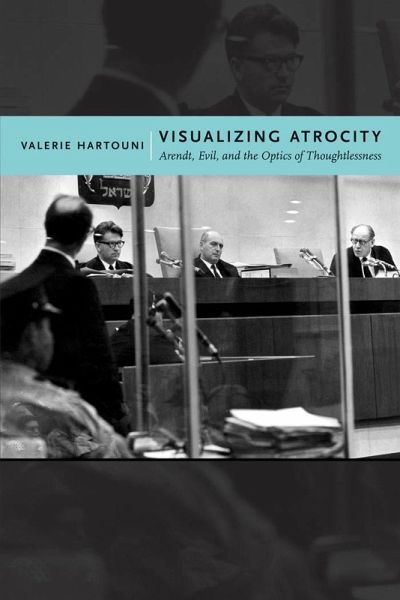
Visualizing Atrocity takes Hannah Arendt's provocative and polarizing account of the 1961 trial of Nazi official Adolf Eichmann as its point of departure for reassessing some of the serviceable myths that have come to shape and limit our understanding both of the Nazi genocide and totalitarianism's broader, constitutive, and recurrent features. These myths are inextricably tied to and reinforced viscerally by the atrocity imagery that emerged with the liberation of the concentration camps at the war's end and played an especially important, evidentiary role in the postwar trials of perpetrators.
At the 1945 Nuremberg Tribunal, particular practices of looking and seeing were first established with respect to these images that were later reinforced and institutionalized through Eichmann's trial in Jerusalem as simply part of the fabric of historical fact. They have come to constitute a certain visual rhetoric that now circumscribes the moral and political fields and powerfully assists in contemporary mythmaking about how we know genocide and what is permitted to count as such. In contrast, Arendt's claims about the banality of evil work to disrupt this visual rhetoric. More significantly still, they direct our attention well beyond the figure of Eichmann to a world organized now as then by practices and processes that while designed to sustain and even enhance life work as well to efface it.
At the 1945 Nuremberg Tribunal, particular practices of looking and seeing were first established with respect to these images that were later reinforced and institutionalized through Eichmann's trial in Jerusalem as simply part of the fabric of historical fact. They have come to constitute a certain visual rhetoric that now circumscribes the moral and political fields and powerfully assists in contemporary mythmaking about how we know genocide and what is permitted to count as such. In contrast, Arendt's claims about the banality of evil work to disrupt this visual rhetoric. More significantly still, they direct our attention well beyond the figure of Eichmann to a world organized now as then by practices and processes that while designed to sustain and even enhance life work as well to efface it.
Dieser Download kann aus rechtlichen Gründen nur mit Rechnungsadresse in A, D ausgeliefert werden.