104,95 €
104,95 €
inkl. MwSt.
Sofort per Download lieferbar

52 °P sammeln
104,95 €
Als Download kaufen
104,95 €
inkl. MwSt.
Sofort per Download lieferbar
52 °P sammeln
Jetzt verschenken
Alle Infos zum eBook verschenken
104,95 €
inkl. MwSt.
Sofort per Download lieferbar
Alle Infos zum eBook verschenken
52 °P sammeln

Andere Kunden interessierten sich auch für
") Nutrition and Food Security in India (eBook, PDF)136,95 €
Nutrition and Food Security in India (eBook, PDF)136,95 €") Climate Change and Adaptation for Food Sustainability (eBook, PDF)80,95 €
Climate Change and Adaptation for Food Sustainability (eBook, PDF)80,95 €") China and India's Development Cooperation in Africa (eBook, PDF)68,95 €
China and India's Development Cooperation in Africa (eBook, PDF)68,95 €") Contemporary Peacemaking (eBook, PDF)36,95 €
Contemporary Peacemaking (eBook, PDF)36,95 €") Fighting Over Peace (eBook, PDF)72,95 €
Fighting Over Peace (eBook, PDF)72,95 €") Sundarbans and its Ecosystem Services (eBook, PDF)80,95 €
Sundarbans and its Ecosystem Services (eBook, PDF)80,95 €") The Politics of the Sustainable Development Goals (eBook, PDF)0,00 €
The Politics of the Sustainable Development Goals (eBook, PDF)0,00 €



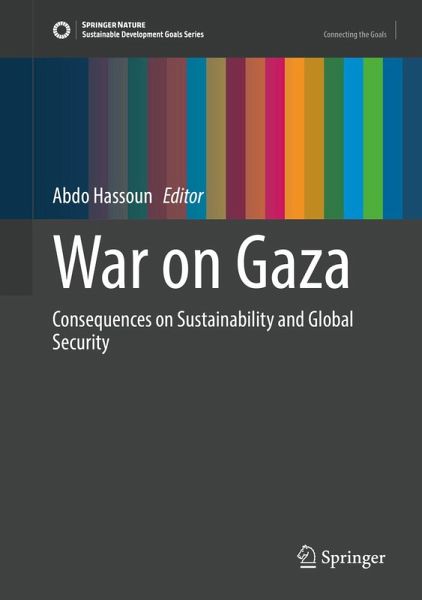
The relentless bombardment and blockade on Gaza have not only drastically restricted the inflow of essential food supplies but have also led to a catastrophic humanitarian crisis with unprecedented casualties. The widespread destruction has crippled the ability of the population to grow and process food, leaving Gazans without sufficient access to basic nutrition and pushing them to the brink of famine. Building on the previous work of Dr. Hassoun on acute food insecurity and malnutrition in Gaza, this book addresses not only Sustainable Development Goal (SDG) 2-Zero Hunger, SDG 3-Good Health and Well-being, and SDG 6-Clean Water and Sanitation, but all seventeen SDGs. While brief reports have been published on the topic, this will be the first in-depth scholarly work, offering case studies, data-driven analysis from various fields, and a comprehensive examination of the multidimensional and devastating impacts of war.
With an urgent and multidisciplinary perspective, this book highlights the interconnectedness of war, sustainability, and global security, emphasizing how hostilities in Gaza have reversed progress toward achieving all SDGs, both in Gaza and beyond. Bringing together diverse expertise from 60 authors across 27 countries, the book showcases the international and interdisciplinary collaboration underlying its research. Through a series of carefully curated chapters written by specialists in various fields, it provides a comprehensive analysis of how war has affected societal structure, economic resilience, and environmental sustainability in Gaza.
For each issue addressed, the text offers strategic insights and practical measures aimed at mitigating damage and fostering resilience. This book serves as a critical resource for policymakers, researchers, humanitarian organizations, and anyone who is interested in understanding and addressing the complex dynamics of conflict and sustainability.
With an urgent and multidisciplinary perspective, this book highlights the interconnectedness of war, sustainability, and global security, emphasizing how hostilities in Gaza have reversed progress toward achieving all SDGs, both in Gaza and beyond. Bringing together diverse expertise from 60 authors across 27 countries, the book showcases the international and interdisciplinary collaboration underlying its research. Through a series of carefully curated chapters written by specialists in various fields, it provides a comprehensive analysis of how war has affected societal structure, economic resilience, and environmental sustainability in Gaza.
For each issue addressed, the text offers strategic insights and practical measures aimed at mitigating damage and fostering resilience. This book serves as a critical resource for policymakers, researchers, humanitarian organizations, and anyone who is interested in understanding and addressing the complex dynamics of conflict and sustainability.
Dieser Download kann aus rechtlichen Gründen nur mit Rechnungsadresse in A, B, BG, CY, CZ, D, DK, EW, E, FIN, F, GR, HR, H, IRL, I, LT, L, LR, M, NL, PL, P, R, S, SLO, SK ausgeliefert werden.