0,49 €
inkl. MwSt.
Sofort per Download lieferbar
0 °P sammeln

Andere Kunden interessierten sich auch für
 (eBook, ePUB)") Waverly (Summarized Edition) (eBook, ePUB)0,49 €
Waverly (Summarized Edition) (eBook, ePUB)0,49 € (eBook, ePUB)") Waverly (Unabridged) (eBook, ePUB)0,49 €
Waverly (Unabridged) (eBook, ePUB)0,49 €") Waverly (eBook, ePUB)1,99 €
Waverly (eBook, ePUB)1,99 € (eBook, ePUB)") Waverly (Unabridged) (eBook, ePUB)0,49 €
Waverly (Unabridged) (eBook, ePUB)0,49 €") Waverly (eBook, ePUB)2,13 €
Waverly (eBook, ePUB)2,13 €") Waverly (eBook, ePUB)1,99 €
Waverly (eBook, ePUB)1,99 €") The Roman Traitor (eBook, ePUB)2,13 €
The Roman Traitor (eBook, ePUB)2,13 €




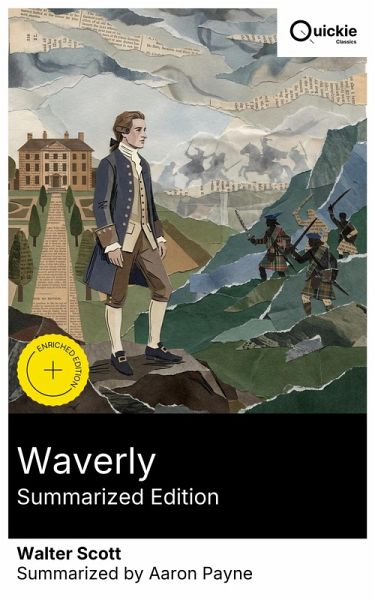
Set during the Jacobite Rising of 1745, the novel traces Edward Waverley, a young Hanoverian officer, as he drifts from English complacency into Highland loyalties, torn between prudence and charisma. In the unabridged text, Scott's ironic narrator blends romance with documentary verisimilitude-dialect, antiquarian notes, legal minutiae-so that Tully-Veolan's faded feudalism and Prestonpans' sudden violence become a meditation on historical change. Scott, a Scottish advocate and Sheriff-Depute, had already secured fame as a narrative poet and as editor of the Minstrelsy of the Scottish Border. His legal training, Tory historicism, and immersion in oral tradition equipped him to dramatize how private attachments meet public cataclysm; publishing anonymously, he fashioned an experiment that reconciles commercial, unionist modernity with a residual, charismatic Jacobite memory. Recommended to readers of Romanticism, Scottish history, and the origins of the historical novel, this unabridged edition offers comic vitality (Baron Bradwardine, Bailie Macwheeble), vivid landscapes, and humane balance. For scholars and curious newcomers alike, it shows how fiction can make history intelligible without simplification-and how moderation can be an adventure. Quickie Classics summarizes timeless works with precision, preserving the author's voice and keeping the prose clear, fast, and readable-distilled, never diluted. Enriched Edition extras: Introduction · Synopsis · Historical Context · Author Biography · Brief Analysis · 4 Reflection Q&As · Editorial Footnotes.
Dieser Download kann aus rechtlichen Gründen nur mit Rechnungsadresse in A, B, BG, CY, CZ, D, DK, EW, E, FIN, F, GR, H, IRL, I, LT, L, LR, M, NL, PL, P, R, S, SLO, SK ausgeliefert werden.