120,95 €
120,95 €
inkl. MwSt.
Sofort per Download lieferbar

60 °P sammeln
120,95 €
Als Download kaufen
120,95 €
inkl. MwSt.
Sofort per Download lieferbar
60 °P sammeln
Jetzt verschenken
Alle Infos zum eBook verschenken
120,95 €
inkl. MwSt.
Sofort per Download lieferbar
Alle Infos zum eBook verschenken
60 °P sammeln

Andere Kunden interessierten sich auch für
") Fuzzy Graph Theory (eBook, PDF)120,95 €
Fuzzy Graph Theory (eBook, PDF)120,95 €") Fuzzy Cognitive Maps (eBook, PDF)112,95 €
Fuzzy Cognitive Maps (eBook, PDF)112,95 €") Graph Neural Networks: Essentials and Use Cases (eBook, PDF)128,95 €
Graph Neural Networks: Essentials and Use Cases (eBook, PDF)128,95 €") Advanced Topics in Fuzzy Graph Theory (eBook, PDF)72,95 €
Advanced Topics in Fuzzy Graph Theory (eBook, PDF)72,95 €") Advances in the Theory of Probabilistic and Fuzzy Data Scientific Methods with Applications (eBook, PDF)72,95 €
Advances in the Theory of Probabilistic and Fuzzy Data Scientific Methods with Applications (eBook, PDF)72,95 €") Fuzzy Techniques: Theory and Applications (eBook, PDF)160,95 €
Fuzzy Techniques: Theory and Applications (eBook, PDF)160,95 €") Statistical and Fuzzy Approaches to Data Processing, with Applications to Econometrics and Other Areas (eBook, PDF)72,95 €
Statistical and Fuzzy Approaches to Data Processing, with Applications to Econometrics and Other Areas (eBook, PDF)72,95 €


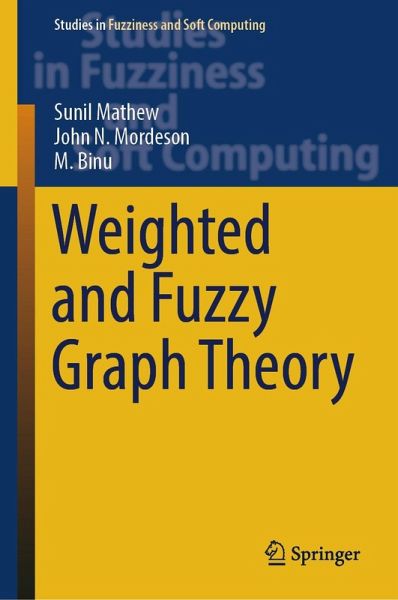
One of the most preeminent ways of applying mathematics in real-world scenario modeling involves graph theory. A graph can be undirected or directed depending on whether the pairwise relationships among objects are symmetric or not. Nevertheless, in many real-world situations, representing a set of complex relational objects as directed or undirected is not su¢ cient. Weighted graphs o§er a framework that helps to over come certain conceptual limitations. We show using the concept of an isomorphism that weighted graphs have a natural connection to fuzzy graphs. As we show in the book, this allows results to be carried back and forth between weighted graphs and fuzzy graphs. This idea is in keeping with the important paper by Klement and Mesiar that shows that many families of fuzzy sets are lattice isomorphic to each other. We also outline the important work of Head and Weinberger that show how results from ordinary mathematics can be carried over to fuzzy mathematics. We focus on the concepts connectivity, degree sequences and saturation, and intervals and gates in weighted graphs.
Dieser Download kann aus rechtlichen Gründen nur mit Rechnungsadresse in A, B, BG, CY, CZ, D, DK, EW, E, FIN, F, GR, HR, H, IRL, I, LT, L, LR, M, NL, PL, P, R, S, SLO, SK ausgeliefert werden.