21,49 €
inkl. MwSt.
Sofort per Download lieferbar
0 °P sammeln

Andere Kunden interessierten sich auch für
") What Is Real? (eBook, ePUB)9,99 €
What Is Real? (eBook, ePUB)9,99 €") Hiding in the Mirror (eBook, ePUB)5,99 €
Hiding in the Mirror (eBook, ePUB)5,99 € (eBook, ePUB)") Einstein's Relativity: The Special Theory and the General Theory - Chapter 7 (Einstein's Relativity - Single Chapter Edition: The Special Theory and the General Theory, #7) (eBook, ePUB)2,99 €
Einstein's Relativity: The Special Theory and the General Theory - Chapter 7 (Einstein's Relativity - Single Chapter Edition: The Special Theory and the General Theory, #7) (eBook, ePUB)2,99 € (eBook, ePUB)") The Great Realignment (Chavan's UED research, #6) (eBook, ePUB)10,99 €
The Great Realignment (Chavan's UED research, #6) (eBook, ePUB)10,99 € (eBook, ePUB)") Chavan's Theory of Light (Chavan's UED research, #9) (eBook, ePUB)12,49 €
Chavan's Theory of Light (Chavan's UED research, #9) (eBook, ePUB)12,49 € (eBook, ePUB)") Chavan's Theory of Everything (Chavan's UED research, #15) (eBook, ePUB)34,49 €
Chavan's Theory of Everything (Chavan's UED research, #15) (eBook, ePUB)34,49 €") Myth Wrapped in Math (eBook, ePUB)11,49 €
Myth Wrapped in Math (eBook, ePUB)11,49 €




What if the greatest achievements of modern physics were never meant to explain reality-but only to describe its behavior?
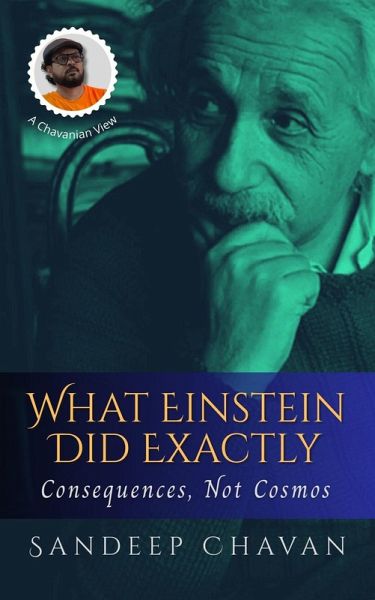
What Einstein Did Exactly by Sandeep Chavan is a philosophical exploration of the boundaries between explanation and understanding, between mathematical description and physical meaning. Rather than proposing a new theory or challenging established science, this book asks a quieter but deeper question: what have we actually explained when we say we understand the universe?
Drawing on ideas from physics, philosophy, and the history of scientific thought, this work examines how modern science came to rely on descriptive frameworks-models that predict with extraordinary accuracy, yet remain silent about underlying causes. It traces how concepts such as space, time, curvature, and expansion became accepted as physical realities rather than interpretive tools, and how this shift shaped modern scientific thinking.
In this book Chavan does not argue against Einstein or modern physics. Instead, he places Einstein's work in its proper intellectual context, showing how his restraint and precision allowed science to progress without claiming ultimate explanations. From this foundation, the text explores how later interpretations extended description into assumption, often without acknowledging the transition.
Rather than offering an alternative theory, this book invites readers to reconsider the boundary between knowledge and interpretation. It explores why certain questions persist despite technological progress, why explanations can be correct yet incomplete, and how meaning emerges not from answers alone, but from the structure of inquiry itself.
Written in clear, accessible language, What Einstein Did Exactly is intended for readers interested in physics, philosophy, and the nature of understanding-without requiring technical expertise. It is not a rejection of science, but a reflection on how science thinks, and what lies just beyond its current horizon.
What Einstein Did Exactly by Sandeep Chavan is a philosophical exploration of the boundaries between explanation and understanding, between mathematical description and physical meaning. Rather than proposing a new theory or challenging established science, this book asks a quieter but deeper question: what have we actually explained when we say we understand the universe?
Drawing on ideas from physics, philosophy, and the history of scientific thought, this work examines how modern science came to rely on descriptive frameworks-models that predict with extraordinary accuracy, yet remain silent about underlying causes. It traces how concepts such as space, time, curvature, and expansion became accepted as physical realities rather than interpretive tools, and how this shift shaped modern scientific thinking.
In this book Chavan does not argue against Einstein or modern physics. Instead, he places Einstein's work in its proper intellectual context, showing how his restraint and precision allowed science to progress without claiming ultimate explanations. From this foundation, the text explores how later interpretations extended description into assumption, often without acknowledging the transition.
Rather than offering an alternative theory, this book invites readers to reconsider the boundary between knowledge and interpretation. It explores why certain questions persist despite technological progress, why explanations can be correct yet incomplete, and how meaning emerges not from answers alone, but from the structure of inquiry itself.
Written in clear, accessible language, What Einstein Did Exactly is intended for readers interested in physics, philosophy, and the nature of understanding-without requiring technical expertise. It is not a rejection of science, but a reflection on how science thinks, and what lies just beyond its current horizon.
Dieser Download kann aus rechtlichen Gründen nur mit Rechnungsadresse in A, B, CY, CZ, D, DK, EW, E, FIN, F, GR, H, IRL, I, LT, L, LR, M, NL, PL, P, R, S, SLO, SK ausgeliefert werden.