6,99 €
inkl. MwSt.
Sofort per Download lieferbar
0 °P sammeln

Andere Kunden interessierten sich auch für
") Arguing About Tastes (eBook, ePUB)16,95 €
Arguing About Tastes (eBook, ePUB)16,95 €") Risk and the State (eBook, ePUB)24,95 €
Risk and the State (eBook, ePUB)24,95 €") The Curious Culture of Economic Theory (eBook, ePUB)19,95 €
The Curious Culture of Economic Theory (eBook, ePUB)19,95 €") An Introduction to Schools of Economic Thought (eBook, ePUB)9,95 €
An Introduction to Schools of Economic Thought (eBook, ePUB)9,95 €") Blunt Instrument (eBook, ePUB)17,95 €
Blunt Instrument (eBook, ePUB)17,95 € (eBook, ePUB)") Death of Money: The Preppers Guide to Economic Collapse, the Loss of Paper Wealth, and What to Do When Money Dies (Survival Family Basics - Preppers Survival Handbook Series) (eBook, ePUB)2,79 €
Death of Money: The Preppers Guide to Economic Collapse, the Loss of Paper Wealth, and What to Do When Money Dies (Survival Family Basics - Preppers Survival Handbook Series) (eBook, ePUB)2,79 €") Mission Economy (eBook, ePUB)9,39 €
Mission Economy (eBook, ePUB)9,39 €






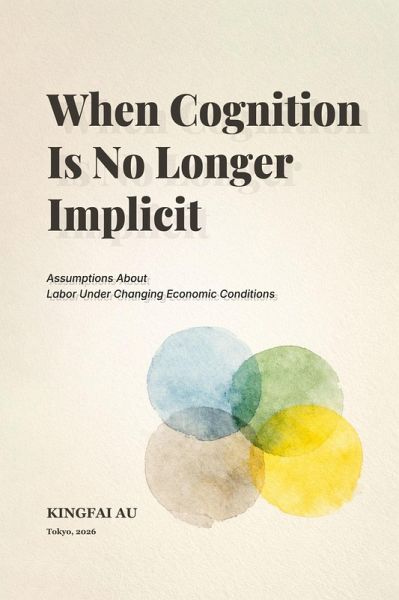
Most economic models treat cognition as implicit.
They assume judgment, reasoning, and interpretation simply "happen" inside labor, without needing to be examined as costs, constraints, or allocatable resources. For a long time, this assumption caused little friction.
When Cognition Is No Longer Implicit explores what begins to shift when that background condition no longer holds.
As tools, systems, and organizations evolve, the cost of inference changes. Judgment can be externalized, distributed, delayed, or amplified-without removing humans from the process. These changes do not invalidate existing economic categories, but they quietly strain the assumptions beneath them.
This book does not propose a new economic theory, predict future labor markets, or argue for automation as a solution. Instead, it makes visible a structural transition already underway: cognition moving from an implicit backdrop to an explicit factor shaping coordination, responsibility, and organizational design.
Written in a measured, analytical tone, the chapters move across economics, organizational structure, and cognitive limits-clarifying questions rather than offering conclusions.
This book is intended for readers who sense that familiar models still work, but no longer explain everything they encounter.
They assume judgment, reasoning, and interpretation simply "happen" inside labor, without needing to be examined as costs, constraints, or allocatable resources. For a long time, this assumption caused little friction.
When Cognition Is No Longer Implicit explores what begins to shift when that background condition no longer holds.
As tools, systems, and organizations evolve, the cost of inference changes. Judgment can be externalized, distributed, delayed, or amplified-without removing humans from the process. These changes do not invalidate existing economic categories, but they quietly strain the assumptions beneath them.
This book does not propose a new economic theory, predict future labor markets, or argue for automation as a solution. Instead, it makes visible a structural transition already underway: cognition moving from an implicit backdrop to an explicit factor shaping coordination, responsibility, and organizational design.
Written in a measured, analytical tone, the chapters move across economics, organizational structure, and cognitive limits-clarifying questions rather than offering conclusions.
This book is intended for readers who sense that familiar models still work, but no longer explain everything they encounter.
Dieser Download kann aus rechtlichen Gründen nur mit Rechnungsadresse in A, B, CY, CZ, D, DK, EW, E, FIN, F, GR, H, IRL, I, LT, L, LR, M, NL, PL, P, R, S, SLO, SK ausgeliefert werden.