Sie sind bereits eingeloggt. Klicken Sie auf 2. tolino select Abo, um fortzufahren.
Bitte loggen Sie sich zunächst in Ihr Kundenkonto ein oder registrieren Sie sich bei bücher.de, um das eBook-Abo tolino select nutzen zu können.
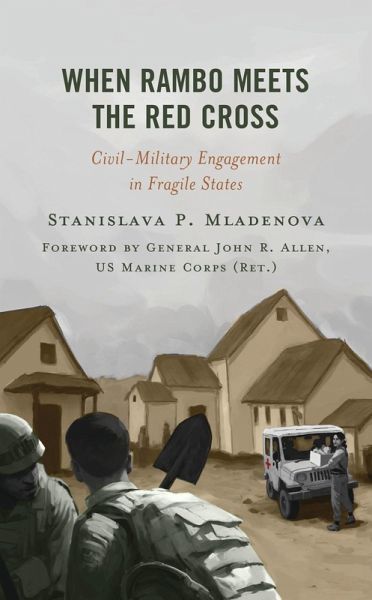
Non-governmental organizations and militaries are notorious for their difficult relationship. The military is mostly understood through the prism of its lethality, and NGOs are perceived as idealistic do-gooders, ready to save the world. Stanislava P. Mladenova traces the changing character of interaction between both of these entities. She argues that the boundaries which once separated their functions are fading. Fragile, ungoverned, and insecure spaces need both of what these actors can provide. As a result, they have drawn closer together, and have everything at their disposal for a…mehr
Non-governmental organizations and militaries are notorious for their difficult relationship. The military is mostly understood through the prism of its lethality, and NGOs are perceived as idealistic do-gooders, ready to save the world. Stanislava P. Mladenova traces the changing character of interaction between both of these entities. She argues that the boundaries which once separated their functions are fading. Fragile, ungoverned, and insecure spaces need both of what these actors can provide. As a result, they have drawn closer together, and have everything at their disposal for a collaborative, efficient, and productive civil-military partnership, which is contrary to what many observers and leaders in the conflict and development space have long believed. Mladenova makes a convincing case that it is high time both sets of actors put aside their differences, bringing to light a fast-changing landscape of vicious poverty, insecurity, and climate change, where the conventional way of doing business will become the exception, not the rule.
Die Herstellerinformationen sind derzeit nicht verfügbar.
Autorenporträt
Stanislava P. Mladenova is a Global Fellow at Brown University's Center for Human Rights and Humanitarian Studies, and Fellow at the Irregular Warfare Initiative at the US Military Academy at West Point. Her work has brought her to Africa, Central and South Asia, South America, and the Balkans. She has held positions at various institutions, including the United States Institute of Peace, working in West Africa to establish dialogue between security actors and local communities. As a Political Advisor for NATO in Afghanistan, she helped shape policy on economic issues, governance, corruption, disaster management, humanitarian assistance, and the recruitment of child soldiers. Her research at the Department of War Studies at King's College London focused on the functional relationship between military and civilian entities in settings affected by low-intensity conflict and state fragility.
Inhaltsangabe
List of Figures and Tables Foreword Preface Acknowledgments List of Acronyms Chapter 1: Introduction Six Missing Pieces The Aim of This Book Together but Apart What's to Come Chapter 2: The Non-Humanitarians Green Warriors Civil Affairs Trading Places The 95th Civil Affairs Brigade Civil Reconnaissance The Non-Humanitarians' Tools Conclusion Chapter 3: The Entrepreneurs Non-Governmental Organizations (NGOs) NGOs and Donors' Relationship Status: It's Complicated NGOs in the Gray Space Conclusion Chapter 4: Brothers from Another Mother From Wholesale to Retail Sequencing Strange Bedfellows or Familiar Strangers? OHDACA Quick Impact The Unbalanced Civil-military Budget Conclusion Chapter 5: Ground Operators: Between a Rock and a Soft Place The Ground Relationship Interactions Among Ground Operators The Loyalists, the Converted, and the Bridgebuilders On Trust Conclusion Chapter 6: The Center of Gravity Consulting and Prioritizing Populations in the Gray Space Local Perceptions SOF and Local Communities Local Perceptions - NGOs and Local Communities All Together Now Populations and the Host Nation Military Do No Harm Conclusion Conclusion Recommendations A Final Note Appendix 1. Methodology Appendix 2. Typology of Civilian and Military Entities' Attributes Bibliography About the Author
List of Figures and Tables Foreword Preface Acknowledgments List of Acronyms Chapter 1: Introduction Six Missing Pieces The Aim of This Book Together but Apart What's to Come Chapter 2: The Non-Humanitarians Green Warriors Civil Affairs Trading Places The 95th Civil Affairs Brigade Civil Reconnaissance The Non-Humanitarians' Tools Conclusion Chapter 3: The Entrepreneurs Non-Governmental Organizations (NGOs) NGOs and Donors' Relationship Status: It's Complicated NGOs in the Gray Space Conclusion Chapter 4: Brothers from Another Mother From Wholesale to Retail Sequencing Strange Bedfellows or Familiar Strangers? OHDACA Quick Impact The Unbalanced Civil-military Budget Conclusion Chapter 5: Ground Operators: Between a Rock and a Soft Place The Ground Relationship Interactions Among Ground Operators The Loyalists, the Converted, and the Bridgebuilders On Trust Conclusion Chapter 6: The Center of Gravity Consulting and Prioritizing Populations in the Gray Space Local Perceptions SOF and Local Communities Local Perceptions - NGOs and Local Communities All Together Now Populations and the Host Nation Military Do No Harm Conclusion Conclusion Recommendations A Final Note Appendix 1. Methodology Appendix 2. Typology of Civilian and Military Entities' Attributes Bibliography About the Author
Es gelten unsere Allgemeinen Geschäftsbedingungen: www.buecher.de/agb
Impressum
www.buecher.de ist ein Internetauftritt der buecher.de internetstores GmbH
Geschäftsführung: Monica Sawhney | Roland Kölbl | Günter Hilger
Sitz der Gesellschaft: Batheyer Straße 115 - 117, 58099 Hagen
Postanschrift: Bürgermeister-Wegele-Str. 12, 86167 Augsburg
Amtsgericht Hagen HRB 13257
Steuernummer: 321/5800/1497
USt-IdNr: DE450055826