0,49 €
inkl. MwSt.
Sofort per Download lieferbar
0 °P sammeln

Andere Kunden interessierten sich auch für
") Who Would Have Thought It? (eBook, ePUB)1,99 €
Who Would Have Thought It? (eBook, ePUB)1,99 €") Who Would Have Thought It? (eBook, ePUB)0,49 €
Who Would Have Thought It? (eBook, ePUB)0,49 €") Who Would Have Thought It? (eBook, ePUB)2,13 €
Who Would Have Thought It? (eBook, ePUB)2,13 €") Who Would Have Thought It? (eBook, ePUB)1,99 €
Who Would Have Thought It? (eBook, ePUB)1,99 €") Who Goes There? (eBook, ePUB)2,13 €
Who Goes There? (eBook, ePUB)2,13 €") Who Goes There? (eBook, ePUB)1,99 €
Who Goes There? (eBook, ePUB)1,99 €") The Red Badge of Courage & Other Civil War Tales (eBook, ePUB)2,13 €
The Red Badge of Courage & Other Civil War Tales (eBook, ePUB)2,13 €





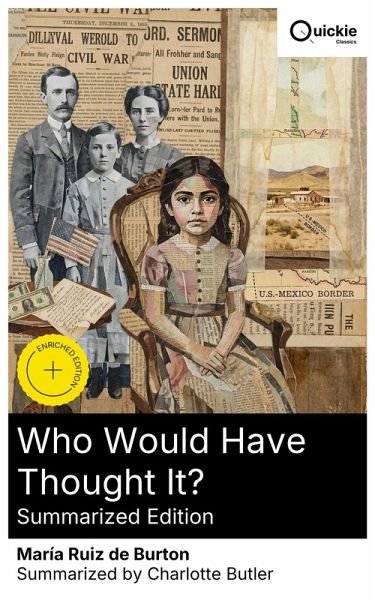
Set during the U.S. Civil War, Who Would Have Thought It? follows the New England Norval household after the arrival of Lola, a Mexican girl wealthy in her own right, whose presence exposes Northern piety and abolitionist rhetoric as racialized self-interest. Mixing sentimental domesticity with sensation fiction and political satire, Ruiz de Burton uses melodrama and irony to anatomize hypocrisy across religious and civic spheres. The novel's transregional vantage situates New England reform within imperial and hemispheric circuits, overturning the moral geography of mid-nineteenth-century American letters. Ruiz de Burton, a Californio-born writer and among the first Mexican American novelists in English, married U.S. Army officer Henry Burton and lived between California and the East during and after the war. Her battles over land and citizenship under the Treaty of Guadalupe Hidalgo, and proximity to federal power, sharpened her critique of legal dispossession, racial hierarchy, and sanctimonious reformism. Readers of American realism, Civil War culture, and borderlands studies will find this novel indispensable. It pairs gripping plot with a decolonial intelligence that revises the canon from within. Assign it alongside Stowe, Alcott, or Howells to witness a contemporaneous counterpoint, witty, acrid, and prescient about the entanglements of virtue, capital, and race. Quickie Classics summarizes timeless works with precision, preserving the author's voice and keeping the prose clear, fast, and readable-distilled, never diluted. Enriched Edition extras: Introduction · Synopsis · Historical Context · Brief Analysis · 4 Reflection Q&As · Editorial Footnotes.
Dieser Download kann aus rechtlichen Gründen nur mit Rechnungsadresse in A, B, BG, CY, CZ, D, DK, EW, E, FIN, F, GR, H, IRL, I, LT, L, LR, M, NL, PL, P, R, S, SLO, SK ausgeliefert werden.