40,95 €
40,95 €
inkl. MwSt.
Sofort per Download lieferbar

20 °P sammeln
40,95 €
Als Download kaufen
40,95 €
inkl. MwSt.
Sofort per Download lieferbar
20 °P sammeln
Jetzt verschenken
Alle Infos zum eBook verschenken
40,95 €
inkl. MwSt.
Sofort per Download lieferbar
Alle Infos zum eBook verschenken
20 °P sammeln

Andere Kunden interessierten sich auch für
") Do Running Mates Matter? (eBook, ePUB)24,95 €
Do Running Mates Matter? (eBook, ePUB)24,95 €") Why States Matter (eBook, ePUB)28,95 €
Why States Matter (eBook, ePUB)28,95 €") Neighborhood Associations and Local Governance in Japan (eBook, ePUB)47,95 €
Neighborhood Associations and Local Governance in Japan (eBook, ePUB)47,95 €") Social Capital and Associations in European Democracies (eBook, ePUB)12,95 €
Social Capital and Associations in European Democracies (eBook, ePUB)12,95 €") Pro-Child Politics: Why Every Cultural, Economic, and National Issue Is a Matter of Justice for Children (eBook, ePUB)8,99 €
Pro-Child Politics: Why Every Cultural, Economic, and National Issue Is a Matter of Justice for Children (eBook, ePUB)8,99 €") Why Constitutions Matter (eBook, ePUB)45,95 €
Why Constitutions Matter (eBook, ePUB)45,95 €") Things That Matter (eBook, ePUB)4,99 €
Things That Matter (eBook, ePUB)4,99 €





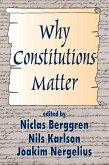

First Amendment rights are hailed as the hallmark of the US constitutional system, protecting religious liberty, freedom of speech, freedom of the press, and freedom of association. But among these rights, freedom of association holds a tenuous position, as demonstrated in the 2010 Supreme Court ruling in Christian Legal Society v. Martinez, which upheld a public university's policy requiring groups seeking official recognition to accept all students regardless of their status or beliefs. This demotion of freedom of association has broad ramifications for the constitutional status of voluntary associations in civil society, Luke C. Sheahan suggests. His book offers a cogent explanation of how this came about, why it matters, and what might be done about it.
Sheahan's argument centers upon what he calls the First Amendment Dichotomy in the Court's theoretical framework: an understanding of the state and the individual as the two analytically exclusive units of constitutional analysis. Why Associations Matter traces this dichotomy through Supreme Court jurisprudence culminating in Martinez, revealing a pattern of free association treated only as an individual right of expressive association derived from the Speech Clause alone. Sheahan then draws on the political sociology of Robert Nisbet to make a case for recognizing the social importance of associations and institutions that cannot be reduced to their individual members or subsumed into the state for purposes of constitutional analysis.
Translating the sociological qualities of associations into jurisprudential categories, Why Associations Matter provides practical advice for protecting freedom of association through the judiciary and the legislature-and guaranteeing this fundamental right its proper place in American society.
Sheahan's argument centers upon what he calls the First Amendment Dichotomy in the Court's theoretical framework: an understanding of the state and the individual as the two analytically exclusive units of constitutional analysis. Why Associations Matter traces this dichotomy through Supreme Court jurisprudence culminating in Martinez, revealing a pattern of free association treated only as an individual right of expressive association derived from the Speech Clause alone. Sheahan then draws on the political sociology of Robert Nisbet to make a case for recognizing the social importance of associations and institutions that cannot be reduced to their individual members or subsumed into the state for purposes of constitutional analysis.
Translating the sociological qualities of associations into jurisprudential categories, Why Associations Matter provides practical advice for protecting freedom of association through the judiciary and the legislature-and guaranteeing this fundamental right its proper place in American society.
Dieser Download kann aus rechtlichen Gründen nur mit Rechnungsadresse in A, D ausgeliefert werden.