38,95 €
38,95 €
inkl. MwSt.
Sofort per Download lieferbar

19 °P sammeln
38,95 €
Als Download kaufen
38,95 €
inkl. MwSt.
Sofort per Download lieferbar
19 °P sammeln
Jetzt verschenken
Alle Infos zum eBook verschenken
38,95 €
inkl. MwSt.
Sofort per Download lieferbar
Alle Infos zum eBook verschenken
19 °P sammeln

Andere Kunden interessierten sich auch für
") Why Human Rights? (eBook, ePUB)38,95 €
Why Human Rights? (eBook, ePUB)38,95 €") Can Human Rights and National Sovereignty Coexist? (eBook, PDF)44,95 €
Can Human Rights and National Sovereignty Coexist? (eBook, PDF)44,95 €") The Oxford Handbook of Citizenship (eBook, PDF)23,95 €
The Oxford Handbook of Citizenship (eBook, PDF)23,95 €") Understanding Peace (eBook, PDF)46,95 €
Understanding Peace (eBook, PDF)46,95 €") Justice and the Just War Tradition (eBook, PDF)42,95 €
Justice and the Just War Tradition (eBook, PDF)42,95 €") The Routledge Handbook of the Philosophy of Human Rights (eBook, PDF)47,95 €
The Routledge Handbook of the Philosophy of Human Rights (eBook, PDF)47,95 €") Wittgenstein and the Nature of Violence (eBook, PDF)35,95 €
Wittgenstein and the Nature of Violence (eBook, PDF)35,95 €


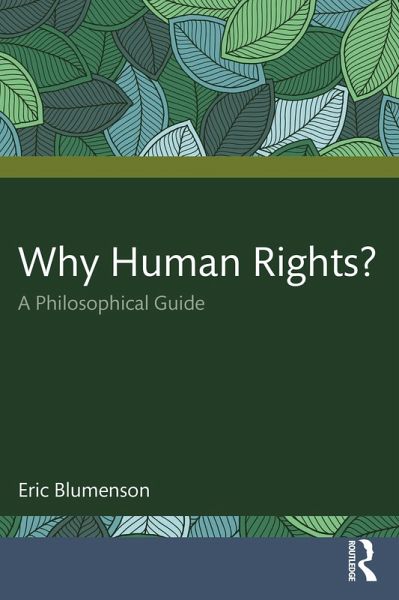
Why Human Rights addresses universal human rights as moral mandates - rights to justice that all persons have by virtue of their humanity alone. These are not the legal rights of statutes and treaties, but moral rights of the kind Gandhi, King, and Mandela invoked to oppose unjust laws. All such rights presuppose three claims: (1) that some duties of justice apply universally, (2) that all human beings have equal moral significance, and (3) that states must protect or serve certain individual interests regardless of the societal impact of doing so.
Can these three premises be justified? Is the human equality claim, for example, rationally supportable, or is it no less faith-based than hierarchical doctrines like caste? This book explores the case for these foundational claims along with other philosophical controversies pertaining to human rights. Because these issues lie at the heart of moral and political philosophy, readers will also obtain a broad appreciation of these disciplines and their leading theorists, including Mill, Kant, Rawls, Sandel, Nozick, Rorty, and many others. Written in concise, jargon-free language, this book presents a high-relief map of the philosophical issues surrounding human rights.
Can these three premises be justified? Is the human equality claim, for example, rationally supportable, or is it no less faith-based than hierarchical doctrines like caste? This book explores the case for these foundational claims along with other philosophical controversies pertaining to human rights. Because these issues lie at the heart of moral and political philosophy, readers will also obtain a broad appreciation of these disciplines and their leading theorists, including Mill, Kant, Rawls, Sandel, Nozick, Rorty, and many others. Written in concise, jargon-free language, this book presents a high-relief map of the philosophical issues surrounding human rights.
Dieser Download kann aus rechtlichen Gründen nur mit Rechnungsadresse in A, B, BG, CY, CZ, D, DK, EW, E, FIN, F, GR, HR, H, IRL, I, LT, L, LR, M, NL, PL, P, R, S, SLO, SK ausgeliefert werden.
"What are universal human rights? Can they be justified? In this highly engaging, powerfully argued, wide-ranging book, Eric Blumenson provides a superb overview of the relevant philosophical issues and develops trenchant critiques of competing philosophical views. For scholars and students interested in the theoretical foundations of universal human rights, this book is replete with penetrating insights and is also a true pleasure to read."-Kenneth W. Simons, University of California, Irvine
"Whether or not you have pondered the issue of human rights, Eric Blumenson's book is for you. In this remarkable work, Blumenson surveys and critiques the major schools of philosophical thought and then puts forth his own powerful synthesis." - Howard Gardner, Harvard University
"In this remarkable book, Blumenson tackles the hard questions surrounding human rights and universality, human dignity, and the tension between individual rights and communitarian perspectives. Students will be particularly grateful for the clarity and balance of his fresh approach to the more vexing conflicts posed by common claims of moral imperatives in a field where consensus is hard to come by." -- Michael Meltsner, Northeastern University Law School
"Reconciling the philosophical foundations of moral status and the equality of persons with the broader, substantive application and understanding of human rights is an incredibly ambitious and difficult task. Blumenson takes up this project (and more) in a clear, compelling, rigorous, and honest way. I can't recommend this book highly enough for those with an interest in human rights and all that is required to best understand and defend them." - John Basl, Northeastern University
"Whether or not you have pondered the issue of human rights, Eric Blumenson's book is for you. In this remarkable work, Blumenson surveys and critiques the major schools of philosophical thought and then puts forth his own powerful synthesis." - Howard Gardner, Harvard University
"In this remarkable book, Blumenson tackles the hard questions surrounding human rights and universality, human dignity, and the tension between individual rights and communitarian perspectives. Students will be particularly grateful for the clarity and balance of his fresh approach to the more vexing conflicts posed by common claims of moral imperatives in a field where consensus is hard to come by." -- Michael Meltsner, Northeastern University Law School
"Reconciling the philosophical foundations of moral status and the equality of persons with the broader, substantive application and understanding of human rights is an incredibly ambitious and difficult task. Blumenson takes up this project (and more) in a clear, compelling, rigorous, and honest way. I can't recommend this book highly enough for those with an interest in human rights and all that is required to best understand and defend them." - John Basl, Northeastern University