Sie sind bereits eingeloggt. Klicken Sie auf 2. tolino select Abo, um fortzufahren.
Bitte loggen Sie sich zunächst in Ihr Kundenkonto ein oder registrieren Sie sich bei bücher.de, um das eBook-Abo tolino select nutzen zu können.
BY THE NOBEL PRIZE-WINNING ECONOMISTS DARON ACEMOGLU & JAMES A. ROBINSON
Shortlisted for the Financial Times Business Book of the Year Award
Why are some nations more prosperous than others? Why Nations Fail sets out to answer this question, with a compelling and elegantly argued new theory: that it is not down to climate, geography or culture, but because of institutions. Drawing on an extraordinary range of contemporary and historical examples, from ancient Rome through the Tudors to modern-day China, leading academics Daron Acemoglu and James A. Robinson show that to…mehr
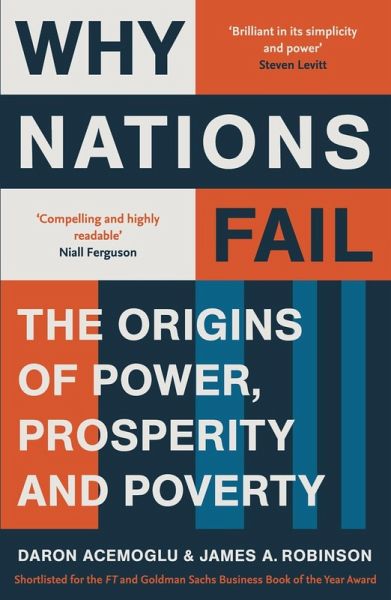
BY THE NOBEL PRIZE-WINNING ECONOMISTS DARON ACEMOGLU & JAMES A. ROBINSON Shortlisted for the Financial Times Business Book of the Year Award
Why are some nations more prosperous than others? Why Nations Fail sets out to answer this question, with a compelling and elegantly argued new theory: that it is not down to climate, geography or culture, but because of institutions. Drawing on an extraordinary range of contemporary and historical examples, from ancient Rome through the Tudors to modern-day China, leading academics Daron Acemoglu and James A. Robinson show that to invest and prosper, people need to know that if they work hard, they can make money and actually keep it - and this means sound institutions that allow virtuous circles of innovation, expansion and peace.
Based on fifteen years of research, and answering the competing arguments of authors ranging from Max Weber to Jeffrey Sachs and Jared Diamond, Acemoglu and Robinson step boldly into the territory of Francis Fukuyama and Ian Morris. They blend economics, politics, history and current affairs to provide a new, powerful and persuasive way of understanding wealth and poverty.
Dieser Download kann aus rechtlichen Gründen nur mit Rechnungsadresse in A, D ausgeliefert werden.
Die Herstellerinformationen sind derzeit nicht verfügbar.
Autorenporträt
Daron Acemoglu is the Killian Professor of Economics at MIT. He has received the John Bates Clark Medal in 2005 for his work on political economy and was the winner of the Nobel Prize in Economics in 2024 for his work on global inequality.
James A. Ronson is the Florence Professor of Government at Harvard University, and a world-renowned expert on Latin America and Africa. He received the Nobel Prize in Economics in 2024 for his work on global inequality.
They are the authors of Economic Origins of Dictatorship and Democracy, which won numerous prizes.
Inhaltsangabe
Preface Why Egyptians filled Tahrir Square to bring down Hosni Mubarak and what it means for our understanding of the causes of prosperity and poverty 1. So Close and Yet So Different Nogales, Arizona, and Nogales, Sonora, have the same people, culture, and geography. Why is one rich and one poor? 2. Theories That Don't Work Poor countries are poor not because of their geographies or cultures, or because their leaders do not know which policies will enrich their citizens 3. The Making of Prosperity and Poverty How prosperity and poverty are determined by the incentives created by institutions, and how politics determines what institutions a nation has 4. Small Differences and Critical Junctures: The Weight of History How institutions change through political conflict and how the past shapes the present 5. "I've Seen the Future, and It Works": Growth Under Extractive Institutions What Stalin, King Shyaam, the Neolithic Revolution, and the Maya city-states all had in common and how this explains why China's current economic growth cannot last 6. Drifting Apart How institutions evolve over time, often slowly drifting apart 7. The Turning Point How a political revolution in 1688 changed institutions in England and led to the Industrial Revolution 8. Not on Our Turf: Barriers to Development Why the politically powerful in many nations opposed the Industrial Revolution 9. Reversing Development How European colonialism impoverished large parts of the world 10. The Diffusion of Prosperity How some parts of the world took different paths to prosperity from that of Britain 11. The Virtuous Circle How institutions that encourage prosperity create positive feedback 12. The Vicious Circle How institutions that create poverty generate negative feedback loops and endure 13. Why Nations Fail Today Institutions, institutions, institutions 14. Breaking the Mold How a few countries changed their economic trajectory by changing their institutions 15. Understanding Prosperity and Poverty How the world could have been different and how understanding this can explain why most attempts to combat poverty have failed Acknowledgments Bibliographical Essay and Sources References Index
Rezensionen
A must-read. Acemoglu and Robinson are intellectual heavyweights of the first rank Guardian
Es gelten unsere Allgemeinen Geschäftsbedingungen: www.buecher.de/agb
Impressum
www.buecher.de ist ein Internetauftritt der buecher.de internetstores GmbH
Geschäftsführung: Monica Sawhney | Roland Kölbl | Günter Hilger
Sitz der Gesellschaft: Batheyer Straße 115 - 117, 58099 Hagen
Postanschrift: Bürgermeister-Wegele-Str. 12, 86167 Augsburg
Amtsgericht Hagen HRB 13257
Steuernummer: 321/5800/1497
USt-IdNr: DE450055826