29,95 €
29,95 €
inkl. MwSt.
Sofort per Download lieferbar

15 °P sammeln
29,95 €
Als Download kaufen
29,95 €
inkl. MwSt.
Sofort per Download lieferbar
15 °P sammeln
Jetzt verschenken
Alle Infos zum eBook verschenken
29,95 €
inkl. MwSt.
Sofort per Download lieferbar
Alle Infos zum eBook verschenken
15 °P sammeln

Andere Kunden interessierten sich auch für
") The Alice Books and the Contested Ground of the Natural World (eBook, ePUB)42,95 €
The Alice Books and the Contested Ground of the Natural World (eBook, ePUB)42,95 €") Writing on sheep (eBook, ePUB)75,95 €
Writing on sheep (eBook, ePUB)75,95 €") Wild Fictions (eBook, ePUB)16,99 €
Wild Fictions (eBook, ePUB)16,99 €") On the Aesthetic Education of Man (eBook, ePUB)9,49 €
On the Aesthetic Education of Man (eBook, ePUB)9,49 €") Dante's Broken Hammer (eBook, ePUB)5,99 €
Dante's Broken Hammer (eBook, ePUB)5,99 €") The Sacred Wood (eBook, ePUB)3,99 €
The Sacred Wood (eBook, ePUB)3,99 €") Robert Burns (eBook, ePUB)3,99 €
Robert Burns (eBook, ePUB)3,99 €

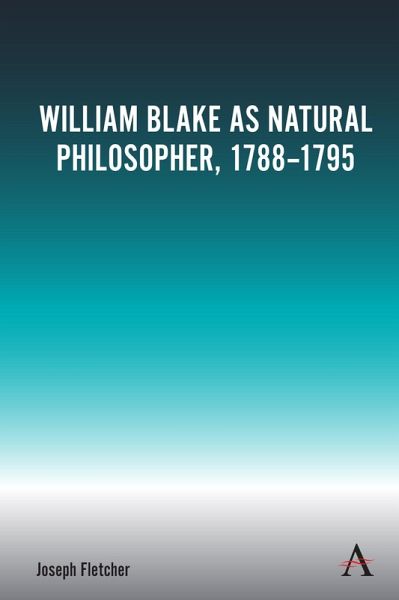
William Blake as Natural Philosopher, 1788-1795 takes seriously William Blake's wish to be read as a natural philosopher, particularly in his early works, and illuminates the way that poetry and visual art were for Blake an imaginative way of philosophizing. Blake's poetry and designs reveal a consistent preoccupation with eighteenth-century natural philosophical debates concerning the properties of the physical world, the nature of the soul, and God's relationship to the material universe. This book traces the history of these debates, and examines images and ideas in Blake's illuminated books that mark the development of the monist pantheism in his early works, which contend that every material thing is in its essence God, to the idealism of his later period, which casts the natural world as degenerate and illusory. The book argues that Blake's philosophical thought was not as monolithic as has been previously characterized, and that his deepening engagement with late eighteenth-century vitalist life sciences, including studies of the asexual propagation of the marine polyp, marks his metaphysical turn.
In contrast to the vast body of scholarship that emphasizes Blake's early religious and political positions, William Blake as Natural Philosopher draws out the metaphysics underlying his commitments. In so doing, the book demonstrates that pantheism is important because it entails an ethics that respects the interconnected divinity of all material objects - not just humans - which in turn spurns hierarchical power structures. If everything is alive and essentially divine, Blake's early work implies, then everything is worthy of respect and capable of giving and receiving infinite delight. Therefore, one should imaginatively and joyfully immerse oneself in the community of other beings in which one is already enmeshed. Often in the works discussed in this book, Blake offers negative examples to suggest his moral philosophy; he dramatizes the disastrous individual and social consequences of humans behaving as if God were a transcendent, immaterial, nonhuman demiurge, and as if they were separate from and ontologically superior to the degraded material universe that they see as composed of inert, lifeless atoms.
William Blake as Natural Philosopher traces the evolution of eighteenth-century debates over the vitalist qualities of life and the nature of the soul both in the United Kingdom and on the continent, devoting significant attention to the natural philosophy of Newton, Locke, Berkeley, Leibniz, Buffon, La Mettrie, Hume, Joseph Priestley, Erasmus Darwin, and many others.
In contrast to the vast body of scholarship that emphasizes Blake's early religious and political positions, William Blake as Natural Philosopher draws out the metaphysics underlying his commitments. In so doing, the book demonstrates that pantheism is important because it entails an ethics that respects the interconnected divinity of all material objects - not just humans - which in turn spurns hierarchical power structures. If everything is alive and essentially divine, Blake's early work implies, then everything is worthy of respect and capable of giving and receiving infinite delight. Therefore, one should imaginatively and joyfully immerse oneself in the community of other beings in which one is already enmeshed. Often in the works discussed in this book, Blake offers negative examples to suggest his moral philosophy; he dramatizes the disastrous individual and social consequences of humans behaving as if God were a transcendent, immaterial, nonhuman demiurge, and as if they were separate from and ontologically superior to the degraded material universe that they see as composed of inert, lifeless atoms.
William Blake as Natural Philosopher traces the evolution of eighteenth-century debates over the vitalist qualities of life and the nature of the soul both in the United Kingdom and on the continent, devoting significant attention to the natural philosophy of Newton, Locke, Berkeley, Leibniz, Buffon, La Mettrie, Hume, Joseph Priestley, Erasmus Darwin, and many others.
Dieser Download kann aus rechtlichen Gründen nur mit Rechnungsadresse in A, D ausgeliefert werden.