Sie sind bereits eingeloggt. Klicken Sie auf 2. tolino select Abo, um fortzufahren.
Bitte loggen Sie sich zunächst in Ihr Kundenkonto ein oder registrieren Sie sich bei bücher.de, um das eBook-Abo tolino select nutzen zu können.
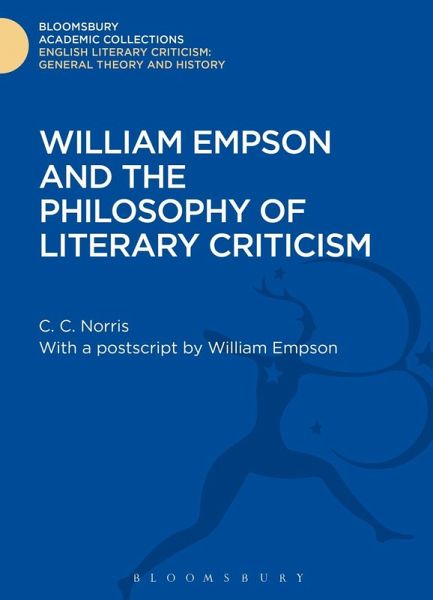
Following the publication of Seven Types of Ambiguity in 1930 William Empson was quickly recognised as a critic of great originality and unique creative gifts and he has inspired a whole new method and style of approach in literary criticism. But this is the first full-length study of his work and it is an important part of Dr Norris's purpose to account for the gulf that has emerged between Empson's viewpoint and the development of his ideas by others, especially the American New Critics, and for the consequent failure of Empson's later books to generate the informed discussion they demand…mehr
Following the publication of Seven Types of Ambiguity in 1930 William Empson was quickly recognised as a critic of great originality and unique creative gifts and he has inspired a whole new method and style of approach in literary criticism. But this is the first full-length study of his work and it is an important part of Dr Norris's purpose to account for the gulf that has emerged between Empson's viewpoint and the development of his ideas by others, especially the American New Critics, and for the consequent failure of Empson's later books to generate the informed discussion they demand and deserve. Here particular attention is given to his critical summa, The Structure of Complex Words. To understand Empson's work as a consistent whole, Dr Norris argues, one must relate it to his philosophy of humanistic rationalism. This is to give a new perspective not only to his practical criticism but also to his differences with Eliot and Leavis and to his anti-Christian polemic.
Die Herstellerinformationen sind derzeit nicht verfügbar.
Autorenporträt
Christopher Norris is Distinguished Research Professor in Philosophy at the University of Cardiff, Wales, and has taught at many universities in India, Australia, Greece, Spain, Germany, Canada, China, the US, and elsewhere. He is the author of numerous books on aspects of philosophy, critical theory, and modern intellectual history.
Inhaltsangabe
Introduction 1 Empson and Present-Day Criticism: a Chapter of Misunderstandings Poet and critic: a change of heart? The rational motive: Empson and the literature of conflict 2 'Beyond Formalism': Pastoral and the 'Subjective Correlative' History and form in Pastoral: the 'timeless prison' of Symbolism 3 Complex Words and the Grammar of Motives Dramatic 'character' and the commonsense ethic 4 Semantics and Historical Method: the Phenomenology of Meaning Structures and meaning: the limits explanation Ordinary language and semantic history Complex Words and the 'renaissance' view of man 5 'Other Minds': the Morality of Knowledge Milton's God and the 'question of intention' Milton, Pastoral and the levels of consciousness Poetry and narrative: the 'plot' dimension The rational bias: some limiting cases in Empson's criticism 6 Literary 'Values' and Modern Humanism: Empson's Work in Perspective Alternative wisdoms: Empson between two cultures Appendix: Complex Words and Recent Semantic Theory Postscript by William Empson Bibliographical Note Notes Index
Introduction 1 Empson and Present-Day Criticism: a Chapter of Misunderstandings Poet and critic: a change of heart? The rational motive: Empson and the literature of conflict 2 'Beyond Formalism': Pastoral and the 'Subjective Correlative' History and form in Pastoral: the 'timeless prison' of Symbolism 3 Complex Words and the Grammar of Motives Dramatic 'character' and the commonsense ethic 4 Semantics and Historical Method: the Phenomenology of Meaning Structures and meaning: the limits explanation Ordinary language and semantic history Complex Words and the 'renaissance' view of man 5 'Other Minds': the Morality of Knowledge Milton's God and the 'question of intention' Milton, Pastoral and the levels of consciousness Poetry and narrative: the 'plot' dimension The rational bias: some limiting cases in Empson's criticism 6 Literary 'Values' and Modern Humanism: Empson's Work in Perspective Alternative wisdoms: Empson between two cultures Appendix: Complex Words and Recent Semantic Theory Postscript by William Empson Bibliographical Note Notes Index
Es gelten unsere Allgemeinen Geschäftsbedingungen: www.buecher.de/agb
Impressum
www.buecher.de ist ein Internetauftritt der buecher.de internetstores GmbH
Geschäftsführung: Monica Sawhney | Roland Kölbl | Günter Hilger
Sitz der Gesellschaft: Batheyer Straße 115 - 117, 58099 Hagen
Postanschrift: Bürgermeister-Wegele-Str. 12, 86167 Augsburg
Amtsgericht Hagen HRB 13257
Steuernummer: 321/5800/1497
USt-IdNr: DE450055826