21,95 €
21,95 €
inkl. MwSt.
Sofort per Download lieferbar

11 °P sammeln
21,95 €
Als Download kaufen
21,95 €
inkl. MwSt.
Sofort per Download lieferbar
11 °P sammeln
Jetzt verschenken
Alle Infos zum eBook verschenken
21,95 €
inkl. MwSt.
Sofort per Download lieferbar
Alle Infos zum eBook verschenken
11 °P sammeln

Andere Kunden interessierten sich auch für
") Women in Policing (eBook, ePUB)21,95 €
Women in Policing (eBook, ePUB)21,95 €") Gender Inclusive Policing (eBook, PDF)55,95 €
Gender Inclusive Policing (eBook, PDF)55,95 €") Women in Policing around the World (eBook, PDF)61,95 €
Women in Policing around the World (eBook, PDF)61,95 €") Crime, Science and Policing (eBook, PDF)38,95 €
Crime, Science and Policing (eBook, PDF)38,95 €") Policing Domestic Abuse (eBook, PDF)35,95 €
Policing Domestic Abuse (eBook, PDF)35,95 €") The Police Identity Crisis (eBook, PDF)41,95 €
The Police Identity Crisis (eBook, PDF)41,95 €") Policing the Global South (eBook, PDF)37,95 €
Policing the Global South (eBook, PDF)37,95 €
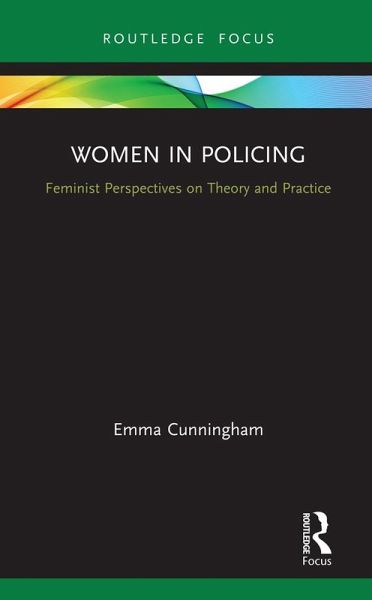
Women in Policing provides an insight into women's role within policing, their emergence, and development, offering a theoretical underpinning to explore this role as well as incorporating two empirical studies, one which reassesses the lived experiences of female officers, and one based on FOI requests to examine police officer disciplinary offences in three police force areas.
The book begins by exploring some of the history of ideas in relation to ideas about women and their supposed nature. Cunningham shows how a variety of feminist ideas and critique are of vital importance in illuminating and critiquing the place of women within this field and provides a feminist lens with which to explore these themes critically. The book also examines the re-emergence of these ideas about women in current women and policing literature. Together, exploration of these sources using a feminist conceptual framework facilitates a new, rich analysis that is both reflective and reflexive, culminating in a novel snapshot of the place of women in policing in England. She argues that accepting both institutional racism and institutional misogyny are vital in approaching transformational change in policing practice. The book concludes with a discussion around how these findings can help with police confidence and legitimacy in the future.
A fundamental examination of the ideas underpinning how women's integration and continuation in policing has happened, where it is currently, and where it may go, Women in Policing will be of great interest to police practitioners and students as well as Criminology, Sociology, and Law and Policing scholars.
The book begins by exploring some of the history of ideas in relation to ideas about women and their supposed nature. Cunningham shows how a variety of feminist ideas and critique are of vital importance in illuminating and critiquing the place of women within this field and provides a feminist lens with which to explore these themes critically. The book also examines the re-emergence of these ideas about women in current women and policing literature. Together, exploration of these sources using a feminist conceptual framework facilitates a new, rich analysis that is both reflective and reflexive, culminating in a novel snapshot of the place of women in policing in England. She argues that accepting both institutional racism and institutional misogyny are vital in approaching transformational change in policing practice. The book concludes with a discussion around how these findings can help with police confidence and legitimacy in the future.
A fundamental examination of the ideas underpinning how women's integration and continuation in policing has happened, where it is currently, and where it may go, Women in Policing will be of great interest to police practitioners and students as well as Criminology, Sociology, and Law and Policing scholars.
Dieser Download kann aus rechtlichen Gründen nur mit Rechnungsadresse in A, B, BG, CY, CZ, D, DK, EW, E, FIN, F, GR, HR, H, IRL, I, LT, L, LR, M, NL, PL, P, R, S, SLO, SK ausgeliefert werden.
'This book is a must-read for police practitioners, academics, professional policing students and policing scholars. At a time when gender-responsive policing and security are gaining traction domestically and internationally, Emma Cunningham fills a void within the contemporary literature on women in policing, drawing upon contemporary research and using original data to shed light upon gender inequality, sexism, and misogyny in the everyday lives of female police officers in the UK and beyond. This book will serve as a wake-up call for policymakers, police leaders, and trainers.'
Dr Wendy Laverick, Programme Director Professional Policing, Hull University
'This book is a clear-sighted exploration of twenty-first-century policing and its impact on women. Emma Cunningham holds current events and practices up to the light of diverse historical sources, in a call to action that is urgent and constructive. She tackles the myth of women's "nature" via Mary Wollstonecraft's pioneering arguments on Justice and human rights, and in doing so delivers a powerful case for an intersectional approach to policing.
Cunningham was a long-term supporter of the Wollstonecraft memorial artwork, well before the controversy kicked in. Like that memorial, this book ensures that Wollstonecraft is, in Virgina Woolf's words, "alive and active [...] even now among the living".
With this feminist critique of police work in Britain and beyond, Cunningham draws on Wollstonecraft's key principles and takes them into action, which is exactly where they belong. I learnt a lot from this book and I am filled with hope that others will learn too.'
Bee Rowlatt, journalist, writer and activist. She chaired the Mary on the Green campaign to memorialise Mary Wollstonecraft and is a founding Trustee of the human rights education charity the Wollstonecraft Society
Dr Wendy Laverick, Programme Director Professional Policing, Hull University
'This book is a clear-sighted exploration of twenty-first-century policing and its impact on women. Emma Cunningham holds current events and practices up to the light of diverse historical sources, in a call to action that is urgent and constructive. She tackles the myth of women's "nature" via Mary Wollstonecraft's pioneering arguments on Justice and human rights, and in doing so delivers a powerful case for an intersectional approach to policing.
Cunningham was a long-term supporter of the Wollstonecraft memorial artwork, well before the controversy kicked in. Like that memorial, this book ensures that Wollstonecraft is, in Virgina Woolf's words, "alive and active [...] even now among the living".
With this feminist critique of police work in Britain and beyond, Cunningham draws on Wollstonecraft's key principles and takes them into action, which is exactly where they belong. I learnt a lot from this book and I am filled with hope that others will learn too.'
Bee Rowlatt, journalist, writer and activist. She chaired the Mary on the Green campaign to memorialise Mary Wollstonecraft and is a founding Trustee of the human rights education charity the Wollstonecraft Society