45,95 €
45,95 €
inkl. MwSt.
Sofort per Download lieferbar

23 °P sammeln
45,95 €
Als Download kaufen
45,95 €
inkl. MwSt.
Sofort per Download lieferbar
23 °P sammeln
Jetzt verschenken
Alle Infos zum eBook verschenken
45,95 €
inkl. MwSt.
Sofort per Download lieferbar
Alle Infos zum eBook verschenken
23 °P sammeln

Andere Kunden interessierten sich auch für
") Projecting the Past (eBook, ePUB)47,95 €
Projecting the Past (eBook, ePUB)47,95 €") Innovations of Antiquity (eBook, ePUB)47,95 €
Innovations of Antiquity (eBook, ePUB)47,95 €") Gilgamesh (eBook, ePUB)42,95 €
Gilgamesh (eBook, ePUB)42,95 €") Courtesans at Table (eBook, ePUB)38,95 €
Courtesans at Table (eBook, ePUB)38,95 €") The Eunuch in Byzantine History and Society (eBook, ePUB)44,95 €
The Eunuch in Byzantine History and Society (eBook, ePUB)44,95 €") The Metamorphoses of Antoninus Liberalis (eBook, ePUB)56,95 €
The Metamorphoses of Antoninus Liberalis (eBook, ePUB)56,95 €") The Greek World in the Fourth Century (eBook, ePUB)41,95 €
The Greek World in the Fourth Century (eBook, ePUB)41,95 €






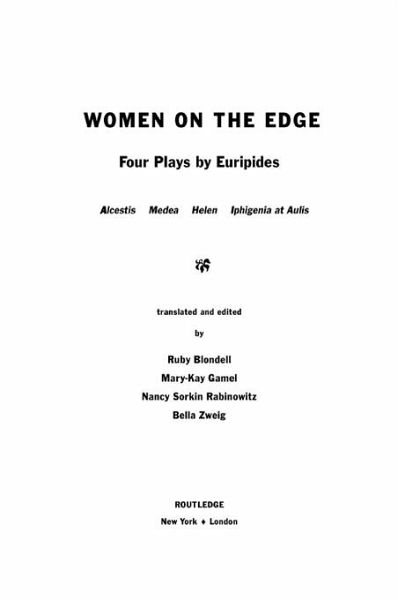
Women on the Edge, a collection of Alcestis, Medea, Helen, and Iphegenia at Aulis, provides a broad sample of Euripides' plays focusing on women, and spans the chronology of his surviving works, from the earliest, to his last, incomplete, and posthumously produced masterpiece. Each play shows women in various roles--slave, unmarried girl, devoted wife, alienated wife, mother, daughter--providing a range of evidence about the kinds of meaning and effects the category woman conveyed in ancient Athens. The female protagonists in these plays test the boundaries--literal and conceptual--of their lives.
Although women are often represented in tragedy as powerful and free in their thoughts, speech and actions, real Athenian women were apparently expected to live unseen and silent, under control of fathers and husbands, with little political or economic power. Women in tragedy often disrupt "normal" life by their words and actions: they speak out boldly, tell lies, cause public unrest, violate custom, defy orders, even kill. Female characters in tragedy take actions, and raise issues central to the plays in which they appear, sometimes in strong opposition to male characters. The four plays in this collection offer examples of women who support the status quo and women who oppose and disrupt it; sometimes these are the same characters.
Although women are often represented in tragedy as powerful and free in their thoughts, speech and actions, real Athenian women were apparently expected to live unseen and silent, under control of fathers and husbands, with little political or economic power. Women in tragedy often disrupt "normal" life by their words and actions: they speak out boldly, tell lies, cause public unrest, violate custom, defy orders, even kill. Female characters in tragedy take actions, and raise issues central to the plays in which they appear, sometimes in strong opposition to male characters. The four plays in this collection offer examples of women who support the status quo and women who oppose and disrupt it; sometimes these are the same characters.
Dieser Download kann aus rechtlichen Gründen nur mit Rechnungsadresse in A, B, BG, CY, CZ, D, DK, EW, E, FIN, F, GR, HR, H, IRL, I, LT, L, LR, M, NL, PL, P, R, S, SLO, SK ausgeliefert werden.
"I highly recommend this collection to anyone eager to encounter an innovative reading of Euripidean drama." -- Monica Silveira Cyrino, University of New Mexico Theatre Jounral
"...in a class by itself... This would make a fine text for advanced students of literature in translation or women in antiquity." -- Classical Outlook
"This is not your grandfather's translation of Euripedes... Provides a good introduction to feminist readings of these plays, accessible translations, helpful background material, and openness about the translators' methods... A valuable addition to translations of Euripidean tragedy." -- Bryn Mawr Classical Review
"...in a class by itself... This would make a fine text for advanced students of literature in translation or women in antiquity." -- Classical Outlook
"This is not your grandfather's translation of Euripedes... Provides a good introduction to feminist readings of these plays, accessible translations, helpful background material, and openness about the translators' methods... A valuable addition to translations of Euripidean tragedy." -- Bryn Mawr Classical Review