72,95 €
72,95 €
inkl. MwSt.
Sofort per Download lieferbar

36 °P sammeln
72,95 €
Als Download kaufen
72,95 €
inkl. MwSt.
Sofort per Download lieferbar
36 °P sammeln
Jetzt verschenken
Alle Infos zum eBook verschenken
72,95 €
inkl. MwSt.
Sofort per Download lieferbar
Alle Infos zum eBook verschenken
36 °P sammeln

Andere Kunden interessierten sich auch für
") Families and Child Health (eBook, PDF)72,95 €
Families and Child Health (eBook, PDF)72,95 €") Good Pharma (eBook, PDF)40,95 €
Good Pharma (eBook, PDF)40,95 €") Communities, Neighborhoods, and Health (eBook, PDF)72,95 €
Communities, Neighborhoods, and Health (eBook, PDF)72,95 €") Challenging Medicine (eBook, PDF)41,95 €
Challenging Medicine (eBook, PDF)41,95 €") Rural Families and Work (eBook, PDF)72,95 €
Rural Families and Work (eBook, PDF)72,95 €") International Handbook of Chinese Families (eBook, PDF)112,95 €
International Handbook of Chinese Families (eBook, PDF)112,95 €") Mental Health, Social Mirror (eBook, PDF)40,95 €
Mental Health, Social Mirror (eBook, PDF)40,95 €







Anyone who has ever had a job has probably experienced work-related stress at some point or another. For many workers, however, job-related stress is experienced every day and reaches more extreme levels. Four in ten American workers say that their jobs are "very" or "extremely" stressful. Job stress is recognized as an epidemic in the workplace, and its economic and health care costs are staggering: by some estimates over $ 1 billion per year in lost productivity, absenteeism and worker turnover, and at least that much in treating its health effects, ranging from anxiety and psychological depression to cardiovascular disease and hypertension.
Why are so many American workers so stressed out by their jobs? Many psychologists say stress is the result of a mismatch between the characteristics of a job and the personality of the worker. Many management consultants propose reducing stress by "redesigning" jobs and developing better individual strategies for "coping" with their stress. But, these explanations are not the whole story. They don't explain why some jobs and some occupations are more stressful than other jobs and occupations, regardless of the personalities and "coping strategies" of individual workers. Why do auto assembly line workers and air traffic controllers report more job stress than university professors, self-employed business owners, or corporate managers (yes, managers!)?
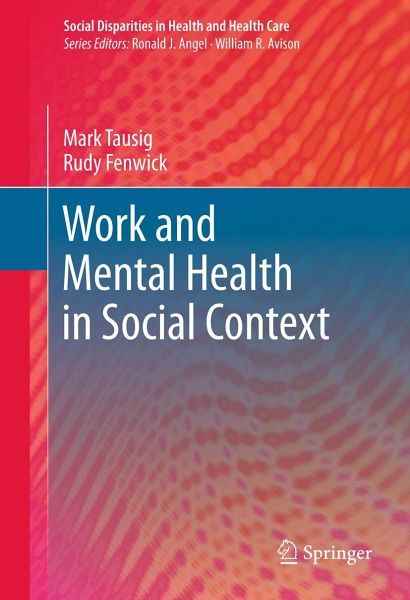
The authors of Work and Mental Health in Social Context take a different approach to understanding the causes of job stress. Job stress is systematically created by the characteristics of the jobs themselves: by the workers' occupation, the organizations in which they work, their placements in different labor markets, and by broader social, economic and institutional structures, processes and events. And disparities in job stress aresystematically determined in much the same way as are other disparities in health, income, and mobility opportunities.
In taking this approach, the authors draw on the observations and insights from a diverse field of sociological and economic theories and research. These go back to the nineteenth century writings of Marx, Weber and Durkheim on the relationship between work and well-being. They also include the more contemporary work in organizational sociology, structural labor market research from sociology and economics, research on unemployment and economic cycles, and research on institutional environments. This has allowed the authors to develop a unified framework that extends sociological models of income inequality and "status" attainment (or allocation) to the explanation of non-economic, health-related outcomes of work. Using a multi-level structural model, this timely and comprehensive volume explores what is stressful about work, and why; specifically address these and questions and more:
-What characteristics of jobs are the most stressful; what characteristics reduce stress?
-Why do work organizations structure some jobs to be highly stressful and some jobs to be much less stressful? Is work in a bureaucracy really more stressful?
-How is occupational "status" occupational "power" and "authority" related to the stressfulness of work?
-How does the "segmentation" of labor markets by occupation, industry, race, gender, and citizenship maintain disparities in job stress?
- Why is unemployment stressful to workers who don't lose their jobs?
-How do public policies on employment status, collective bargaining, overtime affect job stress?
-Is work in the current "Post (neo) Fordist" era of work more or less stressful than work during the "Fordist" era?
In addition to providing a new way to understand the sociological causes of job stress and mentalhealth, the model that the authors provide has broad applications to further study of this important area of research. This volume will be of key interest to sociologists and other researchers studying social stratification, public health, political economy, institutional and organizational theory.
Why are so many American workers so stressed out by their jobs? Many psychologists say stress is the result of a mismatch between the characteristics of a job and the personality of the worker. Many management consultants propose reducing stress by "redesigning" jobs and developing better individual strategies for "coping" with their stress. But, these explanations are not the whole story. They don't explain why some jobs and some occupations are more stressful than other jobs and occupations, regardless of the personalities and "coping strategies" of individual workers. Why do auto assembly line workers and air traffic controllers report more job stress than university professors, self-employed business owners, or corporate managers (yes, managers!)?
The authors of Work and Mental Health in Social Context take a different approach to understanding the causes of job stress. Job stress is systematically created by the characteristics of the jobs themselves: by the workers' occupation, the organizations in which they work, their placements in different labor markets, and by broader social, economic and institutional structures, processes and events. And disparities in job stress aresystematically determined in much the same way as are other disparities in health, income, and mobility opportunities.
In taking this approach, the authors draw on the observations and insights from a diverse field of sociological and economic theories and research. These go back to the nineteenth century writings of Marx, Weber and Durkheim on the relationship between work and well-being. They also include the more contemporary work in organizational sociology, structural labor market research from sociology and economics, research on unemployment and economic cycles, and research on institutional environments. This has allowed the authors to develop a unified framework that extends sociological models of income inequality and "status" attainment (or allocation) to the explanation of non-economic, health-related outcomes of work. Using a multi-level structural model, this timely and comprehensive volume explores what is stressful about work, and why; specifically address these and questions and more:
-What characteristics of jobs are the most stressful; what characteristics reduce stress?
-Why do work organizations structure some jobs to be highly stressful and some jobs to be much less stressful? Is work in a bureaucracy really more stressful?
-How is occupational "status" occupational "power" and "authority" related to the stressfulness of work?
-How does the "segmentation" of labor markets by occupation, industry, race, gender, and citizenship maintain disparities in job stress?
- Why is unemployment stressful to workers who don't lose their jobs?
-How do public policies on employment status, collective bargaining, overtime affect job stress?
-Is work in the current "Post (neo) Fordist" era of work more or less stressful than work during the "Fordist" era?
In addition to providing a new way to understand the sociological causes of job stress and mentalhealth, the model that the authors provide has broad applications to further study of this important area of research. This volume will be of key interest to sociologists and other researchers studying social stratification, public health, political economy, institutional and organizational theory.
Dieser Download kann aus rechtlichen Gründen nur mit Rechnungsadresse in A, B, BG, CY, CZ, D, DK, EW, E, FIN, F, GR, HR, H, IRL, I, LT, L, LR, M, NL, PL, P, R, S, SLO, SK ausgeliefert werden.