48,95 €
48,95 €
inkl. MwSt.
Sofort per Download lieferbar

24 °P sammeln
48,95 €
Als Download kaufen
48,95 €
inkl. MwSt.
Sofort per Download lieferbar
24 °P sammeln
Jetzt verschenken
Alle Infos zum eBook verschenken
48,95 €
inkl. MwSt.
Sofort per Download lieferbar
Alle Infos zum eBook verschenken
24 °P sammeln

Andere Kunden interessierten sich auch für
") The Trauma of Racism (eBook, ePUB)31,95 €
The Trauma of Racism (eBook, ePUB)31,95 €") Trans-generational Trauma and the Other (eBook, ePUB)37,95 €
Trans-generational Trauma and the Other (eBook, ePUB)37,95 €") Transgenerational Haunting in Psychoanalysis (eBook, ePUB)28,95 €
Transgenerational Haunting in Psychoanalysis (eBook, ePUB)28,95 €") Occultism and the Origins of Psychoanalysis (eBook, ePUB)31,95 €
Occultism and the Origins of Psychoanalysis (eBook, ePUB)31,95 €") The Psychological Effects of Immigrating (eBook, ePUB)32,95 €
The Psychological Effects of Immigrating (eBook, ePUB)32,95 €") Inquiries in Psychoanalysis: Collected papers of Edna O'Shaughnessy (eBook, ePUB)41,95 €
Inquiries in Psychoanalysis: Collected papers of Edna O'Shaughnessy (eBook, ePUB)41,95 €") On the History and Transmission of Lacanian Psychoanalysis (eBook, ePUB)33,95 €
On the History and Transmission of Lacanian Psychoanalysis (eBook, ePUB)33,95 €




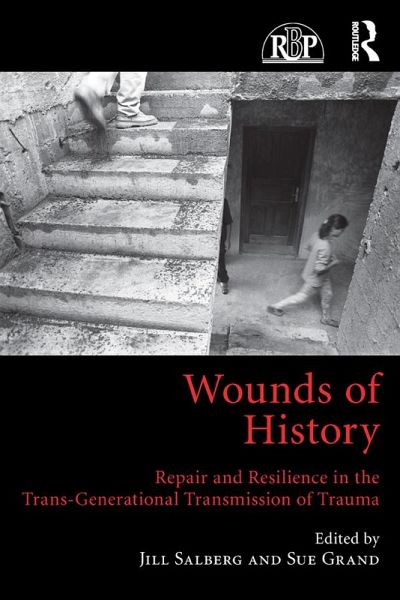
Wounds of History takes a new view in psychoanalysis using a trans-generational and social/political/cultural model looking at trauma and its transmission. The view is radical in looking beyond maternal dyads and Oedipal triangles and in its portrayal of a multi-generational world that is no longer hierarchical. This look allows for greater clinical creativity for conceptualizing and treating human suffering, situating healing in expanding circles of witnessing.
The contributors to this volume look at inherited personal trauma involving legacies of war, genocide, slavery, political persecution, forced migration/unwelcomed immigration and the way attachment and connection is disrupted, traumatized and ultimately longing for repair and reconnection.
The book addresses several themes such as the ethical/social turn in psychoanalysis; the repetition of resilience and wounds and the repair of these wounds; the complexity of attachment in the aftermath of trauma, and the move towards social justice. In their contributions, the authors remain close to the human stories.
Wounds of History will be of interest to psychoanalysts, psychologists and other mental health professionals, as well as students or teachers of trauma studies, Jewish and gender studies and studies of genocide.
The contributors to this volume look at inherited personal trauma involving legacies of war, genocide, slavery, political persecution, forced migration/unwelcomed immigration and the way attachment and connection is disrupted, traumatized and ultimately longing for repair and reconnection.
The book addresses several themes such as the ethical/social turn in psychoanalysis; the repetition of resilience and wounds and the repair of these wounds; the complexity of attachment in the aftermath of trauma, and the move towards social justice. In their contributions, the authors remain close to the human stories.
Wounds of History will be of interest to psychoanalysts, psychologists and other mental health professionals, as well as students or teachers of trauma studies, Jewish and gender studies and studies of genocide.
Dieser Download kann aus rechtlichen Gründen nur mit Rechnungsadresse in A, B, BG, CY, CZ, D, DK, EW, E, FIN, F, GR, HR, H, IRL, I, LT, L, LR, M, NL, PL, P, R, S, SLO, SK ausgeliefert werden.
"This is a rich collection of transnational and interdisciplinary case studies and analyses written by leading scholars in a key field. It should be read for years to come by all those interested in diagnosing and healing the wounds of history."-Ben Kiernan, A.Whitney Griswold Professor of History, founding Director, Genocide Studies Program, Yale University.
"The great contribution of this volume is to enlarge the way we think about family dynamics, so that it is something that happens within history, often histories of violence, and across multiple generations. The other great contribution is to look at the way the transmission of trauma across the generations actually works. Doing so reveals the closeness and strength that may be communicated, as well as the pain and alienation. In both respects this volume reflects the ethical turn in psychoanalysis."-C. Fred Alford, Professor of Government and Distinguished Scholar-Teacher, University of Maryland, and author of Trauma and Forgiveness.
"Wounds of History offers a set of profound meditations on the role of the engaged other - be it the singular witness or the responsive community - as a facilitator of transformation and resilience in the face of indifference to malignant destructiveness. The essays in this volume span multiple ethnicities and historical traumas, and demonstrate a deep concern with an ethic of social justice and individual therapeutics."-Sam Gerson, Ph.D., founder, past president, and training and supervising analyst at the Psychoanalysis Institute of Northern California.
"The great contribution of this volume is to enlarge the way we think about family dynamics, so that it is something that happens within history, often histories of violence, and across multiple generations. The other great contribution is to look at the way the transmission of trauma across the generations actually works. Doing so reveals the closeness and strength that may be communicated, as well as the pain and alienation. In both respects this volume reflects the ethical turn in psychoanalysis."-C. Fred Alford, Professor of Government and Distinguished Scholar-Teacher, University of Maryland, and author of Trauma and Forgiveness.
"Wounds of History offers a set of profound meditations on the role of the engaged other - be it the singular witness or the responsive community - as a facilitator of transformation and resilience in the face of indifference to malignant destructiveness. The essays in this volume span multiple ethnicities and historical traumas, and demonstrate a deep concern with an ethic of social justice and individual therapeutics."-Sam Gerson, Ph.D., founder, past president, and training and supervising analyst at the Psychoanalysis Institute of Northern California.