39,95 €
inkl. MwSt.
Sofort per Download lieferbar
20 °P sammeln

Andere Kunden interessierten sich auch für
") Writing a New Environmental Era (eBook, PDF)39,95 €
Writing a New Environmental Era (eBook, PDF)39,95 €") Quest for the Unity of Knowledge (eBook, ePUB)41,95 €
Quest for the Unity of Knowledge (eBook, ePUB)41,95 €") Global Ecologies and the Environmental Humanities (eBook, ePUB)49,95 €
Global Ecologies and the Environmental Humanities (eBook, ePUB)49,95 €") Routledge Handbook of Ecocriticism and Environmental Communication (eBook, ePUB)50,95 €
Routledge Handbook of Ecocriticism and Environmental Communication (eBook, ePUB)50,95 €") Environmental Humanities and the Uncanny (eBook, ePUB)44,95 €
Environmental Humanities and the Uncanny (eBook, ePUB)44,95 €") Transdisciplinary Journeys in the Anthropocene (eBook, ePUB)48,95 €
Transdisciplinary Journeys in the Anthropocene (eBook, ePUB)48,95 €") World Literature Decentered (eBook, ePUB)46,95 €
World Literature Decentered (eBook, ePUB)46,95 €



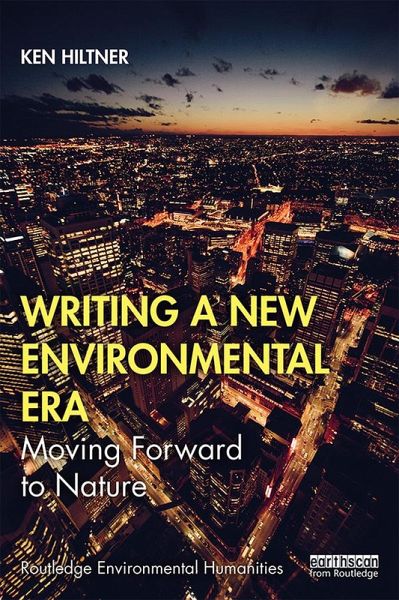
Writing a New Environmental Era first considers and then rejects back-to-nature thinking and its proponents like Henry David Thoreau, arguing that human beings have never lived at peace with nature. Consequently, we need to stop thinking about going back to what never was and instead work at moving forward to forge a more harmonious relationship with nature in the future. Using the rise of the automobile and climate change denial literature to explore how our current environmental era was written into existence, Ken Hiltner argues that the humanities-and not, as might be expected, the sciences-need to lead us there.
In one sense, climate change is caused by a rise in atmospheric CO2 and other so-called greenhouse gases. Science can address this cause. However, approached in another way altogether, climate change is caused by a range of troubling human activities that require the release of these gases, such as our obsessions with cars, lavish houses, air travel and endless consumer goods. The natural sciences may be able to tell us how these activities are changing our climate, but not why we are engaging in them. That's a job for the humanities and social sciences. As this book argues, we need to see anthropogenic (i.e. human-caused) climate change for what it is and address it as such: a human problem brought about by human actions.
A passionate and personal exploration of why the Environmental Humanities matter and why we should be looking forward, not back to nature, this book will be essential reading for all those interested in the future and sustainability of our planet.
In one sense, climate change is caused by a rise in atmospheric CO2 and other so-called greenhouse gases. Science can address this cause. However, approached in another way altogether, climate change is caused by a range of troubling human activities that require the release of these gases, such as our obsessions with cars, lavish houses, air travel and endless consumer goods. The natural sciences may be able to tell us how these activities are changing our climate, but not why we are engaging in them. That's a job for the humanities and social sciences. As this book argues, we need to see anthropogenic (i.e. human-caused) climate change for what it is and address it as such: a human problem brought about by human actions.
A passionate and personal exploration of why the Environmental Humanities matter and why we should be looking forward, not back to nature, this book will be essential reading for all those interested in the future and sustainability of our planet.
Dieser Download kann aus rechtlichen Gründen nur mit Rechnungsadresse in A, B, BG, CY, CZ, D, DK, EW, E, FIN, F, GR, HR, H, IRL, I, LT, L, LR, M, NL, PL, P, R, S, SLO, SK ausgeliefert werden.
"Hiltner agrees that humanities scholars need to use skills we have honed over decades for critical thinking and social responsibility to contribute to "writing forward to nature", in a way that will mitigate the disaster that's waiting. Hiltner has provided a model for others to follow. This is an important book, lucidly written, showing clear thinking; it's a must-read, and should be widely disseminated."
E. Ann Kaplan, Distinguished Professor, Stony Brook University
"At once visionary and pragmatic, this eye-opening book argues for an "applied humanities": science-informed, tech-savvy, and fully equipped to write the greenest possible future into being. Using his own experiment -- the "Nearly Carbon Neutral" conference -- as a test case, Ken Hiltner shows that climate action is the work of every humanities scholar."
Wai Chee Dimock, Yale University
"In this engaging and tightly argued book, environmental humanities scholar Ken Hiltner shows that the solution to our present environmental crises is not a return to some pristine and harmonious natural world. Thoreau's famous retreat on Walden Pond, Hiltner reminds us, was only a short journey away from the textile mills of Lowell. If the pastoral idyll was never more than a convenient fiction, today we face an urgent imperative, as Hiltner puts it, to "move forward" to nature. The environmental humanities can play a key role in this movement, Hiltner suggests, inasmuch as they can help us write the future into being. Blending personal memoir, whip-smart literary criticism, and some extremely forward-thinking suggestions about how to green academia, Hiltner's book models what committed scholarship for our perilous times looks like."
Ashley Dawson, Professor of English, The Graduate Center & College of Staten Island, The City University of New York
"A provocative exploration of how we understand humanity's relationship with nature and a call to write our way not to a romanticized Edenic past, but to a truly sustainable future."
Erik Assadourian, Senior Fellow, Worldwatch Institute
"In an era of accelerating climate breakdown and mass extinction, Hiltner convincingly argues that the environmental movement must take a step back and question its most fundamental assumptions concerning humanity's relationship with nature, culture, and technology."
Peter Kalmus, Climate Scientist, NASA's Jet Propulsion Laboratory
E. Ann Kaplan, Distinguished Professor, Stony Brook University
"At once visionary and pragmatic, this eye-opening book argues for an "applied humanities": science-informed, tech-savvy, and fully equipped to write the greenest possible future into being. Using his own experiment -- the "Nearly Carbon Neutral" conference -- as a test case, Ken Hiltner shows that climate action is the work of every humanities scholar."
Wai Chee Dimock, Yale University
"In this engaging and tightly argued book, environmental humanities scholar Ken Hiltner shows that the solution to our present environmental crises is not a return to some pristine and harmonious natural world. Thoreau's famous retreat on Walden Pond, Hiltner reminds us, was only a short journey away from the textile mills of Lowell. If the pastoral idyll was never more than a convenient fiction, today we face an urgent imperative, as Hiltner puts it, to "move forward" to nature. The environmental humanities can play a key role in this movement, Hiltner suggests, inasmuch as they can help us write the future into being. Blending personal memoir, whip-smart literary criticism, and some extremely forward-thinking suggestions about how to green academia, Hiltner's book models what committed scholarship for our perilous times looks like."
Ashley Dawson, Professor of English, The Graduate Center & College of Staten Island, The City University of New York
"A provocative exploration of how we understand humanity's relationship with nature and a call to write our way not to a romanticized Edenic past, but to a truly sustainable future."
Erik Assadourian, Senior Fellow, Worldwatch Institute
"In an era of accelerating climate breakdown and mass extinction, Hiltner convincingly argues that the environmental movement must take a step back and question its most fundamental assumptions concerning humanity's relationship with nature, culture, and technology."
Peter Kalmus, Climate Scientist, NASA's Jet Propulsion Laboratory