43,95 €
inkl. MwSt.
Sofort per Download lieferbar
22 °P sammeln

Andere Kunden interessierten sich auch für
") Yoga in Modern Hinduism (eBook, PDF)43,95 €
Yoga in Modern Hinduism (eBook, PDF)43,95 €") Religion and the Subtle Body in Asia and the West (eBook, ePUB)45,95 €
Religion and the Subtle Body in Asia and the West (eBook, ePUB)45,95 €") Tradition and Liberation (eBook, ePUB)42,95 €
Tradition and Liberation (eBook, ePUB)42,95 €") Samkara's Advaita Vedanta (eBook, ePUB)55,95 €
Samkara's Advaita Vedanta (eBook, ePUB)55,95 €") Hinduism in Modern Indonesia (eBook, ePUB)39,95 €
Hinduism in Modern Indonesia (eBook, ePUB)39,95 €") A Popular Dictionary of Hinduism (eBook, ePUB)0,00 €
A Popular Dictionary of Hinduism (eBook, ePUB)0,00 € (eBook, ePUB)") Revival: Caste in India (1930) (eBook, ePUB)49,95 €
Revival: Caste in India (1930) (eBook, ePUB)49,95 €
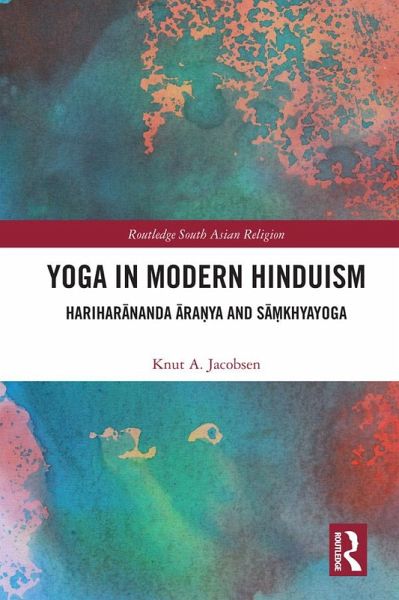
The Säkhyayoga institution of Kapil Mäh is a religious organisation with a small tradition of followers which emerged in the last decade of the nineteenth century and the first decades of the twentieth century in Bengal in India around the renunciant and yogin Hariharananda Aräya. This tradition developed during the same period in which modern yoga was born and forms a chapter in the expansion of yoga traditions in modern Hinduism.
The book analyses the yoga teaching of Hariharananda Aräya (1869-1947) and the Kapil Mäh tradition, its origin, history and contemporary manifestations, and this tradition's connection to the expansion of yoga and the Yogasutra in modern Hinduism. The Säkhyayoga of the Kapil Mäh tradition is based on the Patañjalayogasastra, on a number of texts in Sanskrit and Bengali written by their gurus, and on the lifestyle of the renunciant yogin living isolated in a cave. The book investigates Hariharananda Aräya's connection to pre-modern yoga traditions and the impact of modern production and transmission of knowledge on his interpretations of yoga. The book connects the Kapil Mäh tradition to the nineteenth century transformations of Bengali religious culture of the educated upper class that led to the production of a new type of yogin. The book analyses Säkhyayoga as a living tradition, its current teachings and practices, and looks at what Säkhyayogins do and what Säkhyayoga is as a yoga practice.
A valuable contribution to recent and ongoing debates, this book will be of interest to academics in the fields of Religious Studies, Anthropology, Asian Studies, Indology, Indian philosophy, Hindu Studies and Yoga Studies.
The book analyses the yoga teaching of Hariharananda Aräya (1869-1947) and the Kapil Mäh tradition, its origin, history and contemporary manifestations, and this tradition's connection to the expansion of yoga and the Yogasutra in modern Hinduism. The Säkhyayoga of the Kapil Mäh tradition is based on the Patañjalayogasastra, on a number of texts in Sanskrit and Bengali written by their gurus, and on the lifestyle of the renunciant yogin living isolated in a cave. The book investigates Hariharananda Aräya's connection to pre-modern yoga traditions and the impact of modern production and transmission of knowledge on his interpretations of yoga. The book connects the Kapil Mäh tradition to the nineteenth century transformations of Bengali religious culture of the educated upper class that led to the production of a new type of yogin. The book analyses Säkhyayoga as a living tradition, its current teachings and practices, and looks at what Säkhyayogins do and what Säkhyayoga is as a yoga practice.
A valuable contribution to recent and ongoing debates, this book will be of interest to academics in the fields of Religious Studies, Anthropology, Asian Studies, Indology, Indian philosophy, Hindu Studies and Yoga Studies.
Dieser Download kann aus rechtlichen Gründen nur mit Rechnungsadresse in A, B, BG, CY, CZ, D, DK, EW, E, FIN, F, GR, HR, H, IRL, I, LT, L, LR, M, NL, PL, P, R, S, SLO, SK ausgeliefert werden.