0,99 €
0,99 €
inkl. MwSt.
Erscheint vorauss. 24. Januar 2026

0 °P sammeln
0,99 €
Als Download kaufen
0,99 €
inkl. MwSt.
Erscheint vorauss. 24. Januar 2026
0 °P sammeln
Jetzt verschenken
Alle Infos zum verschenken
0,99 €
inkl. MwSt.
Erscheint vorauss. 24. Januar 2026
Alle Infos zum verschenken
0 °P sammeln
Andere Kunden interessierten sich auch für
") Pan's Labyrinth (MP3-Download)14,99 €
Pan's Labyrinth (MP3-Download)14,99 €") Reprieve (MP3-Download)9,99 €
Reprieve (MP3-Download)9,99 €") The Gold-Bug (MP3-Download)2,99 €
The Gold-Bug (MP3-Download)2,99 €") Dream Girl (MP3-Download)24,99 €
Dream Girl (MP3-Download)24,99 €") Ligeia (MP3-Download)4,99 €
Ligeia (MP3-Download)4,99 €") Zakulise. Zagovor bezlikih (MP3-Download)7,49 €
Zakulise. Zagovor bezlikih (MP3-Download)7,49 €") Mama kukol (MP3-Download)8,49 €
Mama kukol (MP3-Download)8,49 €





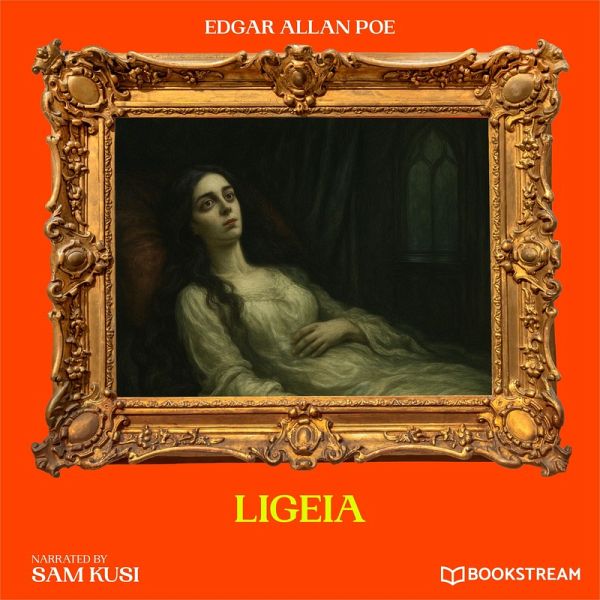
"Ligeia" is an early short story by American writer Edgar Allan Poe, first published in 1838. The story follows an unnamed narrator and his wife Ligeia, a beautiful and intelligent raven-haired woman. She falls ill, composes "The Conqueror Worm", and quotes lines attributed to Joseph Glanvill (which suggest that life is sustainable only through willpower) shortly before dying. After her death, the narrator marries the Lady Rowena. Rowena becomes ill, and she dies as well. The distraught narrator stays with her body overnight and watches as Rowena slowly comes back from the dead – though she has transformed into Ligeia. The story may be the narrator's opium-induced hallucination, and there is debate whether the story was a satire. After the story's first publication in The American Museum, it was heavily revised and reprinted throughout Poe's life. The story is told by an unnamed narrator who describes the qualities of Ligeia: a beautiful, passionate and intellectual woman, raven-haired and dark-eyed. He thinks he remembers meeting her "in some large, old decaying city near the Rhine." He is unable to recall anything about the history of Ligeia, including her family's name, but remembers her beautiful appearance.
Dieser Download kann aus rechtlichen Gründen nur mit Rechnungsadresse in A, D ausgeliefert werden.
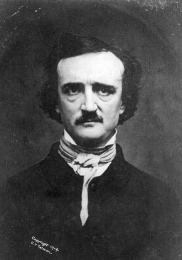
Edgar Allan Poe was an American writer often credited with inventing the detective fiction genre. Born to two poor actors in 1809, Poe was orphaned by age two as his father left in 1810 and his mother died the following year. Edgar Poe was taken in by a wealthy family-John and Francis Allan-though he was never formally adopted. Poe's desire to be a poet and writer eventually ended his relationship with John Allan and contributed to his lifelong struggle to find acceptance and financial stability.Widely considered to be one of the most influential writers of the 19th century, Poe redefined many aspects of horror, science fiction, and mystery writing, especially with his introduction of the first written fictional detective character, C. Augustine Dupin, bestowing Poe with the title: "The Father of Detective Fiction." In fact, many of the first readers of Poe's detective stories were under the impression that Poe's detective stories were nonfiction news articles because the analytical procession of this fictional genre was so unfamiliar.It is not known exactly what caused Poe's premature death at the age of 40 in 1849, though his impact on the literary world is undeniable.