The Allegory of the Cave, or Plato's Cave, was presented by the Greek philosopher Plato in his work Republic (514a–520a) to compare "the effect of education (παιδεία) and the lack of it on our nature". It is written as a dialogue between Plato's brother Glaucon and his mentor Socrates, narrated by the latter. The allegory is presented after the analogy of the sun (508b–509c) and the analogy of the divided line (509d–511e). All three are characterized in relation to dialectic at the end of Books VII and VIII (531d–534e). Plato has Socrates describe a group of people who have lived…mehr
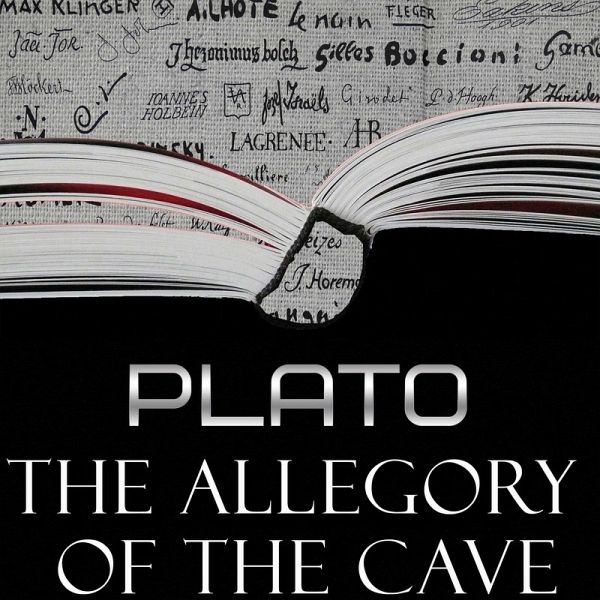
The Allegory of the Cave, or Plato's Cave, was presented by the Greek philosopher Plato in his work Republic (514a–520a) to compare "the effect of education (παιδεία) and the lack of it on our nature". It is written as a dialogue between Plato's brother Glaucon and his mentor Socrates, narrated by the latter. The allegory is presented after the analogy of the sun (508b–509c) and the analogy of the divided line (509d–511e). All three are characterized in relation to dialectic at the end of Books VII and VIII (531d–534e). Plato has Socrates describe a group of people who have lived chained to the wall of a cave all of their lives, facing a blank wall. The people watch shadows projected on the wall from objects passing in front of a fire behind them, and give names to these shadows. The shadows are the prisoners' reality.
Dieser Download kann aus rechtlichen Gründen nur mit Rechnungsadresse in A, D ausgeliefert werden.
Die Herstellerinformationen sind derzeit nicht verfügbar.
Autorenporträt
Plato (428/27-348/47 bce) Plato was an Athenian philosopher from the Classical Period in Ancient Greece. He grew up during the Peloponnesian War (431-404 bce), and came of age around the time of Athens' final defeat and the turmoil that followed. He was a close associate of the great Greek philosopher Socrates, who is considered to be the founder of Western philosophy; he was later condemned to death. The Socratic method of dialogue and debate are extensively found in Plato's works. He wrote approximately 35 dialogues with Socrates as a character in order to bring out the ideas and beliefs of his teacher. Two of his notable works are Apologia, which recounts Socrates' trial, and Phaedo, a dialogue that chronicles the conversations on the day that Socrates was put to death. Following the execution of Socrates, Plato travelled to Egypt, Sicily, and Italy. He studied and contributed to philosophy, mathematics, and science. Upon his return to Athens, he founded the Academy-the first institution of higher learning in the West. The institute focused on research around philosophy and science. One of the famous students at Plato's Academy was Aristotle, who went on to challenge some of Plato's views on literature and poetry.
Es gelten unsere Allgemeinen Geschäftsbedingungen: www.buecher.de/agb
Impressum
www.buecher.de ist ein Internetauftritt der buecher.de internetstores GmbH
Geschäftsführung: Monica Sawhney | Roland Kölbl | Günter Hilger
Sitz der Gesellschaft: Batheyer Straße 115 - 117, 58099 Hagen
Postanschrift: Bürgermeister-Wegele-Str. 12, 86167 Augsburg
Amtsgericht Hagen HRB 13257
Steuernummer: 321/5800/1497
USt-IdNr: DE450055826