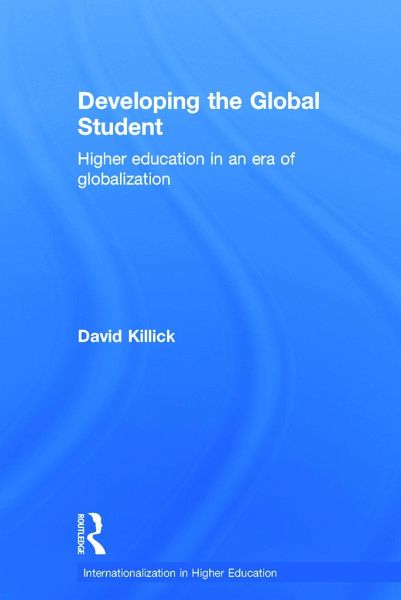
Developing the Global Student addresses the question of how students of higher education can emerge from their university life better equipped to dwell more effectively, ethically, and comfortably amidst the turmoils of a globalising world.
Developing the Global Student addresses the question of how students of higher education can emerge from their university life better equipped to dwell more effectively, ethically, and comfortably amidst the turmoils of a globalising world.
David Killick is Head of Academic Staff Development at Leeds Metropolitan University, UK, and has worked on institutional internationalization initiatives for several years.
Inhaltsangabe
Glossary Introduction Chapter One Questions of Context INTRODUCTION 1 Global Contexts 2 Conceptions of Higher Education 3 Education for Citizenship, Social Justice, and a Better World? 4 Internationalization 5 Internationalization of the Curriculum 6 The Global Self Chapter Two Questions of Alterity INTRODUCTION 1 Social Consequences of Globalization 2 Social Identity and Ethnocentrism 3 Intercultural Competence & Communication 4 Contact & Conflict thoeries Chapter Three Questions of the Lifeworld INTRODUCTION 1 A Model of the Lifeworld 2 The Habitus and the Ready to hand 3 Capital, Capability & Agency 4 Cultural Icebergs 5 Schemata, Scripts and Types 6 Attitudes & Heuristics Chapter Four Questions of Learning INTRODUCTION 1 (Re)forming the Lifeworld 2 Holistic Learning 3 Learning Triggers 4 Situated Learning & Communities of Practice 5 Learning Stages Chapter Five Questions of Practice INTRODUCTION 1 Shaping the Environment: Inclusivity and The Hidden Curriculum 2 Shaping the Curriculum: Content and Outcomes 3 Shaping the Delivery: Learning Experiences and Communities 4 Shaping Broader Institutional Practice Endword Appendix 1 Selected resources and Links to Support Practice Bibliography
Glossary Introduction Chapter One Questions of Context INTRODUCTION 1 Global Contexts 2 Conceptions of Higher Education 3 Education for Citizenship, Social Justice, and a Better World? 4 Internationalization 5 Internationalization of the Curriculum 6 The Global Self Chapter Two Questions of Alterity INTRODUCTION 1 Social Consequences of Globalization 2 Social Identity and Ethnocentrism 3 Intercultural Competence & Communication 4 Contact & Conflict thoeries Chapter Three Questions of the Lifeworld INTRODUCTION 1 A Model of the Lifeworld 2 The Habitus and the Ready to hand 3 Capital, Capability & Agency 4 Cultural Icebergs 5 Schemata, Scripts and Types 6 Attitudes & Heuristics Chapter Four Questions of Learning INTRODUCTION 1 (Re)forming the Lifeworld 2 Holistic Learning 3 Learning Triggers 4 Situated Learning & Communities of Practice 5 Learning Stages Chapter Five Questions of Practice INTRODUCTION 1 Shaping the Environment: Inclusivity and The Hidden Curriculum 2 Shaping the Curriculum: Content and Outcomes 3 Shaping the Delivery: Learning Experiences and Communities 4 Shaping Broader Institutional Practice Endword Appendix 1 Selected resources and Links to Support Practice Bibliography
Es gelten unsere Allgemeinen Geschäftsbedingungen: www.buecher.de/agb
Impressum
www.buecher.de ist ein Internetauftritt der buecher.de internetstores GmbH
Geschäftsführung: Monica Sawhney | Roland Kölbl | Günter Hilger
Sitz der Gesellschaft: Batheyer Straße 115 - 117, 58099 Hagen
Postanschrift: Bürgermeister-Wegele-Str. 12, 86167 Augsburg
Amtsgericht Hagen HRB 13257
Steuernummer: 321/5800/1497
USt-IdNr: DE450055826