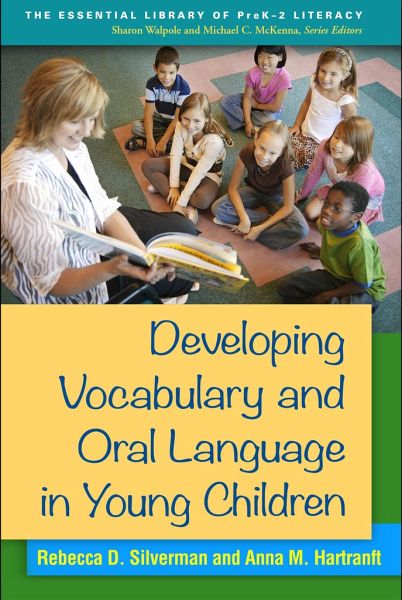
This book presents the most effective instructional strategies for promoting vocabulary growth in the early grades, when the interdependence of word learning and oral language development is especially strong.
This book presents the most effective instructional strategies for promoting vocabulary growth in the early grades, when the interdependence of word learning and oral language development is especially strong.
Rebecca D. Silverman, EdD, is the Judy Koch Professor of Education in the Graduate School of Education at Stanford University. A former elementary school teacher, Dr. Silverman's research focuses on language and literacy development and instruction in early childhood and elementary school. In particular, her work has contributed to the research base on supporting vocabulary and other aspects of language that are critical to reading and writing, and using multimedia and educational technology to facilitate literacy. At Stanford, Dr. Silverman leads the Language to Literacy Research Lab and teaches in the Stanford Teacher Education Program. She also engages in research-practice partnerships with school districts and provides professional development to teachers. Widely published in education journals, she has served on the board of directors of the International Literacy Association and is Editor-in-Chief of Elementary School Journal. Her website is https://langlitlab.stanford.edu. Anna M. Hartranft, MEd,is Faculty Research Associate in the Department of Counseling, Higher Education, and Special Education at the University of Maryland, where she also serves as Project Director for the Reading Buddies Research Project. Her research focuses on the instruction and inclusion of students with disabilities and their peers in the areas of reading and writing. She has managed locally and federally funded projects, contributed to presentations at national conferences, and coauthored publications in journals such as Reading Research Quarterly and the Elementary School Journal.
Inhaltsangabe
1. The Importance of Vocabulary Breadth and Depth 2. Principles of Effective Vocabulary Instruction 3. Explicit and Extended Vocabulary Instruction 4. Word Learning and Word Use in a Language Rich Environment 5. Word Awareness and Independent Word Learning 6. Assessing Vocabulary Knowledge 7. Differentiating Vocabulary Instruction 8. Using Multimedia to Support Word Learning in the Digital Age 9. HomeâEUR"School Connections to Support Word Learning 10. Implementing Vocabulary Instruction in Prekindergarten through Second-Grade Classrooms Appendix. Resources for Vocabulary Instruction
1. The Importance of Vocabulary Breadth and Depth 2. Principles of Effective Vocabulary Instruction 3. Explicit and Extended Vocabulary Instruction 4. Word Learning and Word Use in a Language Rich Environment 5. Word Awareness and Independent Word Learning 6. Assessing Vocabulary Knowledge 7. Differentiating Vocabulary Instruction 8. Using Multimedia to Support Word Learning in the Digital Age 9. HomeâEUR"School Connections to Support Word Learning 10. Implementing Vocabulary Instruction in Prekindergarten through Second-Grade Classrooms Appendix. Resources for Vocabulary Instruction
Es gelten unsere Allgemeinen Geschäftsbedingungen: www.buecher.de/agb
Impressum
www.buecher.de ist ein Internetauftritt der buecher.de internetstores GmbH
Geschäftsführung: Monica Sawhney | Roland Kölbl | Günter Hilger
Sitz der Gesellschaft: Batheyer Straße 115 - 117, 58099 Hagen
Postanschrift: Bürgermeister-Wegele-Str. 12, 86167 Augsburg
Amtsgericht Hagen HRB 13257
Steuernummer: 321/5800/1497
USt-IdNr: DE450055826