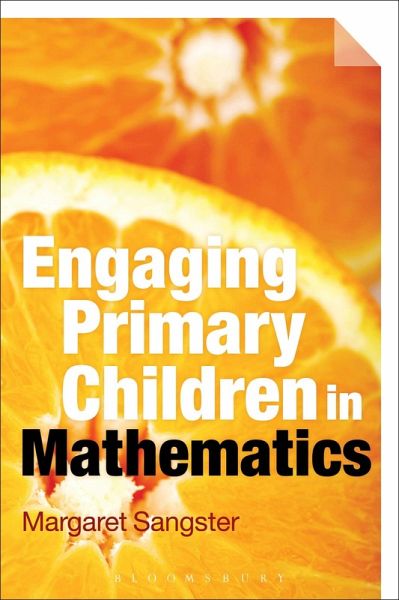
Effective teaching is a combination of technical skills and knowledge but good teachers also need to understand how children learn and how they can most effectively be taught. Engaging Primary Children in Mathematics explores the various strategies for engaging children in mathematical learning in the light of theory and practice and is designed to talk straight to the teacher/student about their classroom approach to the teaching of primary mathematics. The importance of creating a learning environment in which children can learn to be young mathematicians, where they can explore, create and…mehr
Effective teaching is a combination of technical skills and knowledge but good teachers also need to understand how children learn and how they can most effectively be taught. Engaging Primary Children in Mathematics explores the various strategies for engaging children in mathematical learning in the light of theory and practice and is designed to talk straight to the teacher/student about their classroom approach to the teaching of primary mathematics. The importance of creating a learning environment in which children can learn to be young mathematicians, where they can explore, create and solve problems, cannot be underestimated. Margaret Sangster explores how students and practitioners can develop their practice by reviewing a range of approaches to the teaching of mathematics and the development of those young mathematicians, with examples of thought-provoking activities to inform their own practice.
Introduction Part I How Children Learn Primary Mathematics 1 Constructing Mathematical Knowledge The neurological story Is there an innate ability to learn mathematics? Effective learning of mathematics 2 Recalling and Transferring Mathematical Knowledge How can we help children recall and apply knowledge in new situations? Transfer (and generalization) 3 Desirable Outcomes and Motivations External pressures Motivation Engaging children in mathematics 4 Independent Mathematicians What do we mean by independence? Part II The Development of the Primary Mathematics Curriculum 5 The Map of Mathematics Progression through topics A lack of progression Connections across mathematical topics The curriculum is the content - the maths to be taught 6 Young Children Learning Mathematics Do babies have an innate ability to understand mathematics? Significant aspects of early mathematics learning 7 The Role of Mental Mathematics and Its Relationship to Calculation Confidence, rehearsal and flexibility Transition to written calculations 8 Approaches to Numerical Calculation Early number The numbers in-between 9 Mathematics in Context Measures Data handling Ratio and proportion Part III Four Key Issues in Learning Primary Mathematics 10 The Role of the Calculator Questions often arising from calculator use 11 Children Solving Mathematical Problems Simple word problems - calculations with words Why is problem solving generally so difficult? Possible ways forward Prompts to assist solving problems 12 Difficult and Easy Learning, unlearning and relearning The nature of misconception Difficult mathematics Mathematically high attaining children? 13 Relationships, Patterns and Generalization Relationships Patterns Pattern-seeking skills Generalizing Part IV The Teacher's Influence on Children Learning Primary Mathematics 14 The Nature of Mathematical Knowledge for Teaching Teacher beliefs Self-concept and confidence 15 Creating a Good Learning Environment Teacher input Resources and displays Other environments Task type Working with others 16 Teaching Style School structures Structure of the lesson Ways of teaching Task type 17 The Role of Questioning in Enhancing Mathematical Learning Applying questioning strategies to stages of a lesson 18 Planning for Progress Children's progress and achievement Long-, medium- and short-term planning The shape of the lesson Measuring progress Creating a classroom where formative assessment can take place 19 Other Factors Influencing the Teaching of Mathematics National and international league tables The role of government in promoting primary school mathematics Teacher training Cultural and societal expectation The curriculum Social factors 20 A Teacher's Voice Index
Introduction Part I How Children Learn Primary Mathematics 1 Constructing Mathematical Knowledge The neurological story Is there an innate ability to learn mathematics? Effective learning of mathematics 2 Recalling and Transferring Mathematical Knowledge How can we help children recall and apply knowledge in new situations? Transfer (and generalization) 3 Desirable Outcomes and Motivations External pressures Motivation Engaging children in mathematics 4 Independent Mathematicians What do we mean by independence? Part II The Development of the Primary Mathematics Curriculum 5 The Map of Mathematics Progression through topics A lack of progression Connections across mathematical topics The curriculum is the content - the maths to be taught 6 Young Children Learning Mathematics Do babies have an innate ability to understand mathematics? Significant aspects of early mathematics learning 7 The Role of Mental Mathematics and Its Relationship to Calculation Confidence, rehearsal and flexibility Transition to written calculations 8 Approaches to Numerical Calculation Early number The numbers in-between 9 Mathematics in Context Measures Data handling Ratio and proportion Part III Four Key Issues in Learning Primary Mathematics 10 The Role of the Calculator Questions often arising from calculator use 11 Children Solving Mathematical Problems Simple word problems - calculations with words Why is problem solving generally so difficult? Possible ways forward Prompts to assist solving problems 12 Difficult and Easy Learning, unlearning and relearning The nature of misconception Difficult mathematics Mathematically high attaining children? 13 Relationships, Patterns and Generalization Relationships Patterns Pattern-seeking skills Generalizing Part IV The Teacher's Influence on Children Learning Primary Mathematics 14 The Nature of Mathematical Knowledge for Teaching Teacher beliefs Self-concept and confidence 15 Creating a Good Learning Environment Teacher input Resources and displays Other environments Task type Working with others 16 Teaching Style School structures Structure of the lesson Ways of teaching Task type 17 The Role of Questioning in Enhancing Mathematical Learning Applying questioning strategies to stages of a lesson 18 Planning for Progress Children's progress and achievement Long-, medium- and short-term planning The shape of the lesson Measuring progress Creating a classroom where formative assessment can take place 19 Other Factors Influencing the Teaching of Mathematics National and international league tables The role of government in promoting primary school mathematics Teacher training Cultural and societal expectation The curriculum Social factors 20 A Teacher's Voice Index
Es gelten unsere Allgemeinen Geschäftsbedingungen: www.buecher.de/agb
Impressum
www.buecher.de ist ein Internetauftritt der buecher.de internetstores GmbH
Geschäftsführung: Monica Sawhney | Roland Kölbl | Günter Hilger
Sitz der Gesellschaft: Batheyer Straße 115 - 117, 58099 Hagen
Postanschrift: Bürgermeister-Wegele-Str. 12, 86167 Augsburg
Amtsgericht Hagen HRB 13257
Steuernummer: 321/5800/1497
USt-IdNr: DE450055826