- Broschiertes Buch
- Merkliste
- Auf die Merkliste
- Bewerten Bewerten
- Teilen
- Produkt teilen
- Produkterinnerung
- Produkterinnerung
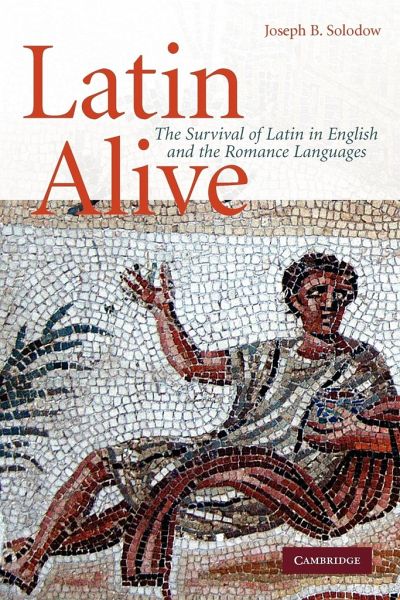
Subtitled, "The Survival Of Latin In English & Romance Languages".
Andere Kunden interessierten sich auch für
Keith SidwellReading Latin30,99 €
Eleanor DickeyLearning Latin the Ancient Way89,99 €
Peter MatthewsInflectional Morphology48,99 €
Maurice PlatnauerLatin Elegiac Verse33,99 €
Early and Late Latin144,99 €
Norma GoldmanLatin Via Ovid42,99 €
William Ernest LinneyGetting Started with Latin21,99 €-
-
-
Produktdetails
- Produktdetails
- Verlag: Cambridge University Press
- Seitenzahl: 370
- Erscheinungstermin: 1. Januar 2010
- Englisch
- Abmessung: 229mm x 152mm x 22mm
- Gewicht: 600g
- ISBN-13: 9780521734189
- ISBN-10: 0521734185
- Artikelnr.: 28177035
- Herstellerkennzeichnung
- Libri GmbH
- Europaallee 1
- 36244 Bad Hersfeld
- gpsr@libri.de
- Verlag: Cambridge University Press
- Seitenzahl: 370
- Erscheinungstermin: 1. Januar 2010
- Englisch
- Abmessung: 229mm x 152mm x 22mm
- Gewicht: 600g
- ISBN-13: 9780521734189
- ISBN-10: 0521734185
- Artikelnr.: 28177035
- Herstellerkennzeichnung
- Libri GmbH
- Europaallee 1
- 36244 Bad Hersfeld
- gpsr@libri.de
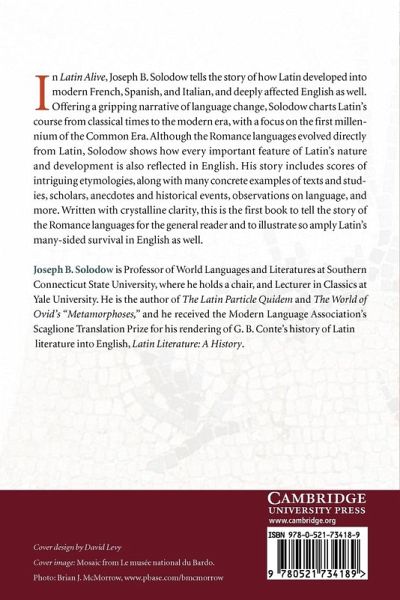
Joseph Solodow is Professor of Foreign Languages at Southern Connecticut State University and Lecturer in Classics at Yale University. The author of The Latin Particle Quidem and The World of Ovid's 'Metmorphoses', he received the Modern Language Association's Scaglione Translation Prize for his rendering of G. B. Conte's history of Latin literature into English, Latin Literature: A History.
1. Introduction: is English a cousin to the Romance languages?
Part I. Latin: 2. The career of Latin, I: from earliest times to the height of empire
3. The career of Latin, II: the empire succeeded by barbarian kingdoms
4. Latin at work, I: nature of the language
names and qualities
pronunciation
5. Latin at work, II: actions and states
6. Vulgar Latin
Part II. The Romance Vocabulary: 7. The lexicon in general
shifts in the meaning of words
8. Changes in the form of words
9. When words collide: conflict and resolution in the lexicon
10. Immigrants: non-Latin words in the Romance languages
Part III. Proto-Romance, or What the Languages Share: 11. The sound of proto-Romance
12. The noun in proto-Romance
13. The verb in proto-Romance
Part IV. Earliest Texts and Future Directions, or Where the Languages Diverge: 14. French
15. Italian
16. Spanish.

Part I. Latin: 2. The career of Latin, I: from earliest times to the height of empire
3. The career of Latin, II: the empire succeeded by barbarian kingdoms
4. Latin at work, I: nature of the language
names and qualities
pronunciation
5. Latin at work, II: actions and states
6. Vulgar Latin
Part II. The Romance Vocabulary: 7. The lexicon in general
shifts in the meaning of words
8. Changes in the form of words
9. When words collide: conflict and resolution in the lexicon
10. Immigrants: non-Latin words in the Romance languages
Part III. Proto-Romance, or What the Languages Share: 11. The sound of proto-Romance
12. The noun in proto-Romance
13. The verb in proto-Romance
Part IV. Earliest Texts and Future Directions, or Where the Languages Diverge: 14. French
15. Italian
16. Spanish.
1. Introduction: is English a cousin to the Romance languages?
Part I. Latin: 2. The career of Latin, I: from earliest times to the height of empire
3. The career of Latin, II: the empire succeeded by barbarian kingdoms
4. Latin at work, I: nature of the language
names and qualities
pronunciation
5. Latin at work, II: actions and states
6. Vulgar Latin
Part II. The Romance Vocabulary: 7. The lexicon in general
shifts in the meaning of words
8. Changes in the form of words
9. When words collide: conflict and resolution in the lexicon
10. Immigrants: non-Latin words in the Romance languages
Part III. Proto-Romance, or What the Languages Share: 11. The sound of proto-Romance
12. The noun in proto-Romance
13. The verb in proto-Romance
Part IV. Earliest Texts and Future Directions, or Where the Languages Diverge: 14. French
15. Italian
16. Spanish.
Part I. Latin: 2. The career of Latin, I: from earliest times to the height of empire
3. The career of Latin, II: the empire succeeded by barbarian kingdoms
4. Latin at work, I: nature of the language
names and qualities
pronunciation
5. Latin at work, II: actions and states
6. Vulgar Latin
Part II. The Romance Vocabulary: 7. The lexicon in general
shifts in the meaning of words
8. Changes in the form of words
9. When words collide: conflict and resolution in the lexicon
10. Immigrants: non-Latin words in the Romance languages
Part III. Proto-Romance, or What the Languages Share: 11. The sound of proto-Romance
12. The noun in proto-Romance
13. The verb in proto-Romance
Part IV. Earliest Texts and Future Directions, or Where the Languages Diverge: 14. French
15. Italian
16. Spanish.