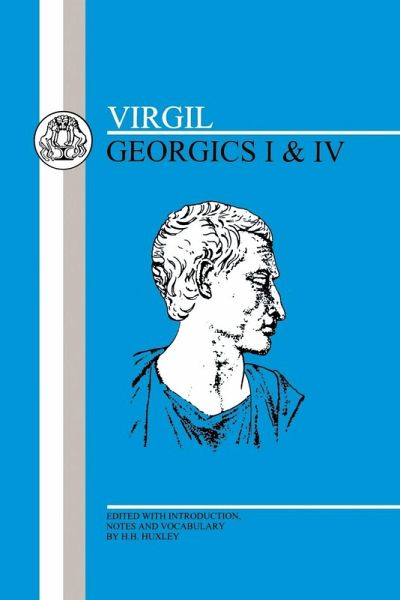
Virgil's Georgics were completed shortly after the battle of Actium (31 BC) and dedicated to Octavian / Augustus' chief 'cultural minister' Maecenas. They purport to be didactic poem in the Hellenistic manner (the title is drawn from Nicander and sections depend on Aratus) a manual on farming in four books dealing with crops, trees and shrubs (including viticulture), animal husbandry, and beekeeping. Yet there is a serious political message, made explicit in the closing lines of the Book I that civil war must be set aside in favour of peaceful agricultural arts, and there is besides much…mehr
Virgil's Georgics were completed shortly after the battle of Actium (31 BC) and dedicated to Octavian / Augustus' chief 'cultural minister' Maecenas. They purport to be didactic poem in the Hellenistic manner (the title is drawn from Nicander and sections depend on Aratus) a manual on farming in four books dealing with crops, trees and shrubs (including viticulture), animal husbandry, and beekeeping. Yet there is a serious political message, made explicit in the closing lines of the Book I that civil war must be set aside in favour of peaceful agricultural arts, and there is besides much beautiful and memorable poetry, such as the self-contained 'epyllion in the second half of the book IV, dealing with the myth of Aristaeus and the plaintive tale of Orpheus and Eurydice. This edition of the first and last books of the poem is intended primarily for students in the final years of the school Latin course or for undergraduates the inclusions of a full vocabulary, as well as the relatively elementary character of the introduction and many of the explanatory notes, make it suitable for student with less experience.
Virgil (Publius Vergilius Maro, 70-19 BC) was born in the north of Italy and completed his education in Rome. Generally considered Rome's greatest poet, he wrote Eclogues, 37 BC, and Georgics, 29 BC. He then devoted the rest of his life to the composition of his greatest work, the epic poem the Aeneid. Virgil (Publius Vergilius Maro, 70-19 BC) was born in the north of Italy and completed his education in Rome. Generally considered Rome's greatest poet, he wrote Eclogues, 37 BC, and Georgics, 29 BC. He then devoted the rest of his life to the composition of his greatest work, the epic poem the Aeneid.
Inhaltsangabe
Preface Introduction Contents I Virgil's Life And Works Ii Didactic Poetry Before Virgil Iii The Georgics Of Virgil Book I Book II Book III Book IV Iv Didactic Poetry After Virgil The Virgilian Hexameter Text Georgics I Georgics Iv List Of Abbreviations Notes On Book I Notes On Book Iv Bibliography Index Vocabulary
Preface Introduction Contents I Virgil's Life And Works Ii Didactic Poetry Before Virgil Iii The Georgics Of Virgil Book I Book II Book III Book IV Iv Didactic Poetry After Virgil The Virgilian Hexameter Text Georgics I Georgics Iv List Of Abbreviations Notes On Book I Notes On Book Iv Bibliography Index Vocabulary
Es gelten unsere Allgemeinen Geschäftsbedingungen: www.buecher.de/agb
Impressum
www.buecher.de ist ein Internetauftritt der buecher.de internetstores GmbH
Geschäftsführung: Monica Sawhney | Roland Kölbl | Günter Hilger
Sitz der Gesellschaft: Batheyer Straße 115 - 117, 58099 Hagen
Postanschrift: Bürgermeister-Wegele-Str. 12, 86167 Augsburg
Amtsgericht Hagen HRB 13257
Steuernummer: 321/5800/1497
USt-IdNr: DE450055826